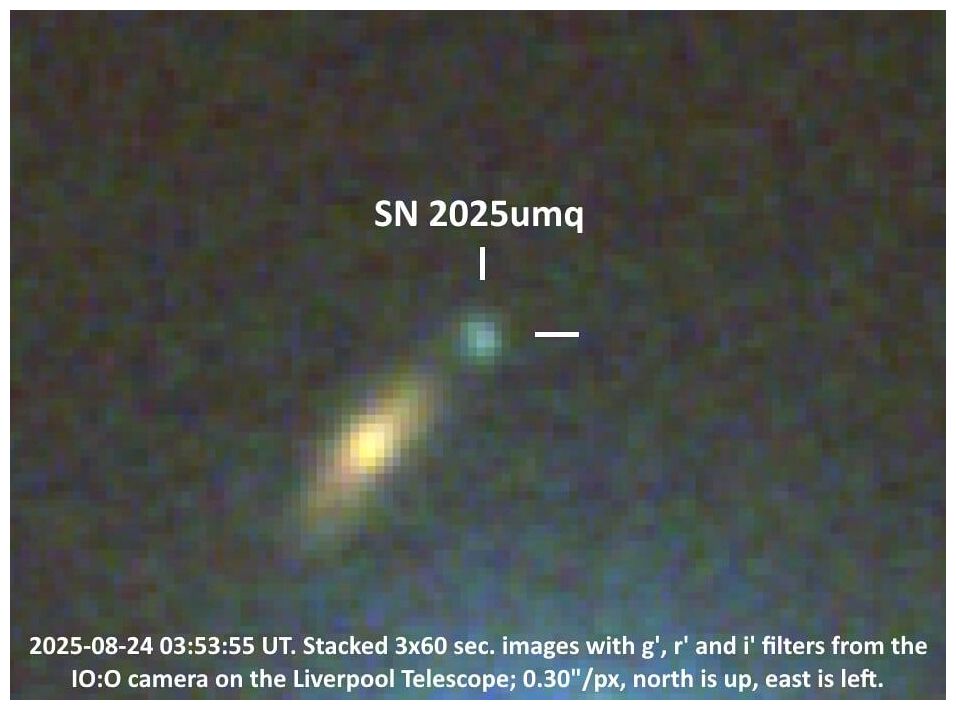
© Filipp Romanov/Liverpool Telescope.Supernova SN 2025umq on August 24th 2025.
Astronomy is increasingly becoming an online affair. Recent discoveries of interstellar Comet 3I/ATLAS and R2 SWAN highlighted this fact, when both were first discussed on message boards and verified via remote telescopes before confirmation. Another recent find also shows what's possible, as devoted amateur astronomer Filipp Romanov accomplished an amazing feat, and discovered a supernova in a remote galaxy.
"I managed to discover a supernova using the remote telescope T59 of iTelescope.net and it was confirmed by spectrum," Filipp told Universe Today.
The discovery is designated AT 2025umq (PSN J00481888+0759006) in the galaxy SDSS J004819.14+075856.8. The phone number-esque names denote the galaxy's position in the constellation Pisces the Fishes.

© Stellarium.The general location of the discovery in Pisces.