
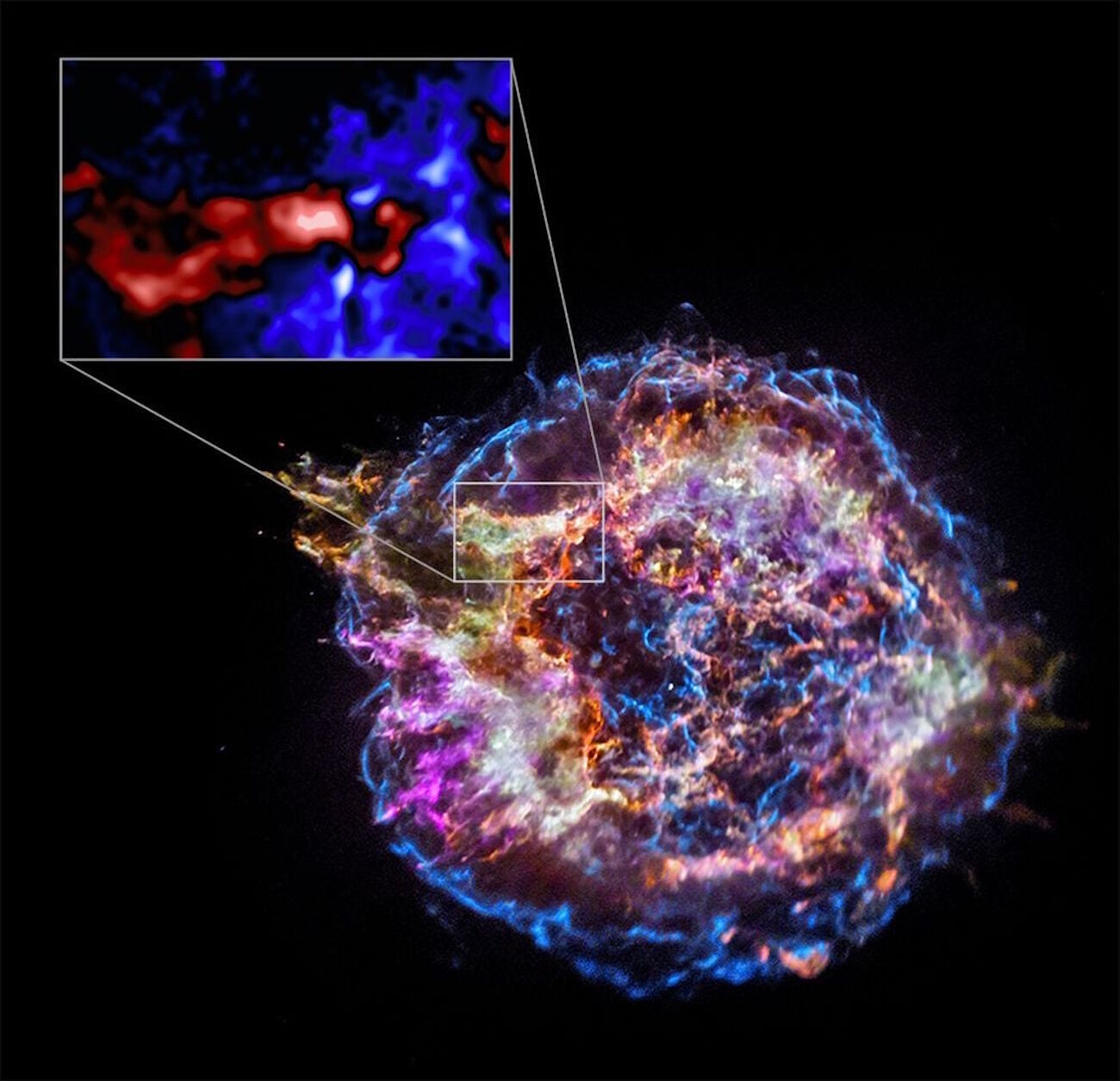
© X-ray: NASA/CXC/Meiji Univ./T. Sato et al.; Image Processing: NASA/CXC/SAO/N. WolkThis graphic features data from NASA’s Chandra X-ray Observatory of the Cassiopeia A (Cas A) supernova remnant. The latest Chandra observations reveal how the progenitor star violently rearranged its interior only hours before it exploded. In the expanded box, red is silicon-rich material, while the blue is rich in neon.
Cas A's progenitor star had between about 15 to 20 solar masses, though some estimates range as high as 30 solar masses. It was likely a red supergiant, though there's debate about its nature and the path it followed to exploding as a supernova. Some astrophysicists think it may have been a Wolf-Rayet star.
In any case, it eventually exploded as a core-collapse supernova. Once it built up an iron core, the star could no longer support itself and exploded. The light from Cas A's demise reached Earth around the 1660s.
There are no definitive records of observers seeing the supernova explosion in the sky, but astronomers have studied the Cas A SNR in great detail in modern times and across multiple wavelengths.
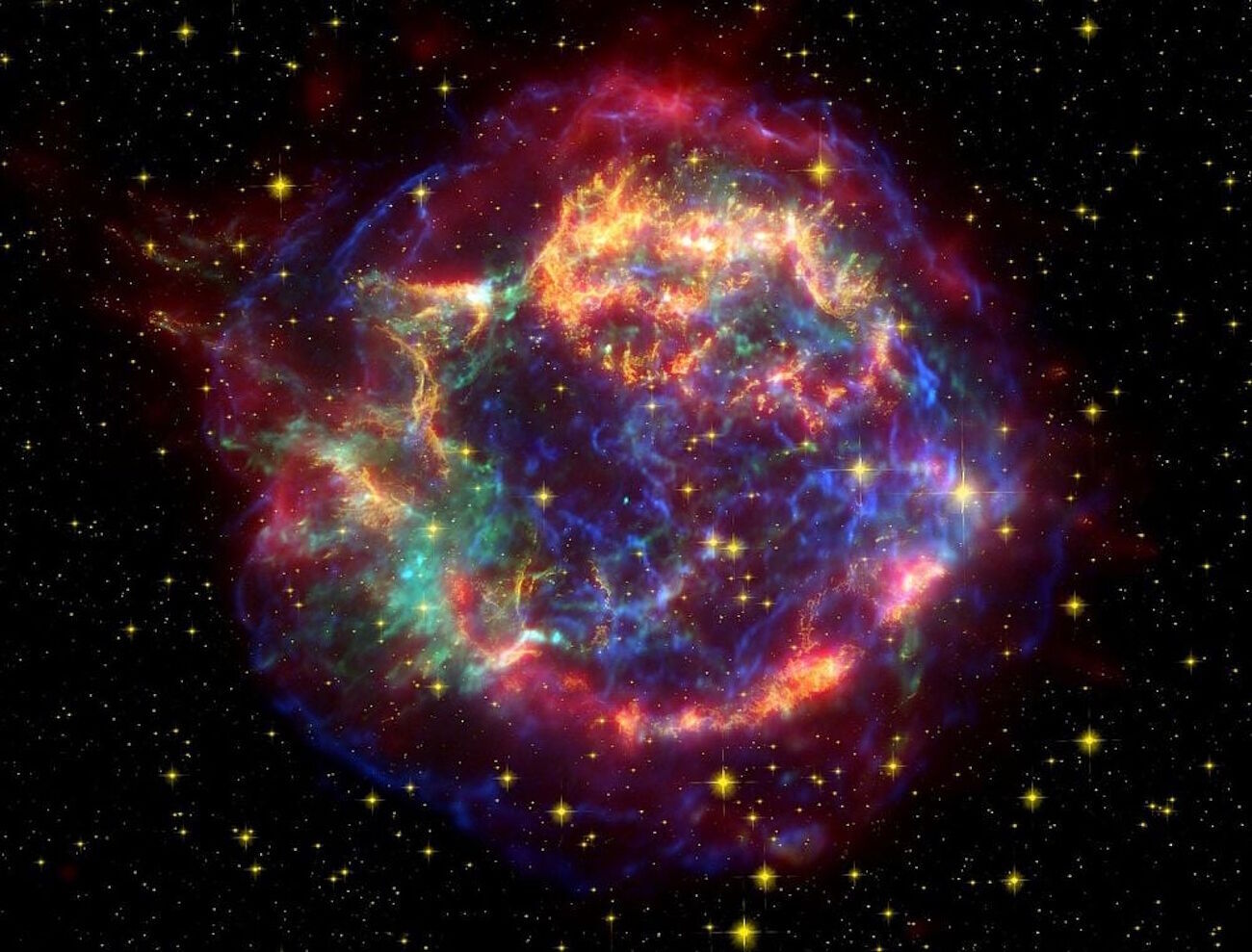
© NASA/JPL-CaltechThis is a composite false colour image of Cassiopeia A. It contains data from the Hubble Space Telescope, the Spitzer Space Telescope, and the Chandra X-ray telescope.
"It seems like each time we closely look at Chandra data of Cas A, we learn something new and exciting," said lead author Sato in a press release. "Now we've taken that invaluable X-ray data, combined it with powerful computer models, and found something extraordinary."
One of the problems with studying supernovae is that their eventual explosions are what trigger our observations. A detailed understanding of the final moments before a supernova explodes is difficult to obtain. "In recent years, theorists have paid much attention to the final interior processes within massive stars, as they can be essential for revealing neutrino-driven supernova mechanisms and other potential transients of massive star collapse," the authors write in their paper. "However, it is challenging to observe directly the last hours of a massive star before explosion, since it is the supernova event that triggers the start of intense observational study."
The lead up to the SN explosion of a massive star involves the nucleosynthesis of increasingly heavy elements deeper into its interior. The surface layer is hydrogen, then helium is next, then carbon and even heavier elements under the outer layers. Eventually, the star creates iron. But iron is a barrier to this process, because while lighter elements release energy when they fuse, iron requires more energy to undergo further fusion. The iron builds up in the core, and once the core reaches about 1.4 solar masses, there's not enough outward pressure to prevent collapse. Gravity wins, the core collapses, and the star explodes.
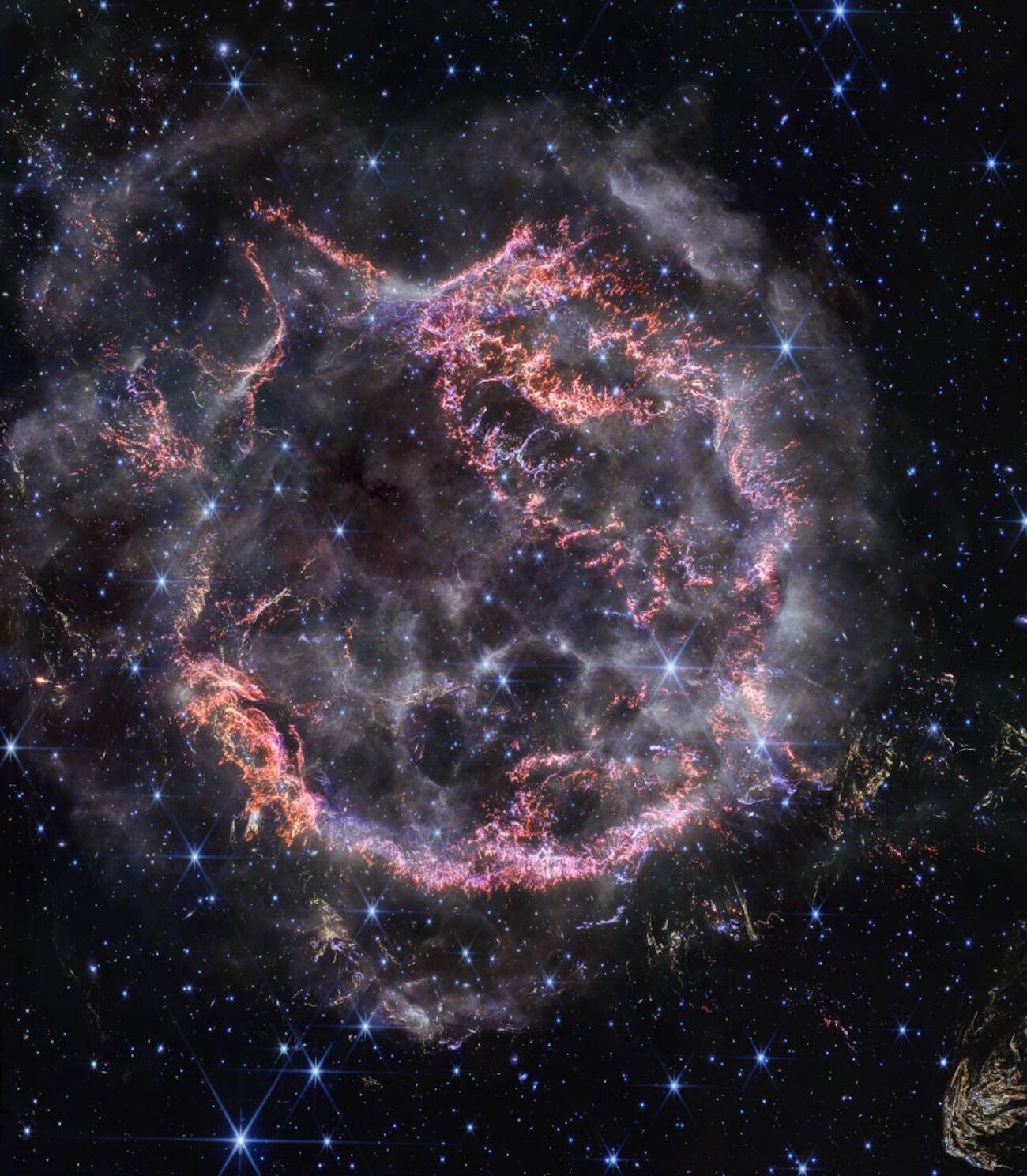
© NASA, ESA, CSA, STScI, Danny Milisavljevic (Purdue University), Ilse De Looze (UGhent), Tea Temim (Princeton University)This high-definition image from NASA's James Webb Space Telescope's NIRCam (Near-Infrared Camera) unveils intricate details of supernova remnant Cassiopeia A (Cas A), and shows the expanding shell of material slamming into the gas shed by the star before it exploded.
"Our research shows that just before the star in Cas A collapsed, part of an inner layer with large amounts of silicon traveled outwards and broke into a neighboring layer with lots of neon," said co-author Kai Matsunaga of Kyoto University in Japan. "This is a violent event where the barrier between these two layers disappears."
The results were two-fold. Silicon-rich material travelled outward, while neon-rich material travelled inward. This created inhomogeneous mixing of the elements, and small regions rich in silicon were found near small regions rich in neon.
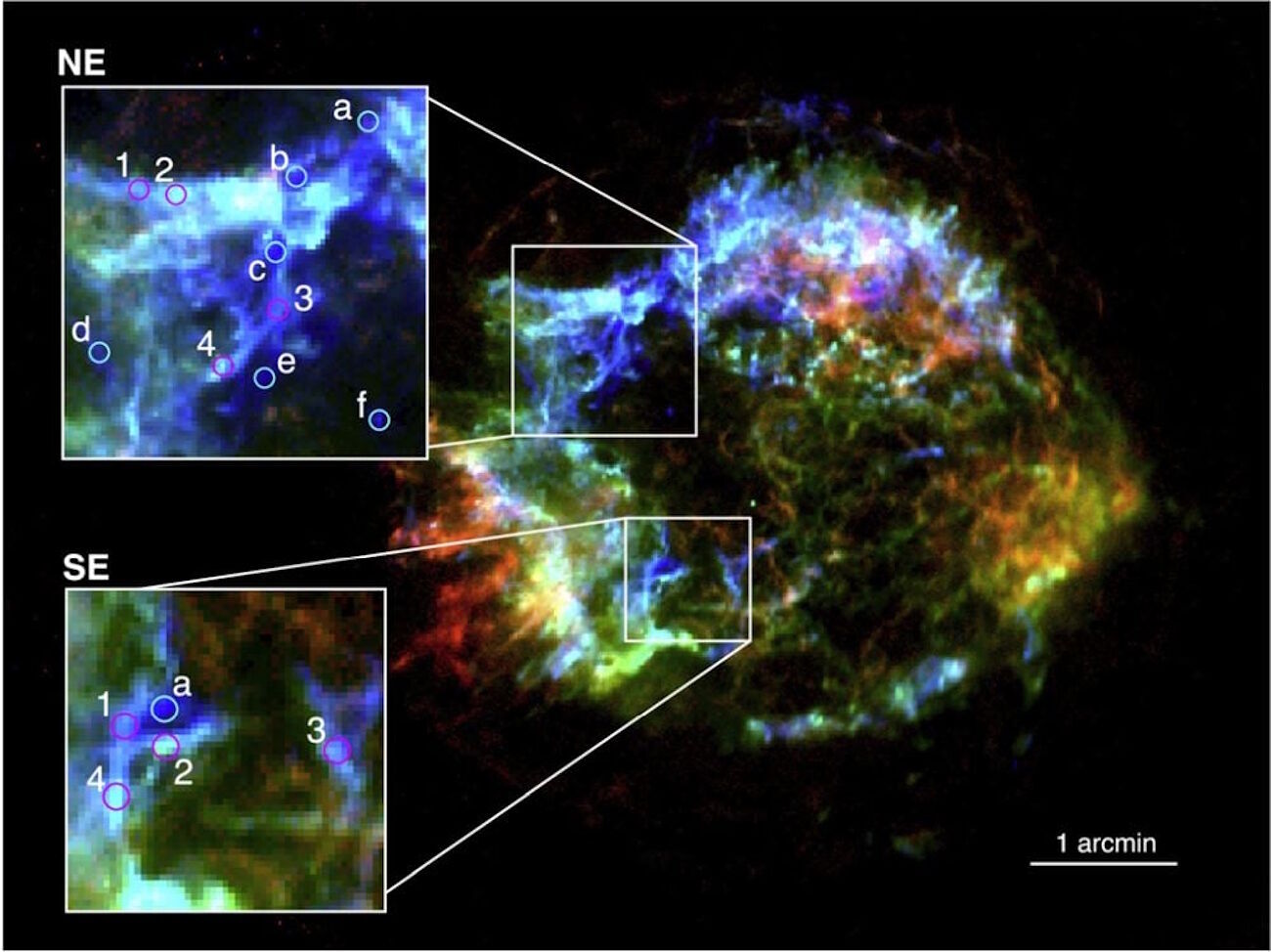
© Toshiki Sato et al 2025 ApJ 990 103Inhomogeneous elemental distribution in Cas A observed by Chandra. The difference in the mixing ratio of blue and green colors clearly shows the different composition in the O-rich ejecta. The red, green, and blue include emission within energy bands of 6.54–6.92 keV (Fe Heα), 1.76–1.94 keV (Si Heα), and 0.60–0.85 keV (O lines), respectively. The ejecta highlighted in red and green are products of explosive nucleosynthesis, while the ejecta in blue and emerald green reflect stellar nucleosynthesis. The circles in the small panels are O-rich regions used for spectral analysis. The regions of high and low X-ray intensity in the Si band are indicated by the magenta and cyan circles, respectively.
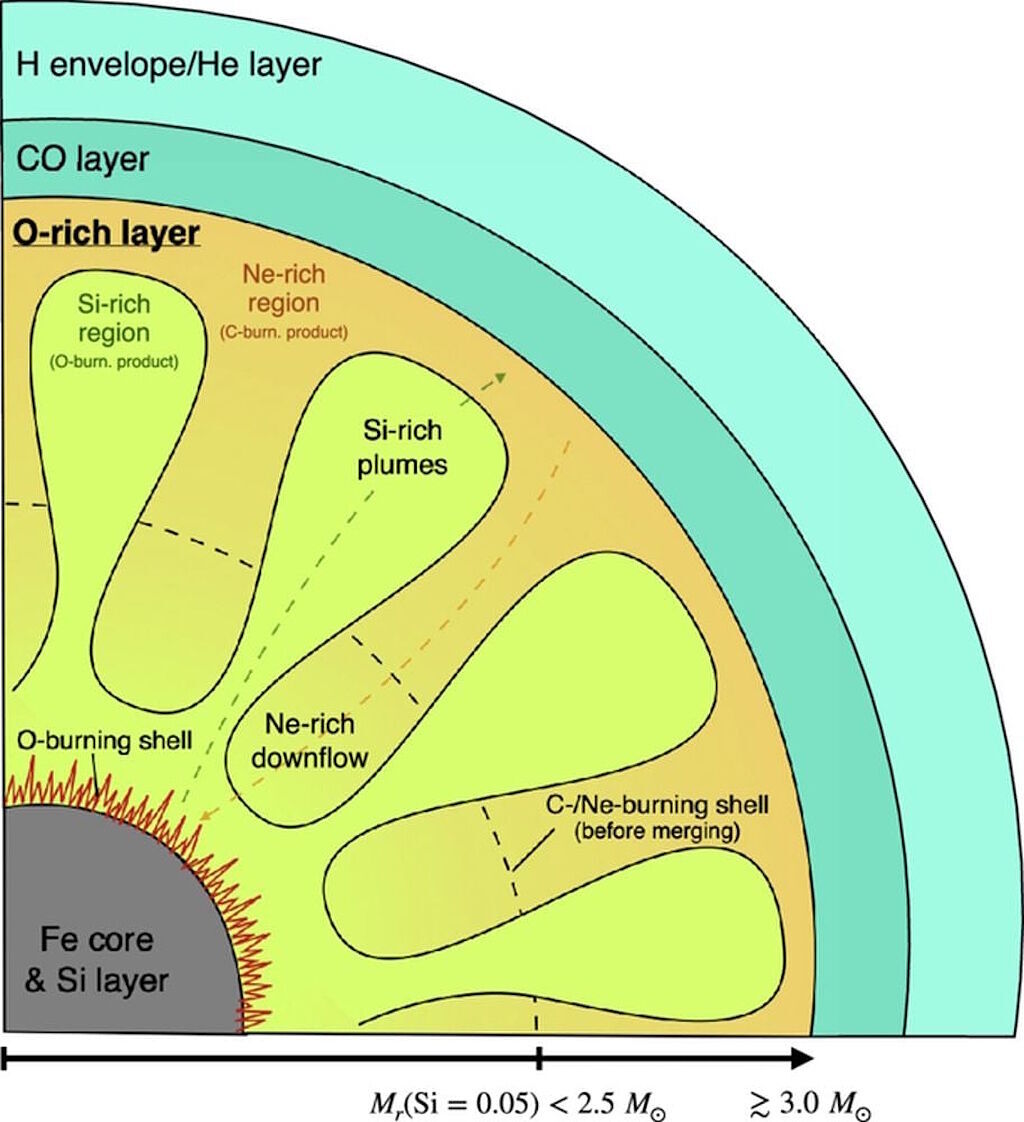
© Toshiki Sato et al 2025 ApJ 990 103This schematic shows the interior of a massive star in the process of a 'shell merger.' It shows both the downward plumes of Neon-rich material and the upward plumes of silicon-rich material
For decades, astrophysicists thought that SN explosions were symmetrical. Early observations supported the idea, and the basic idea behind core-collapse supernovae also supported symmetry. But this research changes the fundamental understanding of supernova explosions as asymmetrical. "The coexistence of compact ejecta regions in both the "O-/Ne-rich" and "O-/Si-rich" regimes implies that the merger did not fully homogenize the O-rich layer prior to collapse, leaving behind multiscale compositional inhomogeneities and asymmetric velocity fields," the researchers write in their conclusion.
This asymmetry can also explain how the neutron stars left behind get their acceleration kick and lead to high-velocity neutron stars.
These final moments in a supernova's life may also trigger the explosion itself, according to the authors. The turbulence created by the inner turmoil may have aided the star's explosion.
"Perhaps the most important effect of this change in the star's structure is that it may have helped trigger the explosion itself," said co-author Hiroyuki Uchida also of Kyoto University. "Such final internal activity of a star may change its fate — whether it will shine as a supernova or not."
"For a long time in the history of astronomy, it has been a dream to study the internal structure of stars," the researchers write in their paper's conclusion. This research has given astrophysicists a critical glimpse into a progenitor star's final moments before explosion. "This moment not only has a significant impact on the fate of a star, but also creates a more asymmetric supernova explosion," they conclude.




Reader Comments
000-GrandeMosaic120DegreesLONG.jpg (JPEG Image, 7023 × 1299 pixels) — Scaled (21%)