Science & TechnologyS


Satellite

NASA announces Voyager I's stunning new discovery at the outer limits of our solar system

Voyager 1
© NASAVoyager 1’s stunning new discovery at the outer limits of our solar system
Voyager 1 has journeyed further than any human-made object, revealing a fiery barrier at the very edge of our solar system that challenges everything we thought we knew about space.

Voyager 1, launched in 1977, has been journeying through space for over four decades, now more than 14.9 billion miles away from Earth. Recently, this legendary probe made headlines once again by crossing an invisible border that separates our solar system from the vast expanse of interstellar space. What it discovered there has left scientists astounded — a "wall of fire" where temperatures soar to an unimaginable 54,000 degrees Fahrenheit.

A new frontier: exploring the edge of the solar system

Since its launch, Voyager 1 has sent back breathtaking images of Jupiter, Saturn, and their moons. But its most daring journey began when it left the familiar territory of the planets behind and headed toward what is known as the heliopause. This is the vast boundary where the sun's influence fades and the realm of interstellar space begins.

At this boundary point, the pressure of the solar wind — the stream of charged particles flowing from the sun — meets the pressure of particles drifting through space beyond our solar system. Voyager's instruments detected a surprising rise in both temperature and particle density at this location, a phenomenon scientists now call the "wall of fire."

Jupiter

Researchers discover new plasma wave in Jupiter's aurora

Research can provide new clues about how to protect Earth from harmful solar radiation.

north polar region of Jupiter
© NASA/JPL-Caltech/SwRI/MSSSThis image from NASA's Juno spacecraft in 2016 shows the north polar region of Jupiter. The JunoCam obtained this view about two hours before closest approach, when the spacecraft was 120,000 miles from Jupiter.
Researchers at the University of Minnesota Twin Cities have made a groundbreaking discovery by observing and analyzing the first new type of plasma wave in Jupiter's aurora. This research helps us understand "alien aurora" on other planets, which in turn teaches us more about how Earth's magnetic field protects us from the sun's harmful radiation.

The research is published in Physical Review Letters, a peer-reviewed, multidisciplinary, high-impact scientific journal.

The observation is based on data from NASA's Juno spacecraft, which made a historic low orbit flight over Jupiter's north pole, where the team was able to use their expertise in data analysis to study data from the northern polar regions of Jupiter for the first time.

"The James Webb Space Telescope has given us some infrared images of the aurora, but Juno is the first spacecraft in a polar orbit around Jupiter," said Ali Sulaiman, an assistant professor in the University of Minnesota School of Physics and Astronomy.

Cassiopaea

First-of-its-kind supernova observations reveal inner workings of a dying star

SN2021yfj supernova
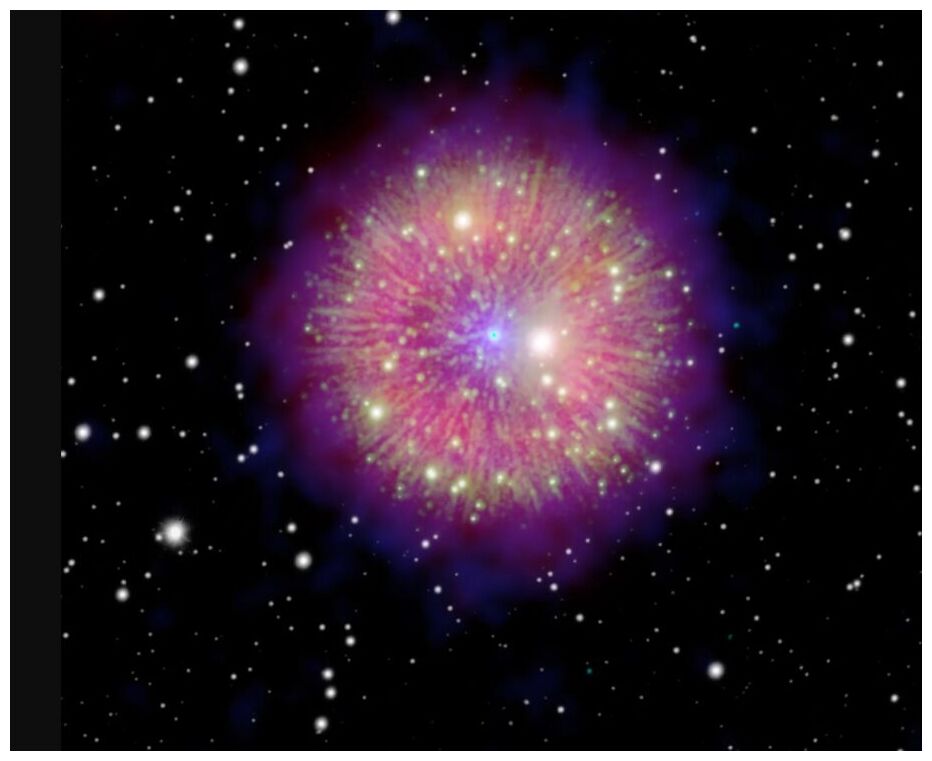
© .M. Keck Observatory/Adam MakarenkoFor the first time, astrophysicists detected a supernova embedded in a wind rich with silicon, sulfur and argon. The observations suggest the massive star somehow lost its outer hydrogen, helium and carbon layers — exposing the inner silicon and sulfur-rich layers — before exploding. 
Newly discovered supernova is 'stripped down to the bone' to reveal heavier elements

An international team of scientists, led by Northwestern University astrophysicists, has detected a never-before-seen type of exploding star, or supernova, that is rich with silicon, sulfur and argon.

When massive stars explode, astrophysicists typically find strong signatures of light elements, such as hydrogen and helium. But the newly discovered supernova, dubbed SN2021yfj, displayed a startling different chemical signature.

Astronomers long have theorized that massive stars have a layered structure, similar to an onion. The outermost layers predominantly comprise the lightest elements. As the layers move inward, the elements become heavier and heavier until reaching the innermost iron core.

Robot

Automating pregnancy through Robot Surrogates

pregnant humanoid robot.
© GuyXotic/Pixel DojoAI-generated concept image of a pregnant humanoid robot.
The most human of experiences has been automated as China unveiled a new AI robot that is capable of carrying a fetus to full term, replicating the entire pregnancy process from conception to birth. Kaiwa Technology in Guangzhou plans to release these robots in 2026 for $1,400, or a small fraction of what couples pay for surrogates. Has science gone to far in the quest to play God?

These "pregnancy robots" are vastly different from traditional incubators that are utilized for premature or at-risk newborns. The fetus develops within the robot's artificial womb in synthetic amniotic fluid. Scientists have developed artificial placentas equipped with a tube system operated by AI, which can feed the baby oxygen and nutrients during gestation. Humans have never procreated through an artificial womb nor has a robot replicated the whole gestation process.


Surrogacy was deemed unethical, and the Chinese government banned the practice in 2001. The government prohibited the trade of ova, sperm, embryos, and other related reproductive items. If not outright banned, most nations have a complicated legal framework surrounding surrogacy and parental rights. The Chinese government believes gestational surrogacy exploits women in poverty, and the law recognizes the birthing mother as the legal mother. Still, repealing the one-child policy and infertility have caused a spike in interest.

Some believe this technology will be a breakthrough for couples suffering from infertility. Outside China, same-sex couples could also benefit from AI-driven surrogacy that costs a fraction of the price. Women may not be exploited for their wombs, but what about the babies born to non-human figures?

The mother-child relationship is the genesis of life and creation. The age-old debate of nature vs nurture always concludes that both are essential. Scientists conducted a number of unethical studies during the last World War to see what would happen if a baby were deprived of nurture. Naturally, these studies could never be replicated again.

Comet 2

The backward tail of interstellar comet 3I/ATLAS

Last month, when astronomers used the Hubble Space Telescope to photograph 3I/ATLAS, they had a "Eureka!" moment. The mysterious interstellar visitor had a fuzzy atmosphere and a growing tail. Clearly, it was a comet.

However, something was not quite right. Take a look, and see if you can spot the problem:

comet 3I/ATLAS
© Spaceweather.com
The tail of 3I/ATLAS points almost straight toward the sun. Normally, comet dust tails are pushed away from the sun by radiation pressure. 3I/ATLAS is doing the opposite — it's backwards.

Why? Researchers led by David Jewitt of UCLA believe they have an explanation: "It is due to the preferential sublimation of ice on the hot day side of the nucleus and the near absence of sublimation on the night side," they wrote in a paper reporting the observations.

Brain

A strikingly 'simple dial' in the brain may help it distinguish imagination from reality

brain gears materialism
Activity levels in a specific region of the brain predict whether we think something is real, irrespective of whether we've seen it or imagined it.

Imagination relies on an ability to differentiate between what's real and what's not — and now, scientists have uncovered potential brain mechanisms that make this distinction possible. These, they hypothesize, may be significant in conditions like schizophrenia, which can affect people's perception of reality.

A paper published June 5 in the journal Neuron explored these mechanisms. Scientists know from previous research that a specific brain region — the fusiform gyrus, a large ridge that runs across two lobes of the brain — is active both when you see something in reality and when you imagine something, first study author Nadine Dijkstra, a neuroscientist at University College London, told Live Science.

"But what we found was that the activity levels in that region predicted whether or not you think something is real, irrespective of whether you see or imagine it," she explained.

Cassiopaea

Astronomers simulate a star's final moments as it's swallowed by a black hole: 'Breaks like an egg'

black hole swallow neutron star artist impression
© Caltech/R. Hurt (IPAC)Artist's concept of a cracked neutron star orbiting a black hole.
A neutron star's final moments may spark violent starquakes, monster shock waves, and even a fleeting, never-before-seen object called a black hole pulsar.

The universe is full of spectacular and violent events, but few are more dramatic than a black hole tearing apart a star. Now, thanks to advanced computer simulations, scientists have gotten their closest look yet at what this cosmic catastrophe might actually look — and even sound — like.

A team of astronomers, led by theoretical astrophysicist Elias Most of the California Institute of Technology (Caltech), modeled the dramatic final milliseconds before a neutron star, the incredibly dense core left behind by a massive stellar explosion, is devoured by a black hole.

Marijuana

The quest to understand the link between cannabis and schizophrenia

link cannabis schizophrenia marijuana graphic
© Stockbyte via Getty Images / Illustration by Emily LankiewiczScientists are currently studying whether cannabis use may cause schizophrenia.
Recent studies have examined the relationship between the drug and psychoses and looked at how the brain responds to the substance

While cannabis has become a mainstay in recreational dispensaries and medical clinics, scientists are still learning about its long-term psychological impacts. The drug's increasing popularity — both recreationally and to treat conditions like chronic pain and anxiety — is making some researchers and consumers concerned over one of its most severe side effects: psychosis.

Cannabis is psychoactive, meaning it affects how a user's brain works. For decades, researchers have been identifying how cannabis' brain-affecting properties can cause symptoms of psychosis. Psychosis refers to any mental state where a person struggles to distinguish between what is real and what is not real. Psychosis is characterized by hallucinations, where people sense things that are not there, and delusions, where people hold inexplicable false beliefs. Some psychoses, like schizophrenia, are chronic, but psychosis can be drug-induced, with cannabis being considered one of the riskiest — if not the riskiest — drugs for chronic psychosis.

Lightning

Astonishing extreme lightning bolt recorded (515 miles)

Death From Sky: Lightning Kills 1,876 People Annually In India, Study Reveals


From the "we still don't know everything about weather and climate" department and Arizona State University:


It was a single lightning flash that streaked across the Great Plains for 515 miles, from eastern Texas nearly all the way to Kansas City, setting a new world record.

"We call it megaflash lightning and we're just now figuring out the mechanics of how and why it occurs," said Randy Cerveny, an Arizona State University President's Professor in the School of Geographical Sciences and Urban Planning.

Cerveny and colleagues used space-based instruments to measure the megaflash, which took place during a major thunderstorm in October 2017. Its astonishing horizontal reach surpasses by 38 miles the previous record of 477 miles recorded during an April 2020 storm in the southern U.S. The new record-setter went unnoticed until a re-examination of satellite observations from the 2017 storm.

"It is likely that even greater extremes still exist, and that we will be able to observe them as additional high-quality lightning measurements accumulate over time," said Cerveny, who serves as rapporteur of weather and climate extremes for the World Meteorological Organization, the weather agency of the United Nations.

Info

Never-before-seen kind of supernova spotted after using AI to scan the skies

With help from AI, astronomers have spotted a never-before-seen kind of supernova that seems to have been blowing up just as it was trying to gobble down a black hole.
Supernova SN 2023zkd
© Melissa Weiss/CfAAn artist's impression of the events leading up to supernova SN 2023zkd, which likely occurred when a star attempted to swallow a nearby black hole. Here, the star's shape is stretched by the black hole's massive gravitational forces.
Scientists may have spotted a never-before-seen kind of supernova, after using a Spotify-like artificial intelligence (AI) to scan the skies for strange activity.

The AI unearthed signs of what could have been a huge star blowing up just as it was attempting to gulp down a nearby black hole.

The stellar explosion, dubbed SN 2023zkd, was spotted in July 2023 with the Zwicky Transient Facility, a full-sky astronomical survey based at the Palomar Observatory in California. But Zwicky didn't find the explosion through happenstance. Rather, it was guided to the right spot using an algorithm optimized to find weird night-sky activity.
Spotting the signs of a supernova early is key to catching how supernovas start, evolve and then fade away — providing insight into how these explosions work.

In this case, the AI found unusual brightenings months before the explosion happened, study co-lead authors Alex Gagliano, a postdoctoral researcher at the Institute For AI and Fundamental Interactions, and Ashley Villar, a supernova researcher and assistant professor at the Harvard-Smithsonian Center for Astrophysics, told Live Science in an email.

This quick alert enabled a number of large observatories to get in on the action and provide observations across a large spectrum of wavelengths.