

© ESA/Gaia/DPAC, S. Payne-Wardenaar, E. Poggio et al (2025)An edge-on visual of the Milky Way, based on data from the European Space Agency's Gaia star-mapping mission. An apparent "wave" of star movements is visible, shown by vertical arrows.
The Milky Way's galactic wave was spotted in mapping data from the European Space Agency's (ESA) Gaia space telescope, which charted the positions and movement patterns of millions of stars with high accuracy before retiring earlier this year.
Like ripples in a pond, the wave has a very large influence: It affects stars between 30,000 and 65,000 light-years away from the galaxy's center, ESA officials said in a statement. That's a large percentage of the Milky Way, which is roughly 100,000 light-years across.
Astronomers still don't know what started the motion. It could have been a past collision with a smaller, dwarf galaxy that caused the large shake, ESA officials said, but more investigation is required to answer that question.
The results were published July 14 in the journal Astronomy & Astrophysics.
Mapping the wave
Gaia mapped the speeds and motions of stars for nearly a dozen years. In 2020, the telescope observed that the disk of the Milky Way wobbles like a spinning top. The newfound wave was charted by following the movements and positions of young, giant stars as well as a set of Cepheids — stars that have predictable-but-variable brightness.
"Because young giant stars and Cepheids move with the wave, the scientists think that gas in the disc might also be taking part in this large-scale ripple," ESA officials wrote in the statement. "It is possible that young stars retain the memory of the wave information from the gas itself, from which they were born."
ESA officials likened the galactic wave to "the Wave" done by a crowd at a stadium: In a group movement starting from one side of the stadium and moving section by section to the other side, individuals rise from their seats, fully stand up with their arms extended, and then sit back down.
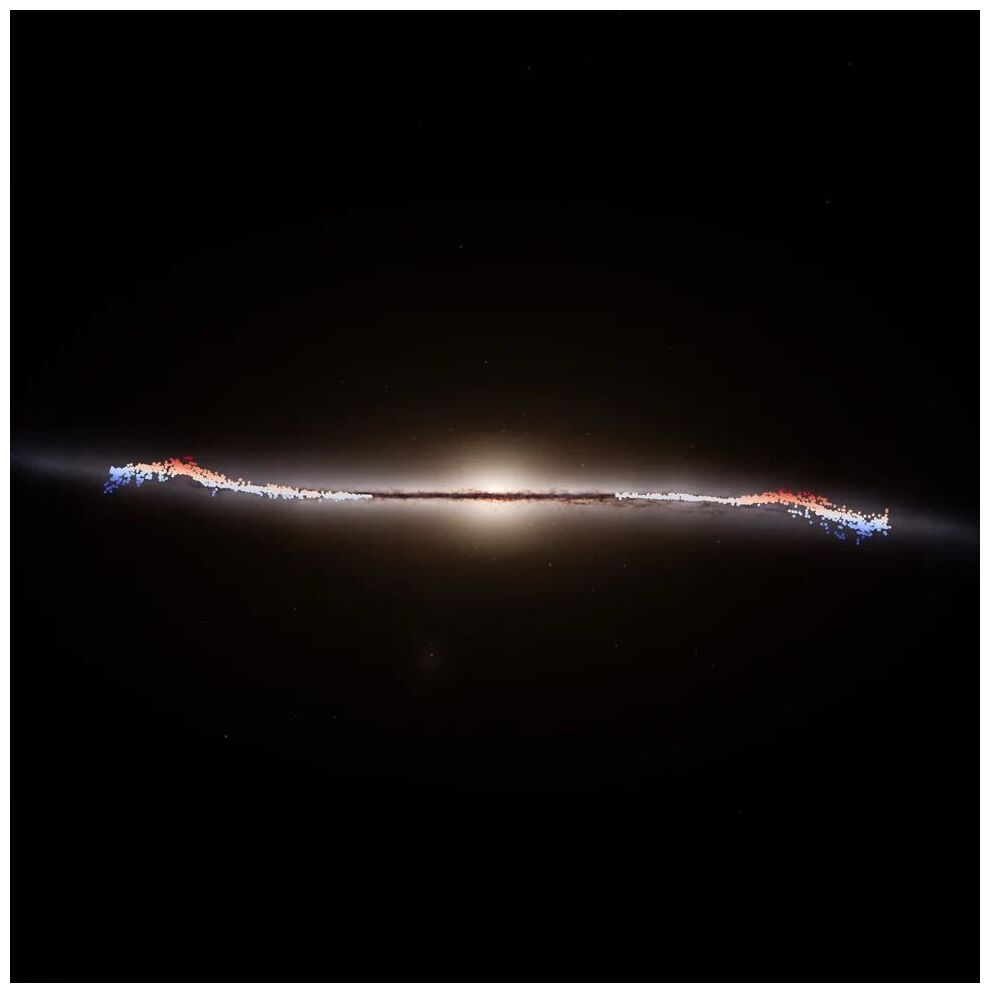
© ESA/Gaia/DPAC, S. Payne-Wardenaar, E. Poggio et al (2025)A clear wave pattern emerges when looking at the motions of stars at the edges of the Milky Way, as seen here in this map of Gaia data.
"This observed behaviour is consistent with what we would expect from a wave," lead author Eloisa Poggio, an astronomer at the National Institute of Astrophysics in Italy, said in the statement.
The newly discovered wave could also be related to a much smaller Milky Way ripple already known by scientists. Called the Radcliffe Wave, it is visible about 500 light-years from the sun and stretches for 9,000 light-years across space.
"However, the Radcliffe Wave is a much smaller filament, and located in a different portion of the galaxy's disc compared to the wave studied in our work," Poggio said. "The two waves may or may not be related. That's why we would like to do more research."



Reader Comments
Who would have thought that ... ?
Sarcasm aside - if you never studies physics, the world seems full of miracles.
Maybe our sun is in a pinch point of a Birkeland current and so is reliant on the energy being supplied via that Birkeland current? It could mean that our minimums and maximum sun cycles are dependent on some other source. If one micro nova has happened in the past then there is a 99% chance of it happening again. Most major things in space seem to be fairly predictable and inevitable.
Just a thought.
There's No Question that our Sun does, indeed, have periodic episodes of micro-novas, and that they occur at regular intervals - approximately every 12,600 years or so. The current estimate for the pole reversal is by 2035 to 2040, with the potential micro-nova by around 2045 to 2050.
ALL stars are the result of the 'Z-pinch' effect in Birkland Currents... they can form like a string of beads along such a current. By the way... ALL the planets, stars and galaxies are connected via the currents... it's how energy is distributed.
All our 'electricity' Comes from these magnetic currents via the Sun's electro-magnetic connection to the Sun. In fact, Thomas Bearden pointed out that Not One Watt of electricity has Ever been 'produced' by our generating stations... all they are doing is making and breaking the dipole - when the alternating current goes through 'zero point', That's when the electrical potential that surrounds the Earth, is drawn into the millions of miles of wires that make up our electrical grid.
There's No Question that our Sun does, indeed, have periodic episodes of micro-novas, and that they occur at regular intervals - approximately every 12,600 years or so. The current estimate for the pole reversal is by 2035 to 2040, with the potential micro-nova by around 2045 to 2050. (my editing time had run out, thus the duplicate postings
that said, I will say that the 'black hole' in the center of the galaxy, and all other 'black holes' are Really Plasmoids... a feature of high energy plasma...
I suppose you are aware of the "standing wave" phenomenon.
While I know it only from text books, the lab and experiments, this was my first association.
[Link]