
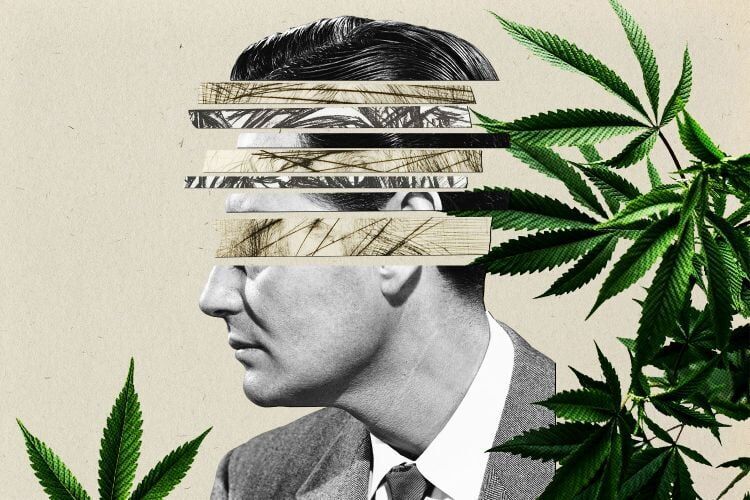
© Stockbyte via Getty Images / Illustration by Emily LankiewiczScientists are currently studying whether cannabis use may cause schizophrenia.
While cannabis has become a mainstay in recreational dispensaries and medical clinics, scientists are still learning about its long-term psychological impacts. The drug's increasing popularity — both recreationally and to treat conditions like chronic pain and anxiety — is making some researchers and consumers concerned over one of its most severe side effects: psychosis.
Cannabis is psychoactive, meaning it affects how a user's brain works. For decades, researchers have been identifying how cannabis' brain-affecting properties can cause symptoms of psychosis. Psychosis refers to any mental state where a person struggles to distinguish between what is real and what is not real. Psychosis is characterized by hallucinations, where people sense things that are not there, and delusions, where people hold inexplicable false beliefs. Some psychoses, like schizophrenia, are chronic, but psychosis can be drug-induced, with cannabis being considered one of the riskiest — if not the riskiest — drugs for chronic psychosis.
"Someone with cannabis-induced psychosis is at a higher risk of transitioning or being subsequently diagnosed with schizophrenia," says Daniel Myran, a public health physician at the University of Ottawa, "than someone with methamphetamine-induced psychosis, or, you know, who's having psychosis related to alcohol use or opioid use or cocaine use."
Myran is the author of a February report published in JAMA Network Open that looked at rates of psychotic disorders in the Canadian province of Ontario among people who were flagged for cannabis use disorder — dependence on or abuse of cannabis, sometimes categorized as cannabis addiction. The study used data collected between 2006 and 2022 from over 13 million people in Ontario and found an association between cannabis use and psychosis onset.
The study looked at two types of psychosis, schizophrenia spectrum disorder and psychosis that did not fit neatly into a diagnostic category. Schizophrenia spectrum disorder includes many disorders characterized by hallucinations, delusions and a struggle to function. The other diagnostic category labels people who may have similar symptoms but do not meet all the criteria for a schizophrenia diagnosis. Researchers found that, while rates of schizophrenia stayed stable over time, the proportion of schizophrenia associated with cannabis use nearly tripled — from 3.7 percent to 10.3 percent — after the drug was legalized for nonmedical use across Canada in 2018. Rates of psychosis that didn't neatly fit into a diagnostic category almost doubled after legalization, with significant upticks among younger people. While the uptick occurred after cannabis legalization, Myran thinks this increase in non-schizophrenia diagnosis could also be affected by other drugs or mental health problems.
Myran's study is also limited by how it defined cannabis addiction. The study identified individuals as having cannabis use disorder when they visited the emergency room or were hospitalized for mental and behavioral disorders due to cannabis use or for cannabis poisoning.
Peter Grinspoon, a cannabis specialist at Massachusetts General Hospital who was not affiliated with the study, says that criteria could include people who do not have cannabis addiction, like someone who tries cannabis for the first time and panics or even hallucinates.
"They diagnosed a person who shows up with an overdose — anybody could have an overdose," Grinspoon says. "You take a gummy the wrong size, you have an overdose." This overdiagnosis problem is not specific to Myran's study, he says. Across the board, Grinspoon thinks the way the medical community defines cannabis addiction is "broken."
To be diagnosed with cannabis use disorder, under the latest edition of the Diagnostic and Statistical Manual of Mental Disorder, a patient has to meet at least 2 of 11 criteria over a year, with two of those criteria being symptoms of withdrawal and tolerance. Since withdrawal and tolerance symptoms can occur in people taking cannabis according to a doctor's prescription, Grinspoon thinks these criteria could prompt "vast" overdiagnosis of cannabis addiction.
"We don't use those for medical opiates or medical benzodiazepines, because everybody that uses them has tolerance and withdrawal," says Grinspoon. "That's not addiction."
Despite this criticism, which Grinspoon says reflects an overdiagnosis problem across the field, he agrees that some kind of link exists between cannabis and psychosis. But he says further, more detailed research needs to be conducted, especially on causality.
An April study in JAMA Psychiatry may help identify where in the brain the proposed cannabis-psychosis link occurs. Jessica Ahrens, a neuroscientist studying for her PhD at Canada's McGill University, led the research. Ahrens and other researchers used magnetic resonance brain imaging to look at and around the substantia nigra, a region of the brain critical for the production of dopamine, the "feel-good" molecule that helps drive the brain's reward system. People with schizophrenia tend to produce more dopamine in the substantia nigra, and when that dopamine breaks down those patients produce a pigment called neuromelanin. Ahrens and her team looked specifically at neuromelanin.
While psychosis can have environmental and genetic causes, Lena Palaniyappan, a psychiatrist at McGill who worked on the study, says dopamine is where all those factors connect.
To see whether cannabis triggered the dopamine pathway similarly to psychosis, researchers took neuromelanin-sensitive brain images of people diagnosed with cannabis use disorder and saw elevated dopamine function, similar to that in psychosis patients. But because researchers are looking at neuromelanin, which can break down from chemicals other than dopamine, they need to find out if cannabis users have high concentrations because of dopamine or another chemical entirely.
Matthew Hill, a developmental neuroscientist at the University of Calgary, says that the study does not appear to offer a complete causal relationship between cannabis use and psychotic disorders, but it does confirm that cannabis sparks enhanced dopamine transmission in humans. But seeing whether the relationship is cannabis-specific is challenging, since a similar dopamine effect has been seen with other substances, including alcohol, Hill says.
So, what actually causes the link between cannabis and psychosis? Researchers have proposed three popular hypotheses: that something that causes chronic psychosis also draws people to cannabis; that people with early symptoms of psychosis are self-medicating with cannabis; and that, for some people, consuming cannabis actually causes psychosis. All three theories could be true, with certain cases having different causes.
"I think that there is a group of individuals who would have never developed schizophrenia ... if they had not regularly used high potency cannabis," Myran says. "I think the debate is more of: How large is that number?"
For now, researchers have no reliable way to differentiate between schizophrenia cases that were directly caused by cannabis and cases that involve confounding variables. For example, some people experiencing the first symptoms of a psychotic disorder, such as paranoia, unease and trouble thinking clearly, may self-medicate with cannabis to ease those symptoms. Meanwhile, people who had adverse childhood experiences tend to be at higher risk for schizophrenia, and they also tend to be a population that uses more cannabis. Researchers still do not know the extent to which any of these factors contributes to the link between schizophrenia and psychosis, says Grinspoon. "All we know is that there's an association."
While the nature of the link is still being researched, experts agree that cannabis is particularly dangerous for young people. Grinspoon advocates a "just say wait" mindset for young people interested in cannabis, choosing not to use it until they are older. Additionally, people with family histories of schizophrenia and psychotic disorder, as well as bipolar disorder, should stay away from the drug, especially as those disorders tend to develop during adolescence and late teens.
"There's a lot of cannabis use that happens during adolescence, and adolescence is also a period when a lot of psychiatric disorders, particularly schizophrenia and psychotic disorders, begin to emerge," says Hill. "So I don't doubt that there is a relationship there."
As with all drugs, the dose makes the poison. Research suggests that more potent cannabis, or cannabis with more of the psychoactive chemical THC, tends to be associated with worse mental side effects. According to Grinspoon, a relatively small dose can help with some anxiety symptoms and relieve nausea, while a large dose can cause paranoia and vomiting.
As cannabis becomes more widely legalized, experts also advocate for firmer regulations, with Myran saying that looking at tobacco regulations would be a good place to start. Grinspoon agrees with that starting point but believes that advertising for all drugs and alcohol should be banned.
"Cannabis advertising, along with alcohol and tobacco and pharmaceutical advertising, is really misleading and unhelpful," says Grinspoon.
While regulation could be helpful, experts also agree that criminalization is not the answer, especially as it disproportionately targets and punishes people of color. Researchers say that users should approach cannabis with caution and moderation. The drug can help relieve some side effects for cancer patients, while aggravating chronic pain in other people. And while new studies, like Myran's and Ahrens', may help solidify the link between cannabis and psychosis, researchers do not want to spark panic.



Reader Comments
Look up some videos from "seasoned" vegans, and hear them complain about frequent brain fog.
So tried of this nonsense. So a disproportionate amount of people of color (what a racist term in and of itself, sheesh) use the drug and that's the reason why and not much else. Every time a perp now gets popped when there's a dead body we get the term "long criminal history" and IT'S NOT SMOKING POT they are talking about.
Oh, I just saw that it's from the Smithsonian, I have a script to that rag and to say they are "woke" is an understatement. You should read their "whiteness" mural that they were forced to take down. They are full on loons IMHO.
This "proportional" insanity is just getting so old.
As someone who has grown cannabis since the 1970's, I can attest to the change in its potency. I live in a State where it's legal to have a certain amount of cannabis available through State licensed stores.
Personally, I would never buy from any of those stores because there's no guarantee that you're getting a product that is unadulterated in some fashion. While in my State recreational marijuana possession is legal for adults 21 and over, only licensed producers, processors, and retailers can legally cultivate cannabis. Growing cannabis at home for personal use is a Class C felony, punishable by up to five years in prison and fines of up to $10,000, regardless of the amount grown.
Since that was instituted, there was a big red flag planted in my mind regarding what is allowed in this so called legally grown weed. I won't touch it. Back in the day before there was CRIPER technology and chemical cocktails that weed can be adulterated with, there was a whole array of variety's that made seed saving worth while. Hermetically sealed, those seeds could last for thousands of years as they found with seeds of cannabis found in clay jars in places like Egypt that are really old.
I'm glad that in my love for the shiny seeds, I was able to seal in glass jars seeds from varies types of Thai weed as found in my Thai sticks, Acapulco Gold seeds, various strains of Columbian, Oaxacan strains of Sativa & Indica. I've even managed to get my hands on some Moroccan seeds of the same variety they still grow and produce their Kief hashish from.
I quit smoking anything decades ago because I need my lungs to operate optimally, especially since the only way I get around is by bicycle, and I'm old fashioned about that too, I won't by an electric bike with a motor powered by lithium ion batteries, they're just too explosive and I prefer to use my own manpower. But I digress. I use hemp products exclusively these days, clothing, backpack, CBD. Although my employer would probably fire me with the amount of THC in my bloodstream, it's ridiculously low compared to the amount one can ingest simply by smoking a 'fat one' with today's weed I hear tell...
For example, Ozempic is the "miracle weight loss" drug for obesity. Oh right obesity that has been made rampant in America by McDonalds and other fast food outlets.
Brave AI: "Parker Waichman LLP filed a lawsuit on August 18, 2025 , on behalf of a Long Island resident who developed nonarteritic anterior ischemic optic neuropathy (NAION), an irreversible eye condition causing permanent vision loss, after taking Ozempic. This case, titled Barzyz v. Novo Nordisk Inc., Docket No: MID-L-005991-25, is one of multiple lawsuits filed in New Jersey state court alleging that the drug manufacturer failed to adequately warn patients about the risk of vision loss .'"
Further effects of Ozempic from Brave AI: "Serious side effects associated with Ozempic (semaglutide) since its release include pancreatitis, which presents as severe, persistent abdominal pain that may radiate to the back, often accompanied by nausea, vomiting, and bloating, and requires immediate medical attention. Another serious concern is the potential for thyroid C-cell tumors, including medullary thyroid carcinoma (MTC), which has been observed in animal studies; therefore, Ozempic carries a FDA Boxed Warning for this risk, and it should not be used by individuals or their families with a history of MTC or Multiple Endocrine Neoplasia syndrome type 2 (MEN 2). Other serious side effects include acute kidney injury, gallbladder problems such as gallstones, and vision changes, including a temporary worsening of diabetic retinopathy, particularly in patients with a history of the condition. A rare but serious risk is lung aspiration, where food or liquid enters the lungs during general anesthesia or deep sedation, due to the drug's effect of slowing stomach emptying. Additionally, Ozempic can cause serious allergic reactions, with symptoms including swelling of the face, lips, tongue, or throat, difficulty breathing, hives, dizziness, and rapid heartbeat, which require emergency medical care. While most common side effects like nausea and diarrhea are typically mild and resolve within a few weeks, persistent or severe gastrointestinal issues may indicate a more serious underlying problem."
Thanks for the link.
I remember JFK well, but of course not that it was an assassination by intelligence. They have tried to muddy his image over time, but deep down he was noble and spoke to the heart of America.
The cia are on record stating that their work was done when every american believed the opposite to reality. Plus this piece is from the Smithsonian who are responsible for the suppression of historic information for maybe the last 100 years. Why believe people who lie to you?
My theory is that cannabis, like some other drugs, only removes some filters in a human's perception. It is well-established fact that about 95% of sensual information is preprocessed and filtered out, as the human brain could not sustain such a high load.
But the problem is, most people are thoroughly indoctrinated, and live a lie their whole live, consciously or unconsciously. When they are suddenly confronted with a reality they practised to ignore so hard and for so long, no wonder they get psychotic ...
Back in the early days (~2012) Jay Weidner is mentioned quite a bit. Use the "search" box on that site if you want to find more but here's one example: [Link]
The British government, for example, have long used this argument to justify keeping cannabis illegal in the UK, despite the data not backing up their claims anywhere near as much as the cat ownership data
PubMed: Cat Ownership and Schizophrenia-Related Disorders and Psychotic-Like Experiences: A Systematic Review and Meta-Analysis [Link]
what do you treat it with ? fenbendazole & ivermectin.
cattle and poultry are being injected with frankenstein gene therapy and designer parasites too
yeah in the past i've asked friends why they had their dog injected with whatever bs the vet says ... only to be ridiculed as a conspiracy nut ... a few years go by, their dog gets tumors. geez.
what do we make of it though, eh ?
as you know, but many readers don't know, we are more than just electrophysical beings - and not being able to remember entirely what / why our purpose is, here, this time around, it's rewarding to know that networking with like-minded souls, like you and other SOTTies, has the potential to expand our awareness and knowledge that we will surely recognize and utilize when we move on to the next grade in this universe classroom. that said though, the bunk ( what i refer to as political flimflam, economic detritus, manipulating mainstream news, fear generating social / cultural issues, etc.) can really deflate our motivation and enjoyment of our present being.
so, i imagine some SOTT readers wondering: in these peanut-butter-crunchy* days, how can we increase our motivation and reduce desperation from that bunk that wants to grind us down ?
well, if we take John Wayne's saying: " Courage is being scared to death, but saddling up anyway", and combine it with captain Kirk's saying: "steady as she goes " - and then go for a walk with yourself, wifey, dog, or friend - it will certainly get some fresh air into our lungs, which is a good start.
* crunchy as opposed to smooth - crunchy has higher viscosity ( viscosity means when you give your dog peanut butter - it's the increased resistance of shear forces relative to the speed, effort, and duration of the dog's tongue moving against the roof of its mouth)
cheers parz
I remain highly motivated even during this solo tour...
cheers life
one might say the young penguin could be any of us, and at some point when the "wave" * is coming ashore we'll be presented with a choice - gather courage and head into it, or stay on the shore and the let fear of the unknown hold us back.
the penguin wasn't too sure, and initially the surf rolled him a couple times, but he just knew that's what he had to do - and he did.
yup, often we feel we're on a solo tour, like you, like that little penguin ... but we're not.
* reference to the Wave discussed in the Cassiopaea material.
I knew plenty of crackheads and dope heads who did.
Marijuana....Inhale too much, feel paranoia.
Next.
.
Trump & promises to legalize weed: [Link]
psychosis can be drug-induced, with cannabis being considered one of the riskiest — if not the riskiest — drugs for chronic psychosis
> Aside from being absurd, this sounds like an opinion rather than a scientific fact. I’ve never heard this before. Riskier than heroin or amphetamines or LSD? Maybe Roll-Aids. No common street drug is potentially more destabilizing or disorienting (psychomimetic) than LSD and the hallucinogens.
Myran's study is also limited by how it defined cannabis addiction. The study identified individuals as having cannabis use disorder when they visited the emergency room or were hospitalized for mental and behavioral disorders due to cannabis use or for cannabis poisoning.
> ...rendering it nearly worthless (not just “limited”). It is not valid to use such widely-divergent selection criteria and then generalize to the wider population - an ethical author would adhere to this. To their credit, the researchers used a huge number of subjects which ordinarily would make the results more compelling. Unfortunately, the study lacks a strong association between the subjects selected and the definition of cannabis addiction, meaning that the validity of any positive results indicating a link between marijuana and later psychosis is completely undermined.
Someone with cannabis-induced psychosis is at a higher risk of transitioning or being subsequently diagnosed with schizophrenia,"
> They got it backwards: people who experience a cannabis-induced psychosis probably had a predisposition toward schizophrenia or already had it (previously undiagnosed), while cannabis likely served as the catalyst to open the door. Because: “If you got rabbits in the box and you open the box, rabbits come out.”
So, this a pivotal issue: Which came first? It’s The CHICKEN vs. The EGG again. >>Did the individual have a predisposition toward psychosis which led to marijuana usage and subsequent hospitalization?
>>Or, did the individual have a substance abuse problem which led to later psychosis and hospitalization? The study failed to consider this difference since it was designed to reveal marijuana leading to psychotic disorder, rather than the reverse, further exposing their bias.
Ideally, I would prefer to see studies that are truly exploratory, rather than ones trying to “uncover” facts to support the researcher’s beliefs. Overall, I found the article to be mostly speculation and wishful thinking.
In the old days, 50 years ago, they said marijuana would lead to heroin and other drugs.