
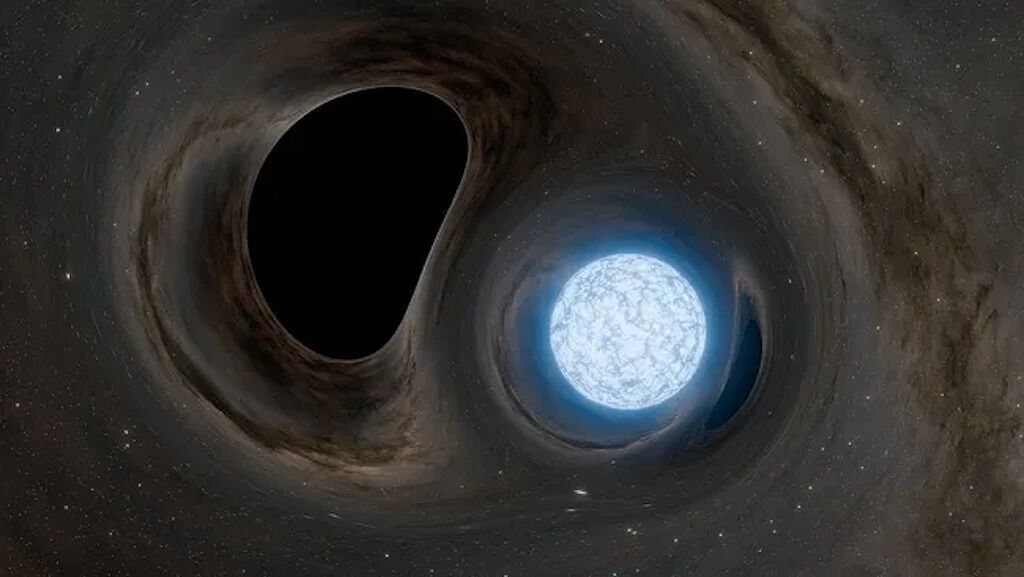
© Caltech/R. Hurt (IPAC)Artist's concept of a cracked neutron star orbiting a black hole.
The universe is full of spectacular and violent events, but few are more dramatic than a black hole tearing apart a star. Now, thanks to advanced computer simulations, scientists have gotten their closest look yet at what this cosmic catastrophe might actually look — and even sound — like.
A team of astronomers, led by theoretical astrophysicist Elias Most of the California Institute of Technology (Caltech), modeled the dramatic final milliseconds before a neutron star, the incredibly dense core left behind by a massive stellar explosion, is devoured by a black hole.
The results, published in The Astrophysical Journal Letters in March, suggest that in those last moments, the star's surface cracks apart much like the ground during an earthquake. Just before the neutron star disappears into the black hole's abyss, some of the most powerful shock waves known to us would erupt outward in a kind of violent, final farewell. The team's work also predicts the kinds of signals this cosmic collision might send through space, signals that astronomers using telescopes on Earth and in orbit could one day detect.
"Before this simulation, people thought you could crack a neutron star like an egg, but they never asked if you could hear the cracking," Most said in a statement. "Our work predicts that, yes, you could hear or detect it as a radio signal."
The simulation shows that just before the neutron star is swallowed, the black hole's immense gravity shears its surface, triggering violent starquakes. That causes the star's powerful magnetic field to ripple and twist, producing what astronomers call Alfvén waves. Then, just before the neutron star is consumed by the black hole, these waves turn into a powerful blast, emitting a burst of radio waves known as a fast radio burst (FRB). Caltech's upcoming network of 2,000 radio dishes in Nevada may one day be sensitive enough to detect these final bursts, according to the statement.
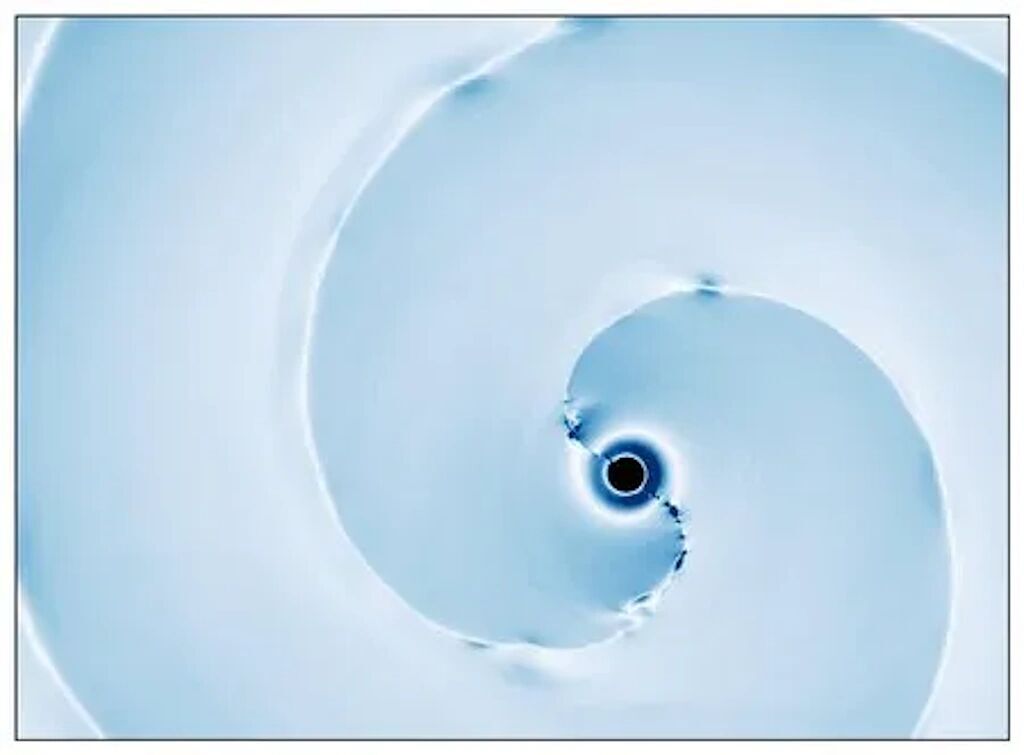
© Yoonsoo Kim/CaltechThis snapshot from a simulation shows a magnetized outflow of plasma launched following the merger of a black hole and a magnetized neutron star. The light blue color maps show the strength of magnetic fields within this wind. The magnetized outflow is powered by the spin of the remnant black hole, like a rotating fan pushing air around.
"This goes beyond educated models for the phenomenon," Katerina Chatziioannou, assistant professor of physics at Caltech and a co-author of the new study, said in the same statement. "It is an actual simulation that includes all the relevant physics taking place when the neutron star breaks like an egg."
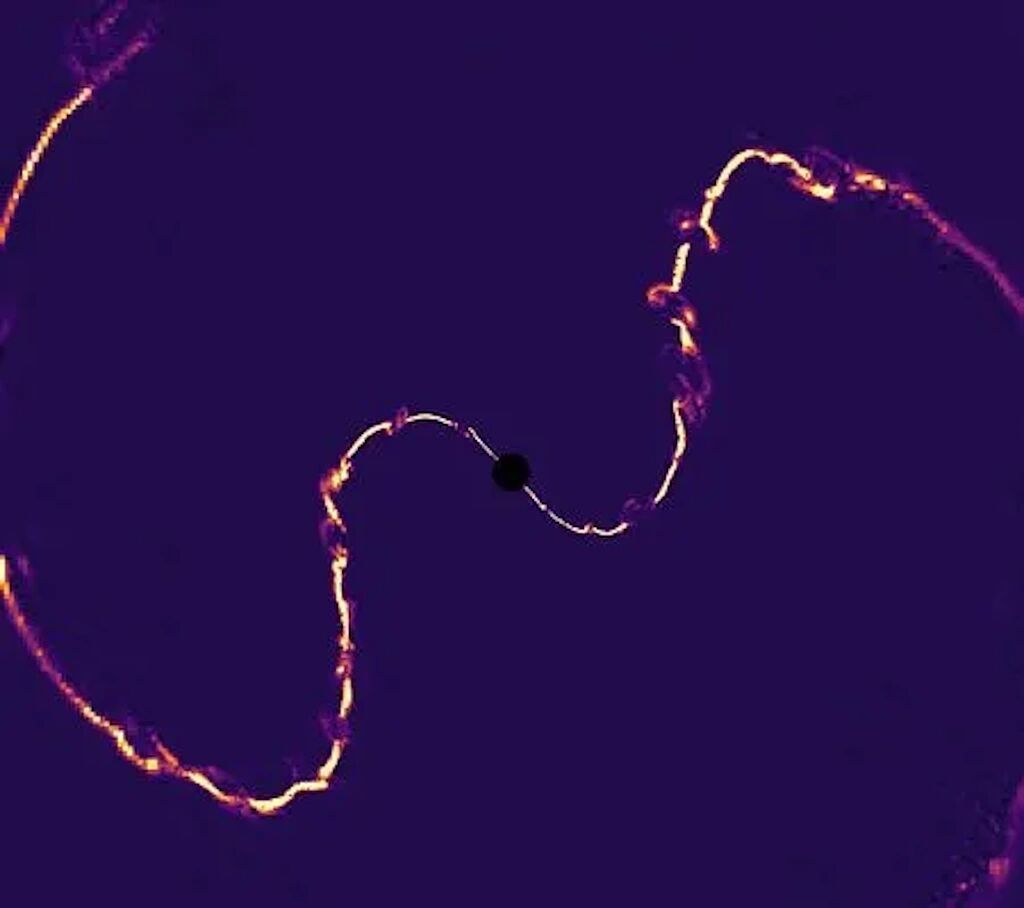
© Yoonsoo Kim/CaltechA side view from a simulation of a "black hole pulsar," a hypothetical object in which a black hole launches magnetized outflows that sweep around the black hole, like a lighthouse beacon, as it spins. The yellow lines show where magnetic fields that are pointing in different directions meet up. Electric currents flow along this interface and heat up plasma, which takes on a characteristic "ballerina's skirt" geometry.
This phenomenon occurs because, as the black hole engulfs the neutron star, it also pulls in the star's magnetic field. "But it needs to get rid of that," Most said in a statement. "What the simulation shows is that it actually does that in a way that forms a state that looks like a pulsar."
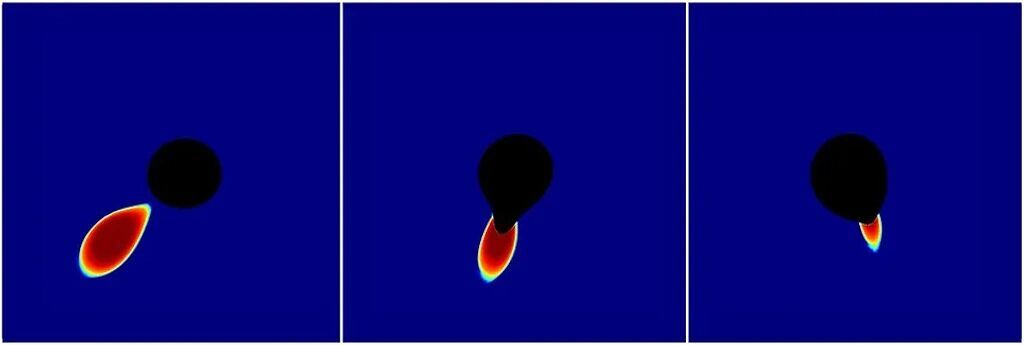
© Elias Most/CaltechThese three panels are taken from a supercomputer simulation of a merger between a black hole (large black circle) and a neutron star (colored blob). The images, which move forward in time from left to right, show how the intense gravity of the black hole stretches the neutron star, before the black hole ultimately consumes it
The team credits their detailed simulation to the power of cutting-edge computing. They used Perlmutter, a supercomputer at Lawrence Berkeley National Laboratory in California that's equipped with GPUs, the same graphics processors used in video games and AI tools like ChatGPT.
"We just did not have enough computing power before to numerically model these highly complex physical systems in sufficient detail," said Most.
"With GPUs, suddenly, everything worked and matched our expectations."
The research was published across two papers in The Astrophysical Journal Letters.
Text




Reader Comments
Unlike this physics simulation for example : [Link] - whose name would be more fitting for those of that astro-junkies. Gamers would notice.