The earliest life on Earth might have been just as purple as it is green today, a scientist claims.
Ancient microbes might have used a molecule other than chlorophyll to harness the Sun's rays, one that gave the organisms a violet hue.
Chlorophyll, the main photosynthetic pigment of plants, absorbs mainly blue and red wavelengths from the Sun and reflects green ones, and it is this reflected light that gives plants their leafy color. This fact puzzles some biologists because the sun transmits most of its energy in the green part of the visible spectrum.
"Why would chlorophyll have this dip in the area that has the most energy?" said Shil DasSarma, a microbial geneticist at the University of Maryland.
In 2008, scientists will, for the very first time, create a continual profile of ice thickness in the Arctic, extending from the Canadian coast across the North Pole to Siberia. At the core of the project lies the crossing of the North Pole by zeppelin. The airship will be equipped with an electromagnetic sensor developed at the Alfred Wegener Institute for Polar and Marine Research, one of the 15 research centres within the Helmholtz Association. The sensational project of French physician Jean-Louis Etienne is financed by the French oil company Total and will be presented in Berlin on April 5.
Background
The extent of sea ice cover in the Arctic Ocean is declining strongly. This reduction in the North represents a stark contrast to sea ice cover in the Antarctic where even a slight increase is detectable. "There is almost no information about regional distribution of ice thickness in the Arctic and Antarctic", explains Dr Christian Haas, geophysicist at the Alfred Wegener Institute. "This lack of knowledge is a consequence of major methodological problems associated with measuring ice floes of only several metres thickness, and of the logistical difficulties of venturing into the central Arctic." The development of ice cover in the polar oceans represents one of the key questions in climate research, and hence is among the core research topics during the International Polar Year 2007 / 2008.
XinhuaTue, 13 Mar 2007 20:40 UTC
Solar storms, which are expected to get worse over the next five years, could threaten China's national defence and communications satellite systems, said the National Satellite Meteorological Center (NSMC) on Tuesday.
Astronomers have long known that the Sun's "activity" rises and falls in cycles that last roughly 11 years each. Now a team of scientists from China and India has developed a theoretical model of solar activity that suggests that the next cycle, which is due to begin in about 2011, will be relatively mild. The model -- the first to confirm predictions based purely on experimental records of solar activity -- is good news because high levels of activity can disrupt satellite communications.
The fact that the Sun goes through cycles of activity was first noticed in the 18th century when astronomers began charting the number of cool, dark patches or "sunspots" on the solar surface where magnetic activity is intense. However, in the mid-1970s -- when the first accurate data of the Sun's polar magnetic field started being recorded -- astronomers found evidence for a possible link between the minimum value of the field in one cycle and the peak field of the next cycle. If such a link does exist, one could then predict the strength of future cycles based on past data. Indeed, the polar field is so low in the current solar cycle that the next cycle is predicted to be the weakest for 100 years.
The case had the makings of an eerie cyber-mystery: A young Alexandria woman told local police she suspected that her ex-boyfriend was tapping into her e-mail inbox from thousands of miles away, reading messages before she could and harassing the senders.
She was right to be suspicious. Her ex had hacked into her e-mail account, either guessing her password or using spyware -- software that can secretly read e-mails and survey cyber-traffic, law enforcement officials said. For months, apparently, he had followed her every online move, part of a pattern of abuse city police are still investigating.
As countless photos from space can attest, Earth is round - the "Blue Marble," as astronauts have affectionately dubbed it. Appearances, however, can be deceiving. Planet Earth is not, in fact, perfectly round.
This is not to say Earth is flat. Well before Columbus sailed the ocean blue, Aristotle and other ancient Greek scholars proposed that Earth was round. This was based on a number of observations, such as the fact that departing ships not only appeared smaller as they sailed away but also seemed to sink into the horizon, as one might expect if sailing across a ball says geographer Bill Carstensen of Virginia Tech in Blacksburg.
ESASat, 14 Apr 2007 08:24 UTC
Cluster is providing new insights into the working of a 'space tsunami' that plays a role in disrupting the calm and beautiful aurora, or Northern Lights, creating patterns of auroral dances in the sky.
Generally seen in high-latitude regions such as Scandinavia or Canada, aurorae are colourful curtains of light that appear in the sky. Caused by the interaction of high-energy particles brought by the solar wind with Earth's magnetic field, they appear in many different shapes.
WHOISat, 14 Apr 2007 08:03 UTC
Scientists have found one of the largest fields of seafloor vents gushing super-hot, mineral-rich fluids on a mid-ocean ridge that, until now, remained elusive to the ten-year hunt to find them.
"The discovery of the first active vents ever found on an ultraslow-spreading ridge is a significant milestone event," said Jian Lin, leader of a team of Woods Hole Oceanographic Institution (WHOI) scientists who participated in a Chinese expedition to the remote Southwest Indian Ridge in the Indian Ocean in February and March.
Since deep-sea hydrothermal vents were first discovered 30 years ago in the Pacific Ocean, scientists have studied them all along the Mid-Ocean Ridge, a 40,000-mile-long mountain range that zigzags through the middle of the world's ocean basins like a giant zipper. The ridge marks the area where the Earth's giant tectonic plates spreads apart and new ocean crust forms from hot lava rising from deep within Earth's mantle.
David Shiga and Maggie McKee
New ScientistThu, 12 Apr 2007 19:00 UTC
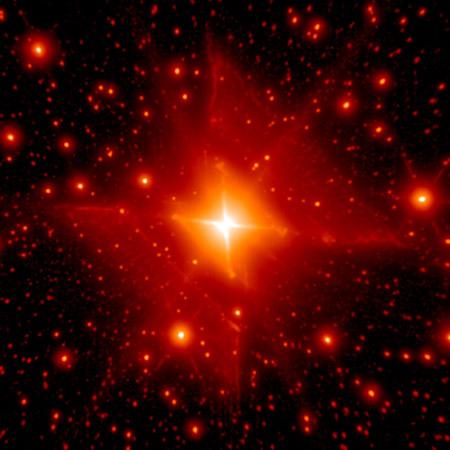
A newly discovered nebula, called the 'Red Square', displays a dazzling, gem-like symmetry, new observations reveal. But the nature of the star or stars that produced it remains a mystery.

|
| ©P Tuthill/Palomar Obs/Keck Obs
|
| The Red Square is revealed in this infrared image made by combining data from the Hale telescope atop Mount Palomar in California, and the Keck II telescope atop Mauna Kea in Hawaii
|
We have to climb a mountain in order to conquer it. In quantum physics there is a different way: objects can reach the opposite side of a hill simply by tunnelling through it, instead of laboriously climbing over it. An international team of researchers working with Prof. Ferenc Krausz from the Max Planck Institute for Quantum Optics has now observed electrons in this tunnelling process. This effect is responsible for the ionization of atoms under the influence of strong magnetic fields. The electrons overcome the attraction of the atomic nucleus by tunnelling through a potential wall. The scientists used ultra-short laser pulses to show discrete stages of ionization in this process, each of which lasts 100 attoseconds - a fraction of a billionth of a second. The results make a significant contribution to understanding how electrons move around in atoms and molecules.