A tomb of an Egyptian courtier who lived about 4,000 years ago was discovered by Belgian archaeologists, Egypt's culture ministry has said.
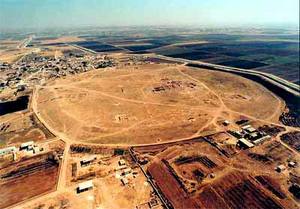
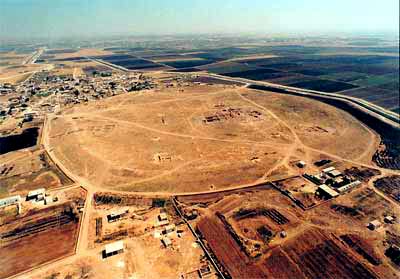
Although nearly seven years have passed, I still vividly remember the events of June 10, 2000. Our archaeological team of students and specialists, about fifteen strong, had begun the third week of a two-month excavation season on the Jabbul Plain of northern Syria. We were bracing ourselves for the hot and dry summer days we could expect at our site, Tell Umm el-Marra. A tell (the word means "mound" in Arabic) is not a natural feature. Rather, it is an archaeological time capsule, with layers of mud bricks, stones, artifacts, and other materials that have accumulated for thousands of years as buildings were lived in, abandoned, fell into ruin, and finally served as the foundations for a new generation of buildings. At Tell Umm el-Marra the remains have accumulated to a height of twenty-seven feet across an area of fifty acres. The mound is one of scores that dot the otherwise featureless plain.
|
| ©Glenn M. Schwartz
|
| Aerial view of Tell Umm el-Marra and its surroundings
|
A paleo-bully of sorts, a Tyrannosaurus rex could chomp down on prey with the force needed to lift a semi-trailer, tearing apart a victim's bones. Now researchers have discovered the dino's secret weapon: it was hard-headed.
"Fused, arch-like nasal bones are a unique feature of tyrannosaurids," said lead scientist Eric Snively of the University of Alberta. "This adaptation, for instance, was keeping the T. rexes from breaking their own skull while breaking the bones of their prey."
Bottlenose dolphins are talking to each other using a dialect that could be unique to Wales, claim scientists.
The whistles of dolphins in Cardigan Bay are different to those living off the Irish coast, a study has found.
Alexander Gelfand
Wired.comTue, 22 May 2007 10:10 UTC
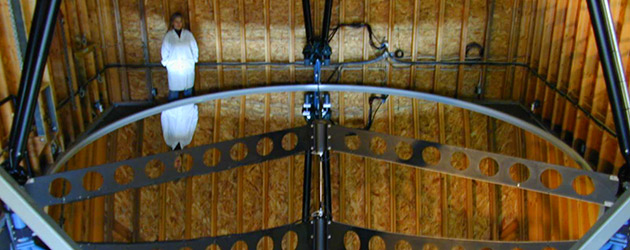
Even by astronomical standards, Roger Angel thinks big.
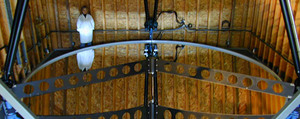
Angel, a leading astronomer at the University of Arizona, is proposing an enormous liquid-mirror telescope on the moon that could be hundreds of times more sensitive than the Hubble Space Telescope.
|
| Dr. Paul Hickson
|
| The Large Zenith Telescope in British Columbia has a 6-meter primary liquid mirror
|
Brendan Borrell
nature.comTue, 22 May 2007 10:00 UTC
How did the South American sweet potato wind up in Polynesia? New research suggests that the crop could have simply floated there on a ship.
The origin of the sweet potato in the South Pacific has long been a mystery. The food crop undisputedly has its roots in the Andes. It was once thought to have been spread by Spanish and Portuguese sailors in the sixteenth century, but archaeological evidence indicates that Polynesians were cultivating the orange-fleshed tuber much earlier than that, by at least AD 1000. However, there's no hard evidence of people travelling between South America and the South Pacific so early in history. Most Polynesian crops have their origins in Asia, where the people are thought to have migrated from.
Yinka Adegoke and Robert MacMillan
ReutersMon, 14 May 2007 09:22 UTC
Satellite television provider DirecTV Group Inc. may test delivering high-speed Internet service through power lines in a major U.S. city in the next year, its chief executive said on Monday.
Archaeologists got a royal surprise last week when they stumbled upon the tomb of a powerful official of the Egyptian court from 4,000 years ago.
Scientists from Belgium's Leuven Catholic University discovered the intact tomb in the Deir Al-Barsha necropolis in Minya, about 150 miles (241 kilometers) south of Cairo, while excavating another burial site, Egypt's culture ministry reported Sunday.
The tomb is of Henu, a courtier and real estate manager during the tumultuous First Intermediate period (2181 to 2050 B.C.) of Egyptian history.
Mathematicians and number buffs have their records. And today, an international team has broken a long-standing one in an impressive feat of calculation.
On March 6, computer clusters from three institutions - the EPFL, the University of Bonn and NTT in Japan -- reached the end of eleven months of strenuous calculation, churning out the prime factors of a well-known, hard-to-factor number that is a whopping 307 digits long.
"This is the largest 'special' hard-to-factor number factored to date," explains EPFL cryptology professor Arjen Lenstra. (The number is 'special' because it has a special mathematical form -- it is close to a power of two.) The news of this feat will grab the attention of information security experts and may eventually lead to changes in encryption techniques.
Although it is relatively easy to identify huge prime numbers, factoring, or breaking a number down into its prime components, is extremely difficult. RSA encryption, named for the three individuals who devised the technique (Ronald Rivest, Adi Shamir and Leonard Adleman), takes advantage of this. Using the RSA method, information is encrypted using a large composite number, usually 1024 bits in size, created by multiplying together two 150-or-so digit prime numbers. Only someone who knows those two numbers, the "keys", can read the message. Because there is a vast supply of large prime numbers, it's easy to come up with unique keys. Information encrypted this way is secure, because no one has ever been able to factor these huge numbers. At least not yet.




Comment: Traditional science who reject ancient high civilisations before The Sumerians have trouble explaining many anormalies. Maybe they should read The Secret History of the World
Another good book is Maps of the Ancient Sea Kings