AFPSat, 16 Jun 2007 18:25 UTC
Australian and US scientists successfully launched a supersonic scramjet engine at an Outback test range Friday, as they work on a device that could revolutionize air travel.
The researchers said a rocket carrying the scramjet reached speeds of mach 10 -- ten times the speed of sound -- after blasting off at the Woomera range in South Australia Friday.
|
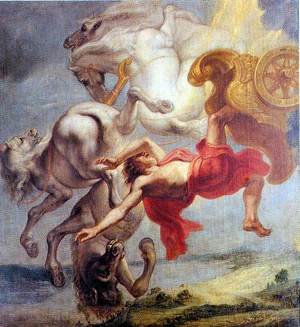
The eagle screams,
And with pale beak tears corpses. . . .
Mountains dash together,
Heroes go the way to Hel,
And heaven is rent in twain. . . .
All men abandon their homesteads
When the warder of Midgard
In wrath slays the serpent.
The sun grows dark,
The earth sinks into the sea,
The bright stars
From heaven vanish;
Fire rages,
Heat blazes,
And high flames play
'Gainst heaven itself"
R.B. Anderson, "Norse Mythology," 1875
|
NASA seems to
spend a lot of time looking for and thinking of ways to divert errant asteroids that might possibly hit earth. However, they keep reassuring the public that the probability of actually being hit by an asteroid is extremely small. So why
all the attention?
An irregularly-shaped space rock nearly 4 m in length and 1.5 to 2.3 m across has entered Earth's gravitational field claimed an amateur astronomer.
''The rock,named 6RIODB9, suddenly entered our planet's gravitational field on June 12 and is slowly making revolutions along the Earth. On June 17, it will be at a distance of nearly 203,000 km from our planet. A similar 'rock' was observed in September 2006 by The University of Arizona's Catalina Sky Survey,'' said Dr Ram S Shrivastava.
Plants on extrasolar planets resembling Earth could be as black as these eggplants. Scientists who speculate on plant life and what might constitute photosynthesis "out there" say that plant color depends on the size and light intensity that the planet feeds off from its star, or sun, as well as the extrasolar planet's atmospheric chemistry.
MIKE SCHNEIDER and VLADIMIR ISACHENKOV
Associated Press Fri, 15 Jun 2007 13:36 UTC
HOUSTON - Russian space officials said Friday they were considering moving up the launch of a Russian cargo ship as cosmonauts aboard the international space station struggled for a second day to reboot failed computers controlling the orbiting outpost's orientation.
Big, brutish and stupid - it's a commonly held view that our prehistoric predecessors were as wild and unsophisticated as the animals they hunted.
But Neanderthal Man was not as slow-witted as he looked and was in reality as smart as we are, an archaeologist claims.
They were actually innovators who used different forms of tools to adapt to the ecological challenges posed by harsh habitats as they spread through regions of Europe.
LatechFri, 15 Jun 2007 11:16 UTC
Six Louisiana Tech researchers in the physics department played a role in discovering a new sub-atomic particle whose existence was announced this week.
The discovery was made by physicists of the DZero experiment at the U.S. Department of Energy's Fermi National Accelerator Laboratory in Batavia, Ill.
Discovery and measurement of the particle's mass will provide new understanding about the basic building blocks of matter.
Local participants in the experiment were physics faculty members Z.D. Greenwood, Lee Sawyer and Markus Wobisch; former post-doctoral researcher Julie Kalk; and current post-doctoral researchers Mike Arov and Joe Steele.
Gusting winds and the pulsating exhaust plumes from the Phoenix spacecraft's landing engines could complicate NASA's efforts to sample frozen soil from the surface of Mars, according to University of Michigan atmospheric scientist Nilton Renno.
Set to launch Aug. 3 from Florida, the $414 million Phoenix Mars Lander will use descent engines to touch down on the northern plains, where vast stores of ice have been detected just below the surface. A robotic arm will scoop frozen soil and dump it into science instruments that will analyze its chemical content to see if it has the potential to sustain microbial life.
With funding from NASA and the spacecraft's manufacturer, Lockheed Martin, Renno and his students are conducting a series of experiments to determine how much dust the 12 descent engines will kick up and whether martian winds could interfere with efforts to deliver soil to the onboard mini-lab.
Renno, an associate professor in the College of Engineering's Department of Atmospheric, Oceanic and Space Sciences, is a member of the Phoenix science team.
"I proposed that my engineering students look into some of the challenges that the Phoenix team will face when the spacecraft arrives at Mars," Renno said. "I wanted the students to contribute to the success of the mission in a meaningful way."
The Chinese military possesses dangerous first-strike cyberwar capabilities that include special units charged with developing viruses to attack enemy computer networks, a U.S. Department of Defense (DoD) report has warned.
"The PLA [People's Liberation Army] has established information warfare units to develop viruses to attack enemy computer systems and networks, and tactics and measures to protect friendly computer systems and networks," the Pentagon's annual report to Congress on China's military power said.
"In 2005, the PLA began to incorporate offensive CNO [computer network operations] into its exercises, primarily in first strikes against enemy networks."
The report shows how the Chinese military's thinking on information warfare has changed in recent years, says Andrew Macpherson, director of the technical analysis group at the University of New Hampshire's Justiceworks and a research assistant professor of Justice Studies.
On average the Venetians who lived during the glory days of the Republic were rather small, just five feet five inches in height; they were well nourished, and if they lacked sugar and fat the result was excellent teeth with no cavities.
These are among the first findings of a group of archaeologists exploring a treasure trove of Venetian history that has been locked away and forgotten for centuries: the graves of Lazzaretto, an island in the Venetian lagoon whichbecame the world's first isolation hospital.
Following an outbreak of the plague in 1348, the Doge and his advisers put their minds to thinking up a way to prevent a recurrence. The upshot, at the beginning of the 15th century, was the world's first isolation hospital occupying the entire small island.
In 1630 the hospital was dissolved and the island taken over by a military garrison; later it was used to hold stray dogs. In the 1960s it was abandoned altogether.