Archaeologists have found a trio of extraordinary stone carvings while charting the phenomenon of prehistoric rock markings in Northumberland, close to the Scottish border in the United Kingdom.
Records and examples of over 950 prehistoric rock art panels exist in Northumberland, which are of the traditional 'cup and ring' variety, with a typical specimen featuring a series of cups and concentric circles pecked into sandstone outcrops and boulders.
However, archaeologists at the University of Newcastle upon Tyne, who are studying prehistoric rock carvings, are baffled by three unusual markings found carved into rocks at separate locations.

|
| ©Aron Mazel
|
| Photograph of the face carving (1), found near Rothbury, Northumberland
|
It's a case of evolutionary detective work. Biology researchers at Lewis & Clark College and the University of Arizona have found evidence for an ancient transfer of a toxin between ancestors of two very dissimilar organisms--spiders and a bacterium. But the mystery remains as how the toxin passed between the two organisms. Their research is published this month in the journal Bioinformatics, 22(3): 264-268, in an article titled "Lateral gene transfer of a dermonecrotic toxin between spiders and bacteria."
"We are piecing together an historical puzzle with evidence from living descendants of an ancient ancestor," said Greta Binford, assistant professor of biology at Lewis & Clark. Her coresearcher on the project is Matthew Cordes, assistant professor of biochemistry and molecular biophysics at the University of Arizona. The toxin is uniquely found in the venom cocktail of brown or violin spiders, including the brown recluse, and in some Corynebacteria. The toxin from the spider's venom can kill flesh at the bite site; the bacterium causes various illnesses in farm animals.
Scientists at Cardiff University, UK, believe they have discovered the cause of crop failures and summer frosts some 1,500 years ago - a comet colliding with Earth.
The team has been studying evidence from tree rings, which suggests that the Earth underwent a series of very cold summers around 536-540 AD, indicating an effect rather like a nuclear winter.
The scientists in the School of Physics and Astronomy believe this was caused by a comet hitting the earth and exploding in the upper atmosphere. The debris from this giant explosion was such that it enveloped the earth in soot and ash, blocking out the sunlight and causing the very cold weather.
This effect is known as a plume and is similar to that which was seen when comet Shoemaker-Levy-9 hit Jupiter in 1995.
Historical references from this period - known as the Dark Ages - are sparse, but what records there are, tell of crop failures and summer frosts.
Recent research by Zeeshan-ul-hassan Usmani, a Florida Institute of Technology doctoral student and Fulbright Scholar, indicates that various crowd formations exacerbate or minimize injuries and fatalities in the event of a pedestrian suicide bomb attack.
His work was conducted through virtual simulation. It showed that the crowd formation experiencing the worst effects is a circular one, with a 51 percent death rate and 42 percent injury rate, thus reaching 93 percent effectiveness. A person that is in line-of-sight with the attacker, rushing toward the exit or in a stampede was found to be in the least safe position.
The safest way to stand or sit in a crowd, Usmani found, was in vertical rows.
Whereas most birds are sole proprietors of their nests, some tropical species "time share" together - a discovery that helps clear up a 150-year-old evolutionary mystery, says Biology professor Vicki Friesen.
The Queen's-led international study confirms one of Charles Darwin's more controversial theories - first put forward in 1859 and since disputed by many experts - that different species can arise, unhindered, in the same place. Others believe that a geographic barrier such as a mountain or a river is required to produce two separate species. Although focused on how species change over time through natural selection, Darwin's landmark book, The Origin of Species, also speculates that it is possible for different species to develop in the same place.
The team's findings will appear in the international journal, Proceedings of the National Academy of Sciences (PNAS).
Seagate Technology LLC has shipped Maxtor disk drives that contain Trojan horses that upload data to a pair of Chinese Web sites, the Taiwanese government's security service warned this weekend.
SPOKANE: Washoe, a female chimpanzee that was believed to be the first non-human ever to acquire human language, has died at the Washington research institute where it was kept.
Comment: It is ironic that scientists would argue whether these animals demonstrate true language ability. It is clear that, when put into a respective nurturing environment, these animals communicate, demonstrate abstract thinking, teach their young to do the same, have self-awareness and even show the ability to understand humor by joking and swearing inventively :)
Most importantly, they identify themselves with humans. All the 'talking' apes, when sorting the photographs they've been given into two categories, "people" and "animals", confidently put their own photos in the "people" pile -- while relegating the photos of their 'non-talking' peers into the "animals" pile.
When in company of zoo apes, the talking apes also would, after unsuccessful tries, refuse to communicate with them and, visibly distraught, would seek the society of people.
One talking ape, Lucy, was returned back into the wild. When her mentor-scientist found her in the jungle a few months later, Lucy signed to her, "take me away from here". Lucy was later killed by a poacher.
Chantek, an orangutan with a vocabulary of several hundred signs, was at some point transferred to a primate center, where he was confined in small quarters and isolation. He was depressed -- and did all he could to teach the zookeepers sign language.
All of this confirms the point of view expressed long ago by Charles Darwin: the difference between intellectual capabilities of animals and humans is quantitative rather than qualitative. The writer Mikhail Bulgakov approached this from another angle with his sarcastic comment: "having mastered speech doesn't make one human, and there are plenty of people out there who are a living proof of that" *:)
*quoted from
an article about Washoe and other talking apes
Stan Cox
AlterNetThu, 15 Nov 2007 23:51 UTC
Space hasn't yet been weaponized but it is already highly militarized, thanks to a money-hungry arms industry and a commission started by Rumsfeld.
Last January 11, a missile launched from China's Xichang Space Center destroyed a satellite 537 miles above the Earth's surface. Although the target was a weather satellite belonging to China itself (shot down ostensibly because it was obsolete), the act clearly rattled the U.S. space establishment.
Said one observer, The new space policy says we can defend the heavens with technology. But we can't, and the Chinese just proved it."
Jon Herskovitz and Jessica Kim
ReutersThu, 15 Nov 2007 23:26 UTC
South Korean university student Seong-sun is a rebel without a TV. Like other twentysomethings in tech-friendly parts of the world, Seong-sun, 27, uses his laptop to watch user-generated content and can see programming on his mobile phone.

|
| ©REUTERS/Kim Kyung-Hoon
|
| A South Korean watches a live webacast at an Internet cafe in Seoul, March 23, 2006. More Koreans are used to finding their programming over the Internet and are aided by even faster download speeds to their laptops and mobile phones.
|
Julie Steenhuysen
ReutersThu, 15 Nov 2007 23:10 UTC
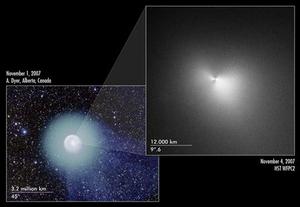
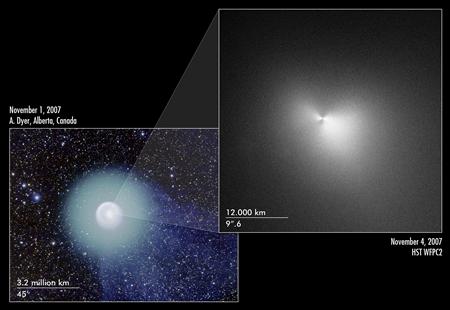
The normally sedate Comet Holmes made a bright splash in the sky about two weeks ago, unexpectedly becoming a million times brighter than normal overnight and causing a stir among astronomers.
|
| ©REUTERS/NASA, ESA, and H. Weaver/The Johns Hopkins University Applied Physics Laboratory/Handout
|
| A Hubble image (R), taken November 4, 2007, shows the heart of Comet 17P/Holmes. The central portion of the image has been specially processed to highlight variations in the dust distribution near the nucleus. About twice as much dust lies along the east-west direction (the horizontal direction) as along the north-south direction (the vertical direction), giving the comet a "bow tie" appearance. The composite color image at left, taken on November 1, 2007, by an amateur astronomer shows the complex structure of the entire coma, consisting of concentric shells of dust and a faint tail emanating from the comet's right side.
|







Comment: And we know exactly what kind of "special event planning" he is talking about.