Science & TechnologyS


Telescope

Light 'echoes' solve mystery of famous supernova

The mystery of what kind of star self-destructed to create the supernova observed by Danish astronomer Tycho Brahe in 1572 has been solved at last. A stellar ember called a white dwarf exploded after gorging on material stolen from its neighbour.

Previous observations had hinted at such a scenario, called a type Ia supernova. But the evidence was not strong enough to rule out other possible causes of death, such as the gravitational collapse of a massive star's core.
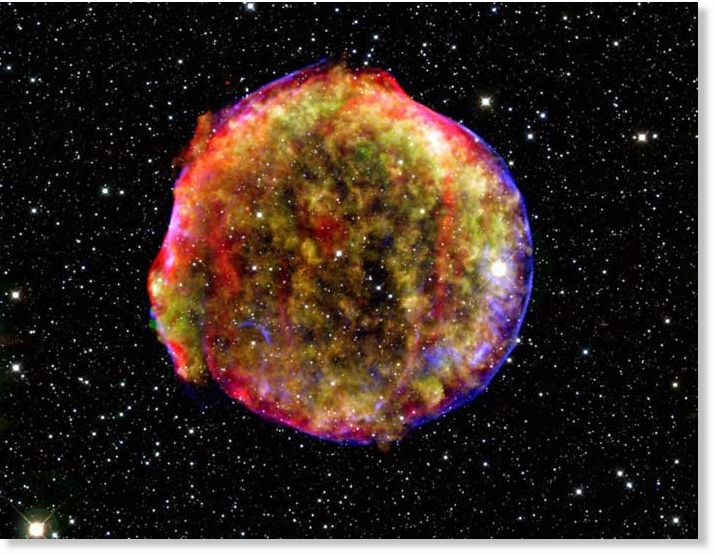
Tycho's supernova
© Max Planck Institute for Astronomy/O Krause/NASATycho's supernova left behind an expanding cloud of super-hot debris, which appears green and yellow in this composite X-ray and infrared image stitched together from data from the Spitzer and Chandra space observatories and the Calar Alto observatory in Spain.

Now, a team led by Oliver Krause at the Max Planck Institute for Astronomy in Heidelberg, Germany, has spotted telltale signs of a type Ia supernova using the powerful 8.2-metre Subaru telescope in Hawaii.

They studied "light echoes" from the centuries-old supernova - light from the original explosion that reflected off interstellar dust and then headed in our direction.


Sun

Sun's Magnetic Field May Impact Weather And Climate: Sun Cycle Can Predict Rainfall Fluctuations

The sun's magnetic field may have a significant impact on weather and climatic parameters in Australia and other countries in the northern and southern hemispheres. According to a study in Geographical Research, the droughts are related to the solar magnetic phases and not the greenhouse effect.

The study uses data from 1876 to the present to examine the correlation between solar cycles and the extreme rainfall in Australia.
sun's magnetic field
© iStockphoto

It finds that the Southern Oscillation Index (SOI) - the basic tool for forecasting variations in global and oceanic patterns - and rainfall fluctuations recorded over the last decade are similar to those in 1914 -1924.

Cell Phone

Cell Phones That Never Need To Be Charged? Sound Wave-powered Devices Possible

Imagine a self-powering cell phone that never needs to be charged because it converts sound waves produced by the user into the energy it needs to keep running. It's not as far-fetched as it may seem thanks to the recent work of Tahir Cagin, a professor in the Artie McFerrin Department of Chemical Engineering at Texas A&M University.

Utilizing materials known in scientific circles as "piezoelectrics," Cagin, whose research focuses on nanotechnology, has made a significant discovery in the area of power harvesting - a field that aims to develop self-powered devices that do not require replaceable power supplies, such as batteries.

Info

New Giant Toothless Pterosaur Species Discovered

A researcher at the University of Portsmouth has identified a new species of pterosaur, the largest of its kind to ever be found. It represents an entirely new genus of these flying reptiles that ruled the skies 115 million years ago.

The finding is significant because it originated in Brazil and is the only example of the Chaoyangopteridae, a group of toothless pterosaurs, to be found outside China and is the largest one ever discovered.
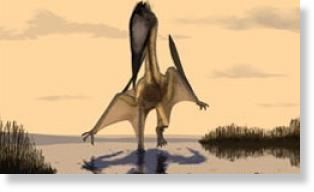
Lacusovagus, meaning 'lake wanderer
© University of PortsmouthMark Witton's depiction of the new species Lacusovagus, meaning 'lake wanderer.'

Mark Witton identified the creature from a partial skull fossil from which he was able to estimate that it would have had a five-metre wingspan - bigger than a family car - and would stand over one metre tall at the shoulder.

Magic Wand

Disappearing Superconductivity Reappears -- In 2-D

Scientists studying a material that appeared to lose its ability to carry current with no resistance say new measurements reveal that the material is indeed a superconductor - but only in two dimensions. Equally surprising, this new form of 2-D superconductivity emerges at a higher temperature than ordinary 3-D superconductivity in other compositions of the same material.
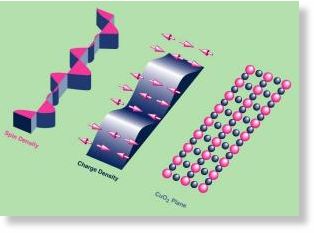
Image
© DOE/Brookhaven National LaboratoryStripe order in the copper oxide planes involves both a modulation of the charge density (blue), detectable with x-ray diffraction, and a modulation of the arrangement of magnetic dipole moments (spin directions) on copper atoms (magenta arrows), detectable with neutron diffraction.

The research, conducted in part at the U.S. Department of Energy's (DOE) Brookhaven National Laboratory, will appear in the November 2008 issue of Physical Review B, and is now available online.

"Our basic research goal is to understand why and how these materials act as superconductors," said Brookhaven physicist John Tranquada, who led the research. "The ultimate practical goal would be to use that understanding to develop improved bulk superconductors - ones that operate at temperatures warm enough to make them useful for real-world applications such as high-efficiency power lines."

Display

US mulls free wireless internet for all

Free wireless internet access for everyone in the US could soon become a reality, but it all depends on the outcome of a vote at the US agency charged with regulating telecommunications.

The current chairman of the Federal Communications Commission, Kevin Martin, is championing the proposal, which would see the winner of an auction of the currently public radio spectrum having to set some aside for free internet access.

Were that plan to become reality, it could bring the benefits of internet connectivity to groups currently being left behind by the broadband age and shake up the market for mobile wireless devices, like cellphones and laptops. The scheme faces several hurdles, however.

Telescope

The lives and deaths of stars

Stars: A journey through stellar birth, life and death by Raman Prinja, is a comprehensive look at the latest developments in our understanding of the birth, life and death of stars.
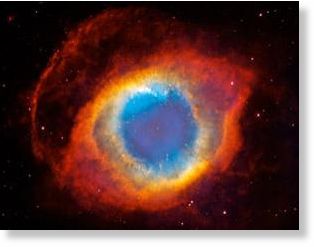
Helix planetary nebula
© NASA, ESA, C R O'Dell (Vanderbilt University), M Meixner and P McCullough (STScI)The Helix planetary nebula is constructed from matter ejected by a dying Sun-like star, almost 690 light-years away.

It features many colour images from NASA, the Hubble Space Telescope and the Spitzer Space Telescope.

Magic Hat

Body-swap illusion tricks mind in new study

Stockholm, Sweden - Shaking hands with yourself is an amusing out-of-body experience. The illusion of having your stomach slashed with a kitchen knife, not so much.

Both sensations, however, felt real to most participants in a Swedish science project exploring how people can be tricked into the false perception of owning another body.

In a study presented Tuesday, neuroscientists at Stockholm's renowned Karolinska Institute show how they got volunteers wearing virtual reality goggles to experience the illusion of swapping bodies with a mannequin and a real person.

Meteor

Odd Comet Possibly from Another Star System

The bizarre chemical make-up of a comet suggests the blob of ice is an interloper, possibly flung into our solar system from beyond, astronomers now say, adding that the wacky comet is forcing them to create a new category for such objects.

The comet, called Machholz 1, was discovered in 1986 by Donald Machholz of Loma Prieta, Calif. Since then, the icy denizen has made a few appearances, including one in 2007.
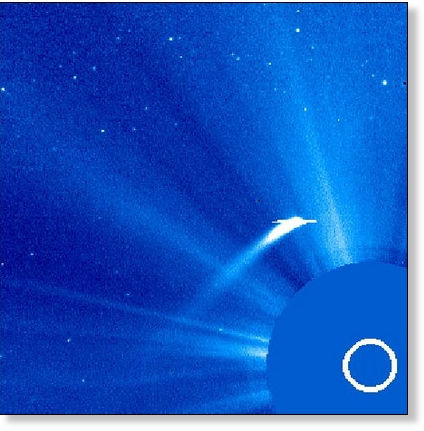
Comet Machholz 1
© SOHO/LASCO (ESA & NASA)This image taken by the ESA-NASA sunwatching spacecraft SOHO reveals Comet Machholz 1 close to the sun on Jan. 8, 2002. SOHO's coronograph hid the bright sun, the size of which is shown by the inner ring.

"A large fraction of comets in our own solar system have escaped into interstellar space, so we expect that many comets formed around other stars would also have escaped," said David Schleicher, a planetary astronomer at Lowell Observatory in Arizona. "Some of these will have crossed paths with the sun, and Machholz 1 could be an interstellar interloper."

Light Sabers

Boeing ABL Fired Through its Beam Control Guidance System

Boeing has successfully fired the laser about the ABL aircraft through the onboard laser guidance system.

The key to stopping missile attacks is to be able to target and destroy the missiles in the boost phase of their flight before they can reach the target and cause untold damage. The U.S. Missile Defense Agency has been testing the Airborne Laser (ABL) system for several years now.

Comment: If the secret military projects are years and decades ahead of what is in the public media we can just imagine what wonderful horror lies in store for the human race.

Here are just a few related links on SOTT regarding the military's directed energy weapons:

Boeing ATL Aircraft High-Energy Laser Ground Tested
Army Moves Ahead With Mobile Laser Cannon
US boasts of laser weapon's 'plausible deniability'
Weapons-Grade Lasers by the End of '08?
Airborne laser weapons heating up
Boeing tests airborne laser gun
Laser plane could destroy tanks from 10 miles
Pentagon wants laser attack warnings for satellites
Police, Military roll out Weapons of Mass Distraction
Pentagon investigated lasers that put voices in your head and mimic Schizophrenia
Boeing Conducts Successful Avenger-Mounted Laser Tests
Record power for military laser
New Weapon, Human Tests
Airborne Laser to test-fire in flight
'Star Wars' becomes reality as US unveils laser-equipped 747
Boeing-Led Team Fires Surrogate Lasers From Airborne Laser Aircraft
Administration Conducting Research Into Laser Weapon
Is The U.S. using new experimental "Tactical High Energy Laser" weapons in Iraq?
New weapon could mean the end of collateral damage
Beam weapons almost ready for battle