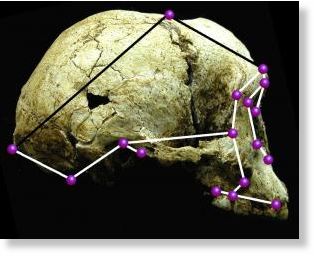
© Karen L. Baab and Kieran P. McNulty.Data collected from the LB1 cranium (superimposed on the original photo) of Homo floresiensis. Size, shape, and asymmetry in fossil hominins: The status of the LB1 cranium based on 3D morphometric analyses.
Discovered on the Indonesian island of Flores in 2003, controversy has surrounded the fossilized hominid skeletons of the so-called "hobbit people," or Homo floresiensis ever since. Experts are still debating whether the 18,000-year-old remains merely belong to a diminutive population of modern-day humans (with one individual exhibiting "microcephaly," an abnormally small head) or represent a previously unrecognized branch in humanity's family tree.
Using 3D modeling methods, McNulty and his fellow researchers compared the cranial features of this real-life "hobbit" to those of a simulated fossil human (of similar stature) to determine whether or not such a species was distinct from modern humans.