Science & TechnologyS


Info

Jupiter: Red Spots in Conjunction

What happens when a raging cyclone as wide as Earth bumps into another storm twice as large? The answer lies in the midnight sky. Two storms on Jupiter--the Great Red Spot and Oval BA--are having just such a close encounter. Amateur astronomer Anthony Wesley sends this picture from Exmouth, Australia:

Red Spot and Oval BA
© Anthony Wesley
The bigger storm is the Great Red Spot, which has been swirling around Jupiter for centuries. The smaller is upstart Oval BA, which formed less than ten years ago. Because the storms travel around Jupiter at different rates, they pass one another periodically, approximately every two years. And when they do ... not much happens. Previous encounters have shown, surprisingly, that the two colossal storms can converge and emerge in tact. Could this time be different?

"Oval BA and the Great Red Spot will be passing one another in the days ahead," says Wesley. "I plan to monitor developments."

Info

Never Before Seen View of The Earth's Magnetosphere

Earth's Magnetosphere
© AGU/IBEX TeamThe IBEX results demonstrating concentrations of energetic neutral atoms. The red areas show the highest concentrations towards the Sun.
A team of scientists have used NASA's IBEX satellite to further our understanding of the solar wind's interaction with our Earth's magnetic field and outer atmosphere.

The team, from the Southwest Research Institute (SwRI) and Lockheed Martin Space Systems Company Advanced Technology Centre (ATC), used the Interstellar Boundary Explorer (IBEX) to produce a picture of the interaction between the solar wind and the Earth's outer atmosphere in March and April 2009.

The solar wind is a stream of sub-atomic particles produced by the Sun travelling out though the Solar System at over a million kilometres per hour. It interacts with the interstellar medium - particles of dust and gas that are distributed between the stars - to produce Energetic Neutral Atoms (ENAs). It is these ENAs that the IBEX satellite was designed and launched to study in October 2008.

Magnify

Prehistoric "Terror Bird" Pecked Creatures to Death

Image
© AP PhotoThe 4 1/2-foot tall bird lived about 6 million years ago in what is now north-western Argentina.
Scientists have discovered a prehistoric bird that used its hooked beak to peck its prey to death.

The ninety-pound flightless birds, which lived in South America, wielded their giant, sharp beaks in quick jabs, repeatedly backing away and jabbing again, according to a new study.

The tactics of the "terror bird", officially called Andalgalornis, were dictated partly by its size and emu-like composition, which made hunting any other way extremely difficult and possibly fatal, scientists said.

"These guys were not sluggers; they couldn't go in and grapple with prey. They had to stand back and dance around and make hatchet-like jabs," said Lawrence Witmer of the Ohio University College of Osteopathic Medicine.

The 4 1/2-foot tall bird lived about 6 million years ago in what is now north-western Argentina. Its skull had a deep, narrow bill armed with a powerful, hawk-like hook.

Newspaper

UK: Victorian Era Doctor "Escaped the Sack Despite Treating Pauper in Acid Bath"

Image
© National ArchivesOakum picking 1900-1909. The archives show what life was like for the poor and working class.
A Victorian doctor killed a workhouse boy after allowing him to be treated in an acid bath for scabies, according to newly released National Archive files detailing the hardships of 19th Century life.

Thomas S Fletcher, a surgeon at the Bromsgrove Workhouse, Worcs, was investigated for negligence after his young patient, Henry Cartwright, died in 1842.

The young pauper, whose details were not recorded, died after being immersed in a solution of "sulphuret of potassium", or potassium sulphate, in a bid to cure "The Itch", the colloquial term for scabies.

He had joined the workhouse three months previously with his mother, who could not afford to support the family.

According to records of the incident, the surgeon, one of the area's most respected medical practitioners, failed to supervise a nurse, Sarah Chambers, who placed the young boy in the acid bath.

Roses

Same-Sex Marriage Debate Has Roots Going Back Centuries

In the late 1700s, something disturbing happened to marriage in Western societies: It began to change. Young people had revolutionary new ideas about the institution and what it meant to them.

"People were terrified," said Stephanie Coontz, a historian at The Evergreen State College in Washington and author of Marriage, A History (Viking Adult, 2005). "Social conservatives of the day said, 'Oh my gosh, you're going to have the wrong people getting married.'"

The radical idea that had everyone so worried? The notion that people should marry for love, rather than for individual power, group survival, or any of a host of other historic reasons to bond.

Saturn

Neptune makes first orbit around sun since 1846

Image
© Unknown
The planet Neptune will be in opposition - when the sun, Earth, and a planet fall in a straight line - on Aug. 20. The planet will be exactly opposite the sun in the sky, being highest in the sky at local midnight. Usually this is also the point where the planet is closest to the Earth.

This opposition is special because Neptune will be returning close to the spot where it was discovered in 1846, marking its first complete trip around the sun since its discovery.

Evil Rays

Phone User 'Killed By His Exploding Mobile'

Image
A man has been killed in India after the mobile phone he was using exploded, according to reports.

The victim, named as 23-year-old Gopal Gujjar, suffered serious injuries to his right ear, neck and shoulders.

There were no witnesses to the incident - but it was assumed he was talking on his Nokia when the blast happened in the northern state of Rajasthan.

His body was found along with the remains of the phone and battery near his farm in Banda village, Kota, reported the Times of India.

Police believe he was killed by the device after discovering pieces of the Nokia 1209 handset, a basic model released in August 2008, scattered nearby.

The victim had gone into a forest to tend to his grazing cattle around noon and his body was recovered later that night.

Powertool

Reverse-Engineering of Human Brain Likely by 2020

brain scan
© IBMA graphic overlay shows neural connections on a scan of IBM researcher Dharmendra Modha's brain
Reverse-engineering the human brain so we can simulate it using computers may be only a decade away, says Ray Kurzweil, artificial intelligence expert and author of the best-selling book The Singularity is Near.

It would be the first step toward creating machines that are more powerful than the human brain. These supercomputers could be networked into a cloud computing architecture to amplify their processing capabilities. Meanwhile, algorithms that power them could get more intelligent. Together these could create the ultimate machine that can help us handle the challenges of the future, says Kurzweil.

This point where machines surpass human intelligence has been called the "singularity." It's a term that Kurzweil helped popularize through his book.

Syringe

Saving the Brain's White Matter With Mutated Mice

Vanishing White Matter (VWM) disease is a devastating condition that involves the destruction of brain myelin due to a mutation in a central factor. To understand the disease and test potential treatments that could apply to other disorders, such as multiple sclerosis, Prof. Orna Elroy-Stein of Tel Aviv University's Department of Cell Research and Immunology is leading a scientific breakthrough by developing laboratory mice which carry the VWM mutation -- an important new tool.

The mice harbor a mutation of the eIF2B enzyme, which regulates protein synthesis in every cell throughout the body. The key to the new development, says Prof. Elroy-Stein, was the use of genetically-engineered embryonic stem cells to introduce the mutation.

The brain is made up of two components: grey matter, or nerves, and white matter, or glial cells which support the nerves and produce myelin, which wraps around and protects nerve extensions. Recently described in the journal Brain, the creation of these mutated mice allows for new research on VWM diseases, which trigger loss of myelin in the brain, leading to paralysis and possible death.

Sun

Extended solar minimum linked to changes in Sun's conveyor belt

Image
© UCAR
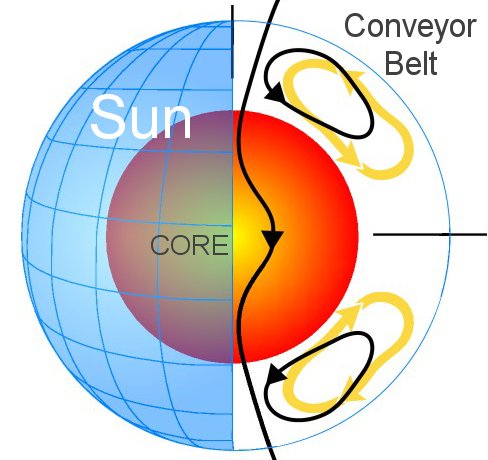
Boulder - A new analysis of the unusually long solar cycle that ended in 2008 suggests that one reason for the long cycle could be a stretching of the Sun's conveyor belt, a current of plasma that circulates between the Sun's equator and its poles. The results should help scientists better understand the factors controlling the timing of solar cycles and could lead to better predictions.

The study was conducted by Mausumi Dikpati, Peter Gilman, and Giuliana de Toma, all scientists in the High Altitude Observatory at the National Center for Atmospheric Research (NCAR), and by Roger Ulrich at the University of California, Los Angeles. It appeared on July 30 in Geophysical Research Letters. The study was funded by the National Science Foundation, NCAR's sponsor, and by NASA's Living with a Star Program.

The Sun goes through cycles lasting approximately 11 years that include phases with increased magnetic activity, more sunspots, and more solar flares, than phases with less activity. The level of activity on the Sun can affect navigation and communications systems on Earth. Puzzlingly, solar cycle 23, the one that ended in 2008, lasted longer than previous cycles, with a prolonged phase of low activity that scientists had difficulty explaining.