Science & TechnologyS


Laptop

Passwords Need at Least 12 Characters to Be Safe, Study Finds

Thanks to rapid increases in computing power, your confidential information is probably not safe unless you use a 12-digit randomized password, experts say.

Recent research from the Georgia Tech Research Institute (GTRI) indicates that to defeat a new generation of encryption cracking software, passwords need a length of at least 12 randomized characters consisting of letters, numbers and symbols. Anything else - a keyword, a birthday or a pattern of symbols - makes you an easy mark.

Binoculars

Chain of Human Pylons Planned for Iceland

Image
© Choi + ShineHuman pylons
A proposal to install a chain of human-shaped pylons across Iceland - transforming an ugly utility into something of remarkable beauty - has won a leading architecture award.

The "Land of Giants" plan would have seen dozens of metallic figures erected across the island's volcanic landscape.

Each humanoid electricity pylon could be twisted into a different posture, allowing the structures to project moods fitting with their surroundings.

Choi + Shine, the US architecture practice behind the proposal, said that the humanoid towers would be "powerful, solemn and variable", and represent a modern take on the ancient Easter Island statues.

According the proposals submitted to an Icelandic energy company, the pylons would stand around 150ft tall and be constructed from steel, glass and concrete.

War Whore

Prototype semi-hovership delivered to Commandos

Aluminium air-riding catamarans for Royal Marines

Blighty's elite Royal Marine Commandos have just taken delivery of a prototype semi-aircushion hover assault craft, intended to speed up the amphibious landings of the future.


Bulb

New Battery for Cheap Electric Vehicles

Image
© Yet-Ming ChiangBattery pioneer: Yet-Ming Chiang has a new battery design that could make electric vehicles much cheaper.
A new startup company will attempt to solve the biggest roadblock facing electric vehicles today--the cost of their batteries.

The new company, called 24M, has been spun out of the advanced battery company A123 Systems. It will develop a novel type of battery based on research conducted by Yet-Ming Chiang, a professor of materials science at MIT and founder of A123 Systems. He says the battery design has the potential to cut those costs by 85 percent.

The battery pack alone in many electric cars can cost well over $10,000. Cutting this figure could make electric vehicles competitive with gasoline-fueled cars.

Robot

Researchers Create Nanoscale Particles For Ultrasound Applications

Nanoparticle could peek inside cells or ferret out chemicals using sound waves.

Ultrasonics have many uses in an array of industries. In medicine, ultrasound is used to peek at babies to measure their development, or to detect and sometimes destroy various types of crystalline "stones" in organs. In manufacturing, ultrasonics can pinpoint microscopic stress fractures that may introduce flaws or weaknesses to a structure, or accurately measure surface and sub-surface topographies.

Various ultrasound machine refinements have come across the DailyTech desks in the past, but a new type of device may herald a new approach to ultrasonic devices as well as dramatically expand their uses. Researchers at the University of Nottingham have created not a machine, but nanoscale particles capable of acting as transducers. Along with the amazingly small size of the multilayer particle, the simplicity of the system is also quite surprising.

Info

Physicists Say Cosmic Rays Affect the Length of Day

Cosmic Rays
© Physics Central
If your Monday is dragging on too long, you might try blaming it on cosmic rays. In a paper published Friday by the journal Geophysical Research Letters, physicists from Paris and Moscow propose that the high energy protons and nuclei might have a surprising influence on Earth's length of day. The team claims that a previously noticed relationship between fluctuations in the length of day and the 11-year solar-cycle are actually caused by cosmic rays.

One of the team members, Vincent Courtillot of the Institute of Geophysics of Paris, says they examined the length of day -- as defined by the speed of the earth's rotation in a reference frame fixed with respect to the stars -- using a series of daily values over a 40 year period. They claim that up to 30-percent of changes could be directly related to the 11-year sunspot cycle.

Of course, 30-percent of that change only amounts to a few tenths of a millisecond, so you'd never actually notice it, but what's more compelling (read 'very highly controversial') is the potential for cosmic-rays to have such a profound effect.

Courtillot and his colleagues have been among those championing a radical theory that cosmic rays can impact the formation of clouds and in turn, play a major part in climate changes. But how could cosmic rays possibly change the speed of our planet's rotation?

HAL9000

Hawking's big-bang team harness SGI super power

A precise science demands big hardware

Cambridge University cosmologists working with physicist Stephen Hawking are getting their first real taste of supercomputing power as they upgrade to Silicon Graphics' Altix UV parallel supers.

The UK Computational Cosmology Consortium, which was established in 1997 by Hawking to probe the structure of the universe in the immediate wake of the hot Big Bang, now has over 30 researchers from ten different universities around the country.

COSMOS, as the consortium and its systems are both known, has been an SGI customer since day one, starting out with a 32-processor Origin 2000 parallel system back in 1997 when that was still pretty cool iron.

Saturn

Home computers discover rare star

skymap
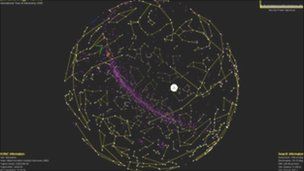
© BBCThe Einstein@Home screensaver shows the area of sky being processed
By putting their home computers to work when they would otherwise be idle, three "citizen scientists" have discovered a rare astronomical object.

The unusual find is called a "disrupted binary pulsar"; these pulsars can be created when a massive star collapses.

The discoverers, from the US and Germany found the object with the help of the Einstein@Home project.

It asks users to donate time on their computers, allowing them to be used for searching through scientific data.

This type of project is known as "distributed computing". Einstein@Home harnesses the power of home machines in order to process large amounts of data.

Credited with the discovery are Chris and Helen Colvin, both information technology professionals from Iowa, US, and systems analyst Daniel Gebhardt from Mainz in Germany.

Their computers, along with 500,000 others from around the world, are being used to analyse data for Einstein@Home.

Blackbox

Jupiter swallowed a super-Earth

Image
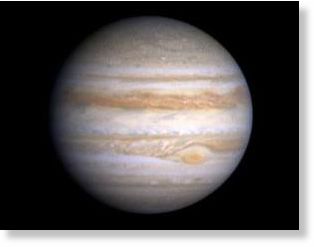
© University of Arizona/JLP/NASAThe solar system's mightiest planet
Jupiter might have secured its position as the solar system's mightiest planet by killing an up-and-coming rival, new simulations suggest. The work could explain why the planet has a relatively small heart, and paints a grisly picture of the early solar system, where massive, rocky "super-Earths" were snuffed out before they could grow into gas giants.

Jupiter and Saturn are thought to have begun life as rocky worlds with the mass of at least a few Earths. Their gravity then pulled in gas from their birth nebula, giving them dense atmospheres.

In this picture, all gas giants should have cores of roughly the same size. Yet spacecraft-based gravity measurements suggest Jupiter's core weighs just two to 10 Earth masses, while Saturn's comes in at 15 to 30.

New simulations by Shu Lin Li of Peking University in China, and colleagues, may explain why. They calculated what would happen when a super-Earth of 10 times the mass of our planet slammed into a gas giant. The rocky body flattened like a pancake when it hit the gas giant's atmosphere, then barrelled into the giant's core about half an hour later. The energy of the collision could have vaporised much of the core.

Better Earth

World's largest tidal turbine unveiled in Scotland

Image
© Jeff J Mitchell/Getty Images
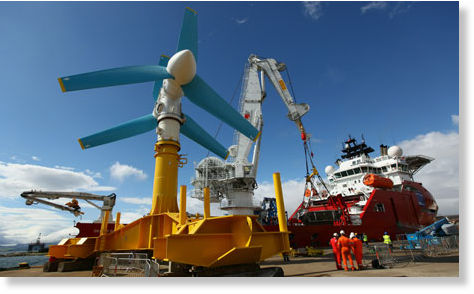
The world's largest tidal turbine was yesterday unveiled at a facility in Invergordon, Scotland, marking the culmination of a decade of development activity and moving tidal power one step closer to commercial viability.

The AK1000 was developed by Atlantis Resources Corporation, a developer of electricity-generating tidal current turbines, and is due to be installed on the sea bed and connected to the grid at a dedicated berth at the European Marine Energy Centre in Orkney later this summer.

The company said the turbine is capable of generating enough electricity for more than 1,000 homes and is designed for harsh weather and rough, open ocean environments such as those off the Scottish coast.