Science & TechnologyS


Magnify

Parental Incest May Be Cause of King Tut's Short Life

Image
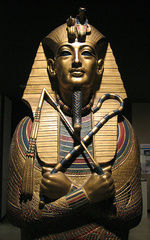
© Jon Parise/Creative CommonsA reproduction of a King Tut statue at the Rosicrucian Egyptian Museum in San Jose, Calif.
Using 21st century technology, including DNA and CT scanning, a team of scientists attempted to put to rest the mystery of King Tut's death -- concluding he was a victim of his incestuous lineage, according to an article in the September issue of National Geographic.

For years, scientists have tried to unravel ancient clues as to why the boy king of Egypt, who reigned for 10 years, died at the age of 19.

Several theories have been put forth. One was that he was killed by a blow to the head. Another put the blame on a broken leg. As recently as June, German scientists said they believe there is evidence he died of sickle cell disease.

A team of researchers using a combination of CT scans, DNA testing and archaeological information now believe his fate was sealed by the fact that his parents were brother and sister. His body was just not built to last.

Sherlock

Enormous Gallo-Roman Temple Complex Unearthed Near Le Mans, France

Image
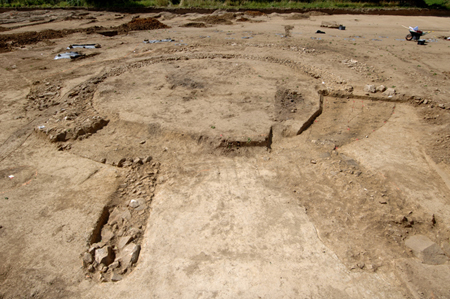
© Herve PaitierThe circular temple is younger than the main temple, and dated to the 2nd or 3rd century AD
Archaeologists have discovered a large Gallo-Roman religious complex located only a few kilometers from the ancient city of Le Mans. The ancient sanctuary is thought to have been an important pilgrimage area, visited by thousands to honor the gods.

The religious complex unearthed in Neuville-sur-Sarthe - about 5km north of Le Mans, France - is excavated by archaeologists from the French National Institute of Archaeological Research (INRAP) and dated to the 1st to 3rd century AD. Traces of the complex were first revealed on aerial photographs taken in 2003, when an long period of drought scorched much of the vegetation on the site, yet nobody anticipated its sheer size - the complex spans more than 4 acres.

The ancient sanctuary, clearly divided in three areas, contains several Gallo-Roman temples (fana) in various shapes - quadrangular, polygonal and circular - and sizes, linked by roads and galleries.

In the west, the main temple and five shrines are located. The temple (or fanum) is a 15m square structure characterized by a sanctuary, a central altar dedicated to the gods, surrounded by a gallery where the faithful would worship. The few architectural fragments discovered, suggest that it was a Corinthian style building with plaster wall paintings. The structures are surrounded by a 60m by 40m quadrangular brick wall enclosure (or temenos).

Telescope

Super-volcano erupts in outer galaxy, similar to Icelandic volcano on Earth

volcano seen erupting at M87 galaxy
© Manikandan Raman / NASA websiteNew huge volcano seen erupting at M87 galaxy

A galactic super-volcano is erupting in massive galaxy M87 and blasting gas outwards, and NASA scientists view that the huge volcano in M87 is very similar to the recent Icelandic volcano that caused heavy air traffic disruptions across Europe.

Sherlock

Malware implicated in fatal Spanair plane crash

Computer monitoring system was infected with Trojan horse, authorities say

Authorities investigating the 2008 crash of Spanair flight 5022 have discovered a central computer system used to monitor technical problems in the aircraft was infected with malware.

An internal report issued by the airline revealed the infected computer failed to detect three technical problems with the aircraft, which if detected, may have prevented the plane from taking off, according to reports in the Spanish newspaper, El Pais.

Flight 5022 crashed just after takeoff from Madrid-Barajas International Airport two years ago today, killing 154 and leaving only 18 survivors.

Info

Radiocarbon Dating

What about carbon dating? Doesn't that give accurate dates of "prehistoric" civilizations?

Carbon dating is the ultimate benchmark of the evolutionary dating world. Everyone assumes that dates that follow the word "radiocarbon" are accurate, precise and sure. But are they?

The basic principle of radiocarbon dating is that plants and animals absorb trace amounts of radioactive carbon-14 from carbon dioxide (CO2) in the atmosphere while they are alive but stop doing so when they die. The carbon-14 in a sample decays at a steady rate after it dies, and thus works like a clock. It is assumed that the amount of radioactive carbon left in the sample indicates how old it is.

But there is a major problem with this method. It is based on several assumptions, one of which is false. For this method to work, the rate of production of carbon-14 in the atmosphere has to remain constant through time. In truth, however, the amount of carbon-14 in the atmosphere varies with fluctuations in solar activity and Earth's magnetic field, changes in atmospheric conditions and even the exploding of atomic bombs!

As a result, radiocarbon dating isn't so accurate: "Provided they are adjusted, radiocarbon dates are now considered reliable as far back as 5000 B.C.," writes archeologist and professor Martha Joukowsky in A Complete Manual of Field Archeology. "Since the dendrochronological sequence extends back only as far as about 5500 B.C., no way exists at present to check radiocarbon dates from 5500 to 10,000 B.C."

When comparing radiocarbon dates with dates derived from tree rings, known as dendrochronological dating, the dates only agree accurately as far back as A.D. 640, and only generally well back to the time of Christ. Anything further back and the dates are as much as 800 years off. So scientists made calibration charts to make up for the variation. But they still have to verify their calibrations with samples of known dates. There is still a problem!

Info

The Magnetosphere Is Real

Magnetosphere
© Doug WheelockMagnetosphere
It's easy to forget that invisible things are actually real. Take air or subatomic particles: out of sight, out of mind, out of reality.

That's why this picture of the Earth's magnetic field interacting with the solar wind last week is so amazing. It makes the magnetosphere real. Far above the tops of the clouds, in seeming emptiness, a fierce collision is taking place, throwing off that eerie green light. And we can see it!

Astronaut Doug Wheelock was hanging out in the International Space Station watching this with his own two eyes, so he snapped a photo and tweeted it.

Sun

Coronal Hole Facing Towards Earth

A coronal hole on the sun is turning to face Earth. Coronal holes are places in the sun's atmosphere where the magnetic field opens up and allows solar wind to escape.

Here is a magnetic map of the hole from NASA's Solar Dynamics Observatory:

Image
© Karel Schrijver, Lockheed Martin SAL
In the image, magnetic field lines are color-coded. White field lines are closed; they hold the solar wind in. Golden field lines are open; they allow the solar wind out.

Satellite

China's Lunar Twins

Image
© UnknownLet's dissect the plans. Chang'e 2 is, strictly speaking, an orbiter, but the inclusion of a lunar impactor will certainly count as a lunar landing, albeit a hard one. The Chinese have previously stated that this mission was intended to provide support data for future landers, and the deorbit and descent phase, coupled with tracking the fall, will certainly help. We could then say that Chang'e 3 and 4 are true landers, each carrying a rover. Similarly, Chang'e 5 and 6 are probably both sample return missions.
Before the end of 2010, China will have launched its second lunar probe. Chang'e 2 is an orbiting spacecraft that was originally built as a back-up for China's first lunar probe, Chang'e 1, which flew to the moon in 2007. The launch is widely tipped for some time in October.

Sending the back-up spacecraft on its own mission makes sense. The spacecraft was already built, and the integrity of its design was confirmed by Chang'e 1's successful mission.

By changing a few instruments, the mission can perform tasks that weren't carried out by the first orbiter. China has added a high-resolution camera to Chang'e 2, and has also added a small surface impactor. The mission will also fly to the Moon with a faster trajectory.

The existence of the back-up Chang'e spacecraft was publically disclosed shortly before Chang'e 1 was launched, and the likelihood of its launch as a follow-up mission was also apparent. But this is not the end of China's plans for robot lunar exploration.

Telescope

Mud Volcanoes On Mars

Image
© NASA/JPL/University of ArizonaThe mounds shown here, located in the Southern Acidalia Planitia, range in size between 20 and 500 meters in diameter.
If life does - or did - exist on Mars, signs of such life might well be found in a region in the northern plains called Acidalia Planitia, according to a new study.

The region appears to be dotted with what scientists believe are geological structures known as mud volcanoes, spewing out muddy sediments from underground. These sediments might contain organic materials that could be biosignatures of possible past and present life.

"If there was life on Mars, it probably developed in a fluid-rich environment," said lead author Dorothy Oehler, a research scientist at the Astromaterials Research and Exploration Science Directorate at NASA's Johnson Space Center.

"Mud volcanoes themselves are an indicator of a fluid-rich subsurface, and they bring up material from relatively deep parts of the subsurface that we might not have a chance to see otherwise."

In a study published in the August issue of Icarus, Oehler and her co-author Carlton Allen mapped, for the first time, more than 18,000 of these circular mounds. Their estimate is that more than 40,000 mud volcanoes could be found in that region if the mapping continued.

Blackbox

Lunar Reconnaissance Orbiter Reveals More of the Incredible Shrinking Moon

Image
© NASA/Goddard/Arizona State University/SmithsonianThe mare basalts that fill the Taurus-Littrow valley were thrust up by contractional forces to form the Lee-Lincoln fault scarp, just west of the Apollo 17 landing site (arrow). It is the only extraterrestrial fault scarp to be explored by humans (astronauts Eugene Cernan and Harrison Schmitt). The digital terrain model derived from Lunar Reconnaissance Orbiter Camera (LROC) stereo images shows the fault extending upslope into North Massif were highlands material are also thrust up. The fault cuts upslope and abruptly changes orientation and cuts along slope, forming a narrow bench. LROC images show boulders shed from North Massif that have rolled downhill and collected on the bench.
Newly discovered cliffs in the lunar crust indicate the moon shrank globally in the geologically recent past and might still be shrinking today, according to a team analyzing new images from NASA's Lunar Reconnaissance Orbiter (LRO) spacecraft. The results provide important clues to the moon's recent geologic and tectonic evolution.

The moon formed in a chaotic environment of intense bombardment by asteroids and meteors. These collisions, along with the decay of radioactive elements, made the moon hot.

The moon cooled off as it aged, and scientists have long thought the moon shrank over time as it cooled, especially in its early history. The new research reveals relatively recent tectonic activity connected to the long-lived cooling and associated contraction of the lunar interior.

"We estimate these cliffs, called lobate scarps, formed less than a billion years ago, and they could be as young as a hundred million years," said Dr. Thomas Watters of the Center for Earth and Planetary Studies at the Smithsonian's National Air and Space Museum, Washington. While ancient in human terms, it is less than 25 percent of the moon's current age of more than four billion years.