Science & TechnologyS


Satellite

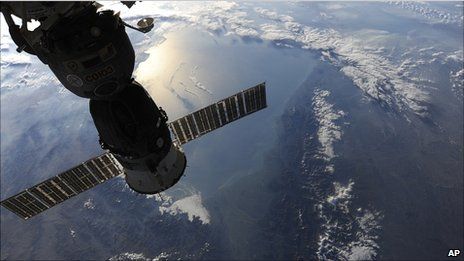
'Space hotel' plan unveiled in Russia

Image
© Associated PressHotel guests would view the Earth 'through large portholes', the company said
A Russian company has unveiled an ambitious plan to launch a "cosmic hotel" for wealthy space tourists.

Orbital Technologies says its "comfortable" four-room guest house could be in orbit by 2016, Russia's RIA Novosti news agency reports.

Guests would be ferried to the hotel on a Soyuz shuttle of the type used to transport cosmonauts to the International Space Station (ISS).

The Moscow-based firm did not reveal how the hotel would be built or funded.

Up until now space tourists, such as American businessman Dennis Tito, have squeezed into the cramped ISS, alongside astronauts and their experiments.

The new hotel would offer greater comforts, according to Sergei Kostenko, chief executive of Orbital Technologies.


Network

China Breaks Own Speed Record, Will Spend $1 Trillion on High Speed Rail

Image
© ReutersChina's Shanghai and Hangzhou rail line is the world's highest average speed rail line.
When it comes to high speed rail transportation, the U.S. is getting left behind. Europe and Japan have long championed high speed rail, and China is currently working to install 16,000 miles of high speed rail track -- or roughly 1/3 of the length of the U.S.'s total interstate highway system -- and spending $1T USD on the project. By comparison, U.S. President Barack Obama has committed a mere $13B USD in high speed rail investment. And where the U.S. deployment has struggled with landowner and property concerns, the more efficient Chinese system has simply relocated land owners (despite their protests) and started construction.

A few months back set a speed record (average speed, not top speed) of 236 mph (380 km/h) for its Shanghai to Beijing line. This week it bumped that speed up even higher recording a speed of 258.9 mph (416.6 km/h) for its new train line between Shanghai and Hangzhou.

Telescope

"Goldilocks" Planet Found, Could Possibly Support Human Life

Image
© nsf.govIdeal planet discovered 20 light-years away.
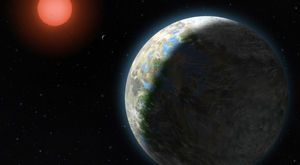
Astronomers have found an Earth-like planet that they believe can support life. The newly discovered exoplanet Gliese 581g, dubbed Planet G, exists in the Gliese 581 system and is believed to be the right size and location for life according to a press release and webcast from the National Science Foundation.

Part of a six-member family of planets, this particular exoplanet is situated in the middle of the system's habitable region. Scientists believe the temperatures at this position would be ideal for sustaining liquid water on the planet's surface.

"The planet has to be the right distance from the star so it's not too hot and not too cold that liquid water can exist," said Paul Butler, a staff scientist at the Carnegie Institution of Washington. "And then the planet has to have the right surface gravity."

Info

Mysterious Ribbon at Edge of Solar System is Changing

Image
© IBEX - NASAIncoming?
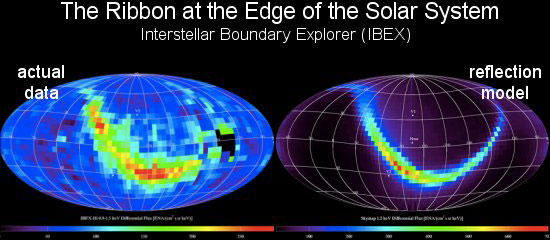
A year ago, researchers from the IBEX mission - NASA's Interstellar Boundary Explorer - announced the discovery of an unexpected bright band or ribbon of surprisingly high energy emissions at the boundary between our solar system and interstellar space. Now, after a year of observations, scientists have seen vast changes, including an unusual knot in the ribbon which appears to have 'untied.' Changes in the ribbon - a 'disturbance in the force,' so to speak, along with a shrunken heliosphere, may be allowing galactic cosmic rays to leak into our solar system.

"We didn't understand where the ribbon came from in the first place," said David McComas, IBEX principal investigator, during a press briefing. "It's even more confounding now, to know the structure can change on incredibly short timescales."

Researchers believe the ribbon forms from the interactions between interstellar space and the heliosphere, the protective bubble in which the Earth and other planets reside. The heliosphere is inflated by the solar wind, and acts as a protective shield from galactic cosmic rays that would otherwise bombard planets and perhaps prohibit life.

The interaction of the solar wind and interstellar medium creates energetic neutral atoms of hydrogen, called ENAs, that zip away from the heliosheath in all directions. Some of these atoms pass near Earth, where IBEX records their arrival direction and energy. As the spacecraft slowly spins, the detectors gradually build up pictures of the ENAs as they arrive from all over the sky.

Info

Want to Speak Babylonian? Well, Now the Secret is Out

Dr. Martin Worthington
© Cambridge News, UKDr. Martin Worthington
Forget about walking like an Egyptian - now you can learn to talk like a Babylonian.

Cambridge University researcher Martin Worthington has created an online audio archive of ancient Babylonian almost 2,000 years after its last native speakers disappeared.

The project is recording readings of Babylonian poems, myths, and other texts in the original tongue dating back to the first years of the second millennium BC.

Curious linguists can access the free audio library and stream 30 recordings in Babylonian, one of the chief languages of Mesopotamia, while reading English translations.

Dr Worthington, an expert in Babylonian and Assyrian grammar who is based at St John's College, Cambridge, put the collection together in his spare time with readings by fellow Assyriologists.

Blackbox

Scientists move objects across meter-scale distances using only light

Image
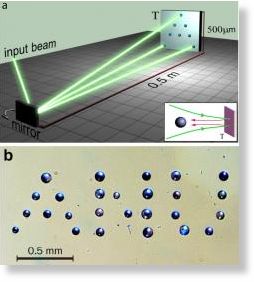
© Vladlen G. Shvedov, et al.,The American Physical Society(A) The set-up for transporting particles using optical vortex pipelines. (B) Microspheres form the abbreviation for the Australian National University, having been remotely deposited over a distance of 0.5 meters with a positioning accuracy of 10 micrometers. The microspheres' diameters vary from 60 to 100 micrometers.
For more than 40 years, scientists have been using the radiation pressure of light to move and manipulate small objects in space. But until now, the movements have always been restricted to very small scales, typically across distances of a few hundred micrometers, and mostly in liquids. In a new study, scientists have demonstrated a technique that achieves giant optical manipulation in air using a new kind of optical trap that can move 100-micrometer-sized objects across meter-scale distances with an accuracy of about 10 micrometers.

The researchers, Vladlen Shvedov from the Australian National University in Canberra, Australia, and Taurida National University in Simferopol, Ukraine, and coauthors, have published their study in a recent issue of Physical Review Letters.

As the scientists explain, moving objects with light can be done using the photophoresis effect in air and other gases. When a particle is heated nonuniformly by light, the surrounding gas molecules bounce off the particle's surface with different velocities, creating a force on the particle that pushes it in the direction from the higher illumination to the lower illumination.

Info

Ancient New Guinea Settlers Headed for The Hills

Ancient Settlers_1
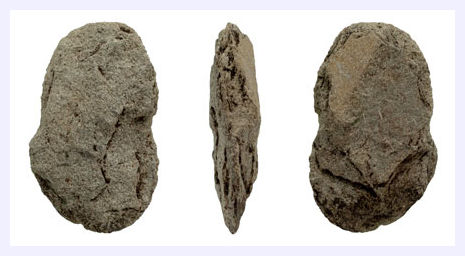
© G. SummerhayesPeople who reached New Guinea nearly 50,000 years ago fashioned stone tools dubbed waisted axes, such as this specimen shown from three angles, that were apparently used to fell trees and clear patches of forest in a mountain valley.
Excavations in Papua New Guinea's western highlands have turned up the oldest well-documented evidence of people in Sahul, a land mass that once joined the island to Australia.

Stone tools and plant remains indicate that, as early as 49,000 years ago, people lived 2,000 meters, or 1.2 miles, above sea level in Papua New Guinea's Ivane Valley, say archaeologist Glenn Summerhayes of the University of Otago in Dunedin, New Zealand, and his colleagues.

By at least 50,000 years ago, modern humans occupied lowland rainforests and savannas of southeastern Asia's land mass known as Sunda. From there they crossed the open ocean to Sahul, presumably in seacraft of some kind. Rising sea levels separated Papua New Guinea from Australia roughly 10,000 years ago.

Many researchers assume that modern humans spread from Africa to Sahul along the coast and preferred living at low altitudes. That idea gets drubbed by the new discoveries, Summerhayes says. Shortly after reaching Sahul's shores, settlers headed uphill to the Ivane Valley's thin air, cold temperatures and harsh habitat, the scientists conclude in the Oct. 1 Science.

Telescope

Among The Stars Of Cassiopeia, Comet Hartley 2 Approaches Earth

Image
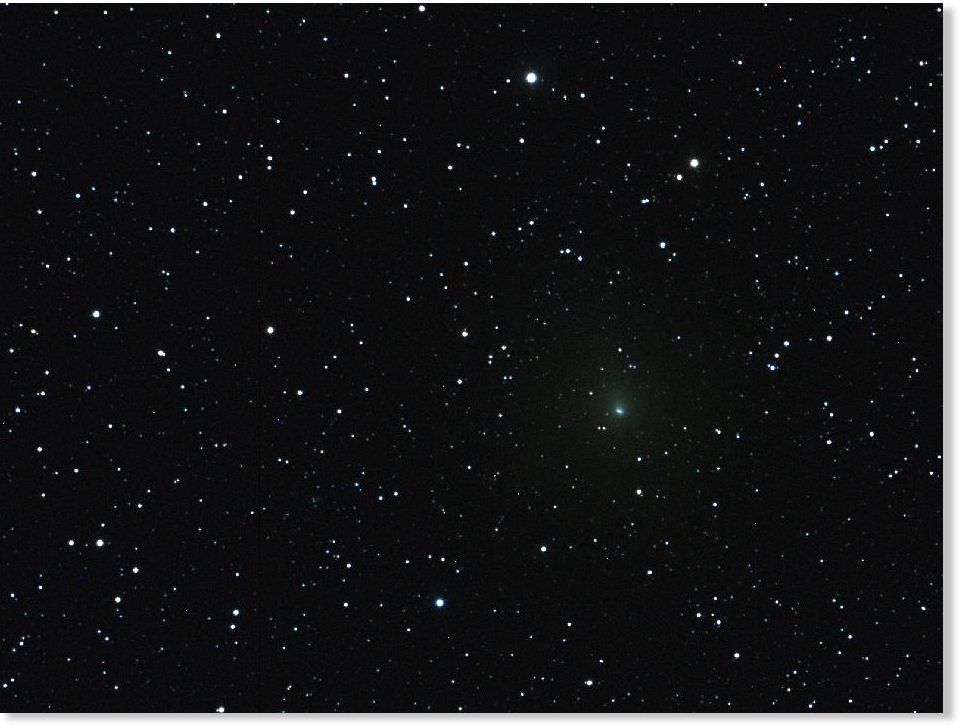
© NASA/MSFC/Bill Cooke, NASA's Meteoroid Environment OfficeA pale green interloper among the stars of Cassiopeia, Comet Hartley 2 shines in this four-minute exposure taken on the night of Sept. 28, 2010, by NASA astronomer Bill Cooke.
Still too faint to be seen with the unaided eye, the comet was 18 million miles away from Earth at the time. Cooke took this image using a telescope located near Mayhill, N.M., which he controlled via the Internet from his home computer in Huntsville, Ala.

Comet-watching from the comfort of your living room? Modern astronomy is truly amazing...

Comet 103P/Hartley 2, a small periodic comet, was discovered in 1986 by Malcolm Hartley, an Australian astronomer. It orbits the sun about every 6.5 years, and on Oct. 20, the comet will make its closest approach to Earth since its discovery.

Telescope

Flashback Best of the Web: Dot Earth: Apocalypse Then. Next One, When?

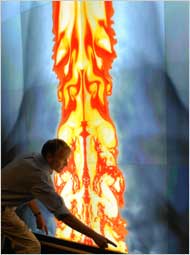
Monday marks the 100th anniversary of the moment when something roared through the empty skies over Siberia and exploded, blasting forests for hundreds of square miles. More such incoming space rocks are inevitable. Are we ready? No.

Sandia Labs
©Randy Montoya/Sandia
Sandia researcher Mark Boslough with an image from a simulated mid-air explosion of an asteroid.

Sherlock

Ancient Sanctuary Dedicated to Mithras Discovered in France

Image
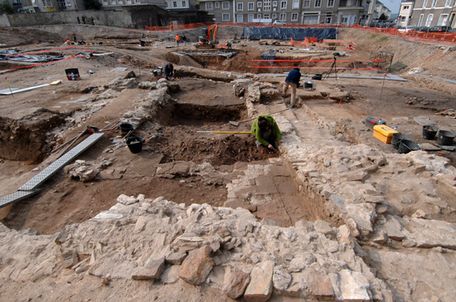
© Hervé Paitier/INRAPThe excavations at Angers have revealed a Roman urban area and Mithraeum.
Archaeologists excavating at Angers, France, have discovered the remains of a temple dedicated to the Indo-Iranian god Mithras. The small, rectangular chapel, in which worshippers gathered for banquets and sacrifices dedicated to the god, is dated to the third century AD.

At the sanctuary, a typical bas-relief of the god Mithras wearing his Phrygian cap shows him slaughtering a bull - the so-called tauroctony. The depiction of the god was intentionally damaged in ancient times, possibly by early Christians trying to suppress the pagan cult.

Among the artefacts discovered are oil lamps, fragments of a chandelier containing Nubian terracotta figures, a bronze 4th century crucifix fibula and about 200 coins. Large quantities of cockerel bones (a favoured dish at the cultic banquets) were found inside and around the ancient temple.

A ceramic beaker - offered by a certain Genialis, in the first half of the 3rd century - reads: "DEO [INVIC]TO MYTRH[AE].../...]VS GENIALIS CIVES MA [...]VS EXVOTO D[.../...]RIBVS OMNIS LOCO OMNIS (...)" or "To the unconquered god Mithras, Genialis, citizen of ?, offers in ex voto (this vase)".