Science & TechnologyS


Telescope

Crescent Planet

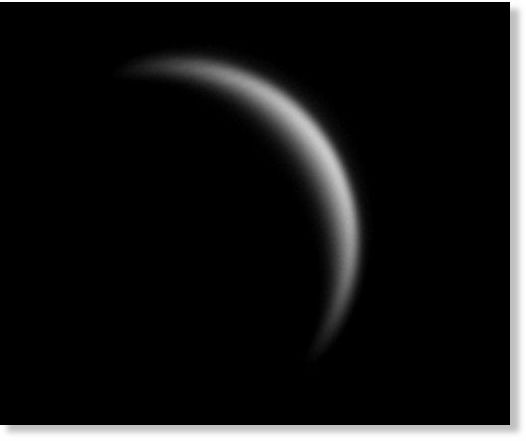
Venus is moving between Earth and the sun and, in the process, turning its night side toward us. From the terrestrial point of view, only a thin sliver of Venus remains illuminated. Dennis Put sends this picture of the crescent planet from Brielle, The Netherlands:

Image
© Dennis Put
"Even modest equipment will allow Venus to be viewed as a crescent disk," says Put. "This image was taken in infrared light using a 9-inch Celestron telescope and a DMK21 camera."

The trick is finding Venus. Because the planet is so close to the sun, it hangs very close to the western horizon after sunset. Any low trees or buildings will block the view. One possibility: look before sunset. Venus is actually bright enough to be seen in blue sky.

Sky & Telescope makes the following recommendation: "The time to view Venus is in daylight long before sunset - but don't accidentally sweep up the sun! In mid-afternoon, place your scope in the shadow of a building or other obstacle where you have a clear view of the sky 28° to 21° to the sun's left." Observing from inside a shadow means the sun will be safely hidden while you scan the suggested region of sky for Venus. Try it!

Satellite

SpaceShipTwo flies free for first time

Image
© Mark Greenberg / Virgin GalacticVirgin Galactic's SpaceShipTwo plane, also known as VSS Enterprise, glides earthward after its release from the White Knight Two mothership. The unpowered flight was piloted by Pete Siebold, an engineer and test pilot at Scaled Composites.
Virgin Galactic's SpaceShipTwo rocket plane was set loose for its first gliding flight today, about 45,000 feet above California's Mojave Desert — and landed to a chorus of cheers minutes later. That's one small step for gliders, but one giant leap for SpaceShipTwo and the future of suborbital space tourism.

The free-flying test was chronicled as it happened by Popular Mechanics' Joe Bargmann from the Mojave Air and Space Port, where the spaceship's builder, Scaled Composites, has its headquarters. Scaled has been working on the craft for years as a commercial follow-up to the history-making, prize-winning spaceflights of SpaceShipOne in 2004. The $100 million-plus development effort is being bankrolled by Virgin's billionaire founder, Richard Branson, who was among the crowd watching today's flight.

More than 300 would-be passengers have already put down more than $45 million in deposits for $200,000-a-seat rides on the plane. The experience will include a roller-coaster rocket ride to a space-worthy altitude of more than 65 miles, several minutes of weightlessness, a picture-window view of the curving Earth beneath the black sky of space ... and spaceflight bragging rights for years afterward.

Meteor

NASA Cameras Spot Meteors From Obscure Shower

Camelopardalis

Camelopardalids_1
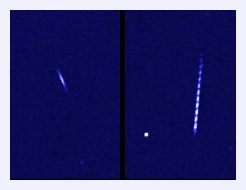
© NASA/MSFC/B. CookeCamelopardalids meteors from Oct. 5, 2010.

It's a strange-sounding name for a constellation, coming from the Greco-Roman word for giraffe, or "camel leopard". The October Camelopardalids are a collection of faint stars that have no mythology associated with them -- in fact, they didn't begin to appear on star charts until the 17th century.

Even experienced amateur astronomers are hard-pressed to find the constellation in the night sky. But in early October, it comes to prominence in the minds of meteor scientists as they wrestle with the mystery of this shower of meteors, which appears to radiate from the giraffe's innards.

The October Camelopardalids are not terribly spectacular, with only a handful of bright meteors seen on the night of Oct. 5. It may have been first noticed back in 1902, but definite confirmation had to wait until Oct. 2005, when meteor cameras videotaped 12 meteors belonging to the shower. Moving at a speed of 105,000 miles per hour, Camelopardalids ablate, or burn up, somewhere around 61 miles altitude, according to observations from the NASA allsky meteor cameras on the night of Oct. 5, 2010.

Saturn

Saturn's Glowing Southern Lights

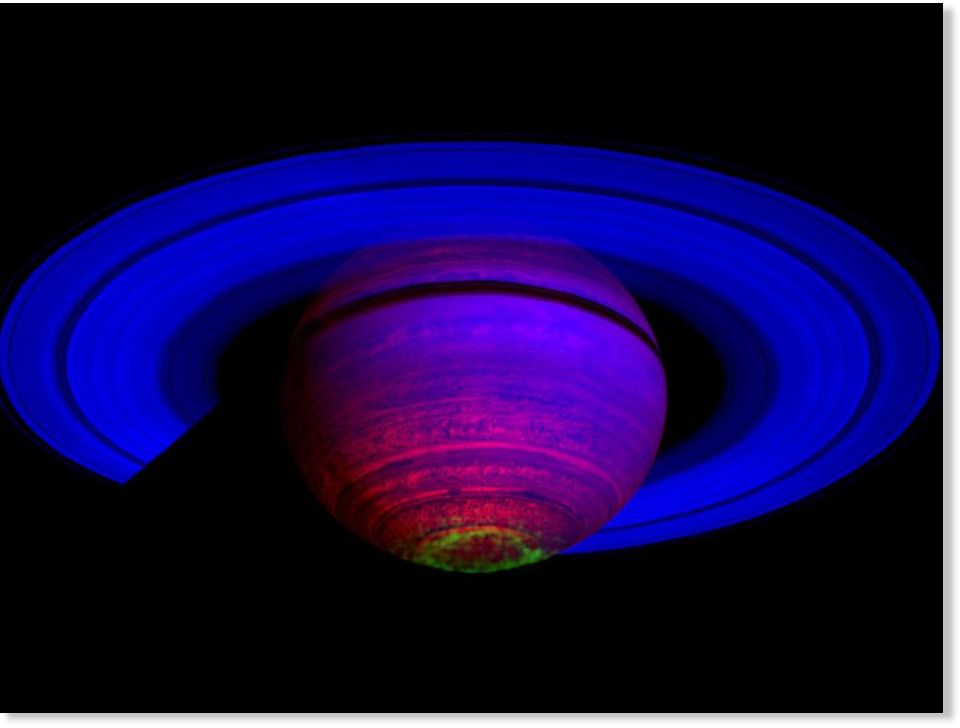
This false-color composite image, constructed from data obtained by NASA's Cassini spacecraft, shows the glow of auroras streaking out about 1,000 kilometers (600 miles) from the cloud tops of Saturn's south polar region. It is among the first images released from a study that identifies images showing auroral emissions out of the entire catalogue of images taken by Cassini's visual and infrared mapping spectrometer.

Image
© NASA/JPL/University of Arizona/University of Leicester
In this image constructed from data collected in the near-infrared wavelengths of light, the auroral emission is shown in green. Scientists designated blue to indicate sunlight reflected at wavelengths from 2 to 3 microns, green to indicate light from hydrogen ions at wavelengths between 3 and 4 microns and red to indicate thermal emission at 5 microns. Saturn's rings and high altitude haze only reflect sunlight at 3 microns or less, so they appear deep blue. The glow from the aurora can only be seen at the wavelengths in the green channel. The heat emission from the interior of Saturn is only seen at 5 microns wavelength in the spectrometer data, and thus appears red. The dark spots and banded features in the image are clouds and small storms that outline the deeper weather systems and circulation patterns of the planet. They are illuminated from underneath by Saturn's thermal emission, and thus appear in silhouette.

The composite image was made from 65 individual observations by Cassini's visual and infrared mapping spectrometer on Nov. 1, 2008. The observations were each six minutes long. The composite image was made from 65 individual observations by Cassini's visual and infrared mapping spectrometer on Nov. 1, 2008. The observations were each six minutes long.

Saturn

Cassini Catches Saturn Moons in Paintball Fight

Image
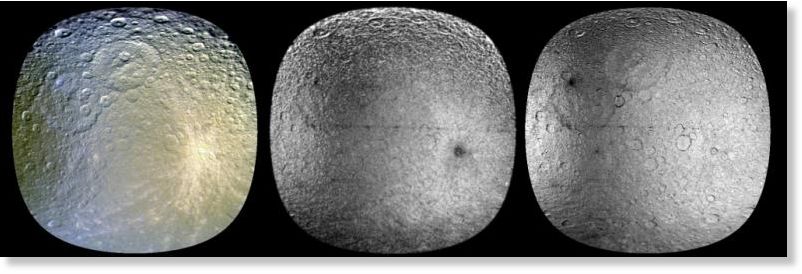
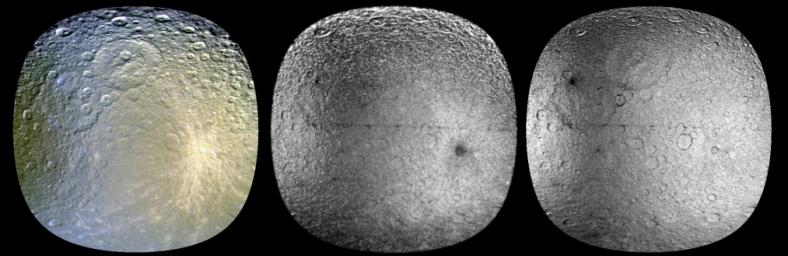
© NASA/JPL/SSI/LPIThese three views of Saturn’s moon Rhea were made from data obtained by NASA’s Cassini spacecraft, enhanced to show colorful splotches and bands on the icy moon’s surface.
Scientists using data from NASA's Cassini spacecraft have learned that distinctive, colorful bands and splotches embellish the surfaces of Saturn's inner, mid-size moons. The reddish and bluish hues on the icy surfaces of Mimas, Enceladus, Tethys, Dione and Rhea appear to be the aftermath of bombardments large and small.

A paper based on the findings was recently published online in the journal Icarus. In it, scientists describe prominent global patterns that trace the trade routes for material exchange between the moons themselves, an outer ring of Saturn known as the E ring and the planet's magnetic environment. The finding may explain the mysterious Pac-Man thermal pattern on Mimas, found earlier this year by Cassini scientists, said lead author Paul Schenk, who was funded by a Cassini data analysis program grant and is based at the Lunar and Planetary Institute in Houston.

"The beauty of it all is how the satellites behave as a family, recording similar processes and events on their surfaces, each in its own unique way," Schenk said. "I don't think anyone expected that electrons would leave such obvious fingerprints on planetary surfaces, but we see it on several moons, including Mimas, which was once thought to be rather bland."

Magnify

Bacteria Can Stand Up and "Walk"

Image
© UCLAArtist's representation of a bacterium "walking."
Many drug-resistant infections are the result of bacterial biofilms, structured aggregates of bacteria that live on surfaces and that are extremely resistant to environmental stresses. These biofilms impact human health in many ways -- cystic fibrosis, for example, is a disease in which patients die from airway bacterial biofilm infections that are invulnerable to even the most potent antibiotics.

Now, UCLA researchers and their colleagues have found that during the initial stages of biofilm formation, bacteria can actually stand upright and "walk" as part of their adaptation to a surface.

"Bacteria exist in two physiological states: the free-swimming, single-celled planktonic state and the surface-mounted biofilm state, a dense, structured, community of cells governed by their own sociology," said Gerard Wong, a professor of bioengineering at the UCLA Henry Samueli School of Engineering and Applied Science and at the California NanoSystems Institute at UCLA.

"Bacteria in biofilms are phenotypically different from free-swimming bacteria even though they are genomically identical. As part of their adaptation to a surface and to the existence of a community, different genes are turned up and down for bacteria in biofilms, leading to drastically different behavior," he said.

Sherlock

Jericho unveils massive ancient mosaic

Image
© AP
Visitors to ancient Jericho are getting a rare glimpse at what archaeologists say is the largest carpet mosaic in the Middle East.

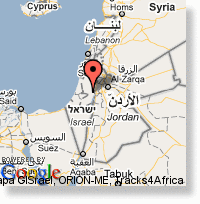
The mosaic measures nearly 9,700 square feet (900 square meters) and shows patterns and flowers in blue, ochre and red. It covers the floor of the ruins of the main bath house of an 8th-century Islamic palace outside Jericho.

Since being briefly excavated in the 1930s, the mosaic has largely remained covered by canvas and sand to protect it against sun and rain. Starting Sunday, a small section is being laid bare for a week, as part of the West Bank town's 10,000th birthday celebrations.

Question

Human History DNA Explained

A new theory explaining the reason why human life has turned out the way it has is causing shock and alarm around the globe.

A single mother from Canada, who gave up career and income to raise her kids while doing research at home, has come forward with evidence she says proves without a doubt that an ancient, isolated family group of the Intan racial type, more commonly known as Native American, has a genetic link to most modern humans, including those claiming "white" European ancestry.

Dispelling theories put forth by The National Geographic Society, among others, which claim we all share African primate ancestry, her research connects many of the current world leaders, celebrities, and prominent religious figures, as well as up to 90% of the world's human population, to genetic traits inherited directly from an Intan group who began colonizing islands and coastal areas approximately 50,000 years ago, moving into the Mediterranean region around 12,000 years ago.

Working alone for over a decade and wishing to remain anonymous due to threats she has received, the 37-year-old says she has found evidence that this "red-skin Indian" DNA has long been a well-guarded secret of the world's aristocracy, who nevertheless boast of their lineage using a method of code-writing called allegory.

Health

Ancient tattoos linked to healing ritual

Image
© Brian Gordon Green/GettyAncient origins
Mysterious circle tattoos on a Peruvian mummy have been identified as containing burned plant material. The finding sheds light on a possible ancient healing practice that may have been based on similar principles to acupuncture.

The 1000-year-old female mummy was found unwrapped in the sand of the desert at Chiribaya Alta in southern Peru in the early 1990s. She bears two distinct types of tattoos: emblems representing birds, apes, reptiles and other symbols cover her hands, arm and lower left leg, while an asymmetric pattern of overlapping circles is present on her neck.

Maria Anna Pabst of the Medical University of Graz in Austria and her colleagues used microscopy and spectroscopy to analyse the tattoos. Almost all known ancient tattoos were made with ash or soot. But the researchers found that while this was true for the tattoos on this mummy's extremities, the circles on her neck contained burned plant material.

Better Earth

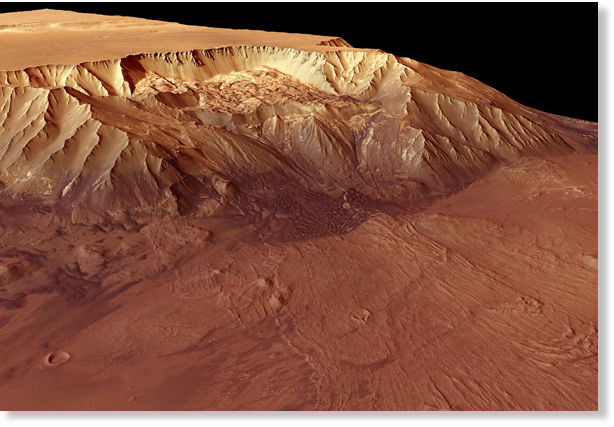
Evidence of water in megacanyon on Mars

Melas Chasma, a huge canyon forming part of the 4000 km Valles Marineris rift valley on Mars, plunges 9 km below the surrounding plains in this image, which was taken by the High Resolution Stereo Camera on the European Space Agency's Mars Express orbiter, making it one of the deepest depressions on the planet.

Image
© ESA/DLR/FU Berlin (G. Neukum)
Released today by the German Aerospace Centre, the image also shows evidence that water once flowed and lakes once stood on the Martian surface. White lines are channels cut by water and lighter-coloured regions indicate deposits of sulphate components. Rock formations display evidence of flow textures, indicating that they were once deposited by liquid water, water ice or mud.