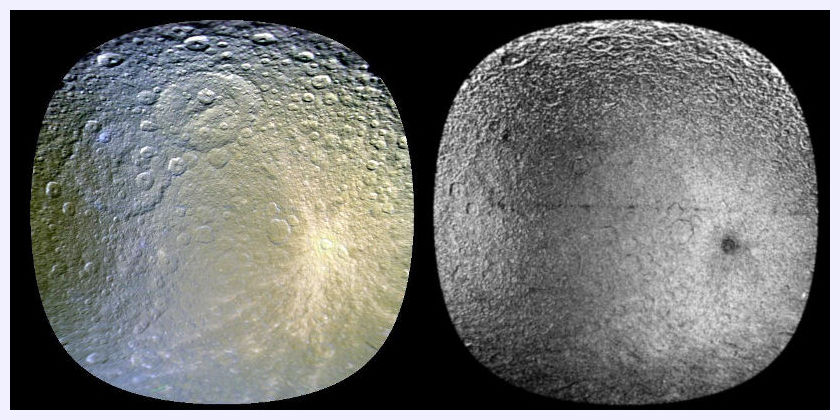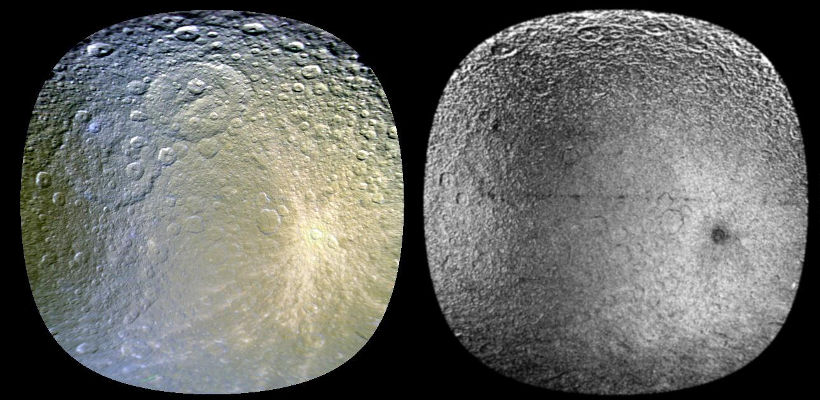
© NASA / JPL / SSI / LPICassini images of the Saturnine moon Rhea.
Experts from NASA announce that new data on Saturn's inner moons seem to indicate that the large amount of scars they have on their surfaces was produced by a cosmic bombardment.
These cosmic events mostly affected the gas giant's inner, mid-sized moons, including Mimas, Enceladus, Tethys, Dione and Rhea. All of them have icy surface, so the scars are clearly visible.
They all display reddish and bluish hues on their surfaces, and the investigators say that these features are due to cosmic impacts of varying intensities and sizes.
But a new scientific paper on the issue would seem to indicate that other factors might be at work too. The study appears in the latest online issue of the esteemed scientific journal
Icarus.The investigators behind it look at the intricate network of connections that formed between these moons, Saturn's magnetic field, and the gas giant's outer ring (the E Ring).
All of them exchange materials, or contribute to influencing the patterns in which material is distributed within this system. Analyzing this could shed more light on the massive planet.
A Cassini data analysis program grant was used to support this research, which was conducted by Lunar and Planetary Institute in Houston expert Paul Schenk. He is also the lead author of the paper.
"The beauty of it all is how the satellites behave as a family, recording similar processes and events on their surfaces, each in its own unique way," the expert argues.