
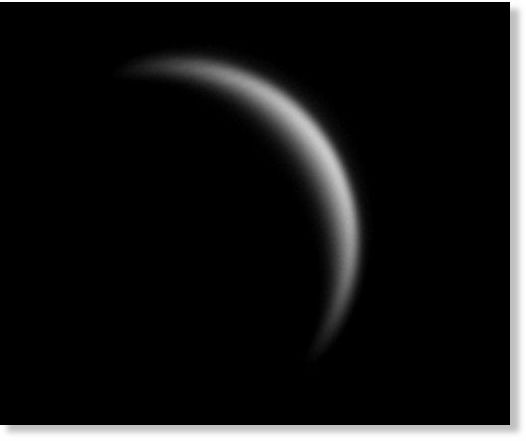
© Dennis Put
The trick is finding Venus. Because the planet is so close to the sun, it hangs very close to the western horizon after sunset. Any low trees or buildings will block the view. One possibility: look before sunset. Venus is actually bright enough to be seen in blue sky.
Sky & Telescope makes the following recommendation: "The time to view Venus is in daylight long before sunset - but don't accidentally sweep up the sun! In mid-afternoon, place your scope in the shadow of a building or other obstacle where you have a clear view of the sky 28° to 21° to the sun's left." Observing from inside a shadow means the sun will be safely hidden while you scan the suggested region of sky for Venus. Try it!
More images: from Mariusz Rudziński of Mirostowice Dolne, Poland; from Stephen Williams of Chabot Space and Science Center, Oakland, California



Reader Comments
to our Newsletter