© Physics WorldGigantic bubbles
Giant bubbles of gamma-ray-emitting materials surrounding the Milky Way are created by our galaxy's central black hole - and its appetite for stars - according to an international team of astronomers.
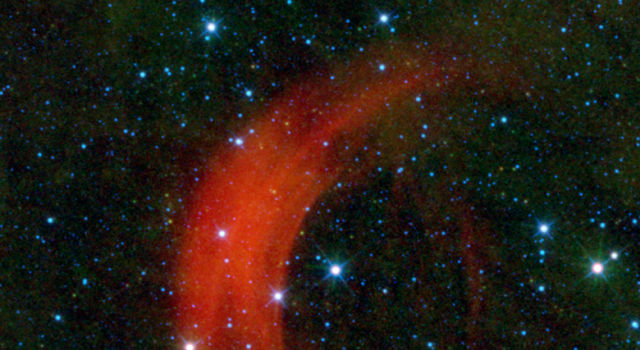
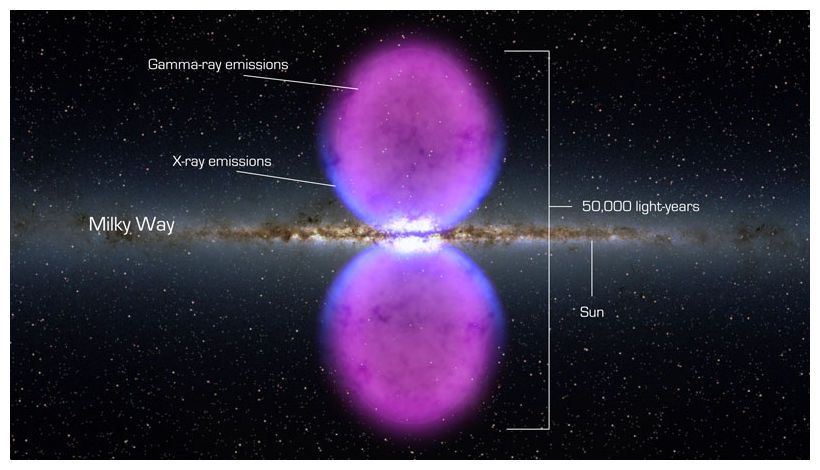
Back in November 2010 astronomers using the Fermi Gamma-ray Space Telescope released details of a colossal but previously unseen structure burgeoning out from the core of the Milky Way (see figure). Stretching some 25,000 light-years above and below our galaxy's main disc, the well-defined edge of these two gamma-ray-emitting "bubbles" hints at a sizeable and rapid release of energy as their creator.
Some astronomers have suggested that our galaxy's central super-massive black hole is powering the mysterious bubbles, but the exact process remains unclear. Now, a team of researchers led by K S Cheng at the University of Hong Kong has created a model that makes the connection.