© North Carolina State UniversityAlpha clusters in the Carbon-12 nucleus forming a "bent arm" shape.
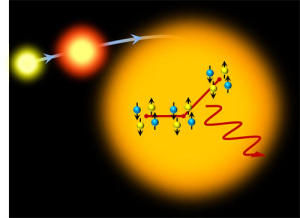
Carbon-12 can only exist when three alpha particles, or helium-4 nuclei, combine in a very specific way. This combination is known as the Hoyle state. NC State physicist Dean Lee and German colleagues Evgeny Epelbaum, Hermann Krebs and Ulf-G. Meissner had previously confirmed the existence of the Hoyle state using a numerical lattice that allowed the researchers to simulate how the protons and neutrons interact. When the researchers ran their simulations on the lattice, the Hoyle state appeared together with other observed states of carbon-12, proving the theory correct from first principles.
But they also wanted to find out how the nucleons (the protons and neutrons inside the nucleus of an atom) were arranged inside the nucleus of carbon-12. This would enable them to "see" the structure of the Hoyle state. Using the same lattice, the researchers, along with collaborator Timo Laehde, found that carbon-12's six protons and six neutrons formed three "alpha clusters" of four nucleons each. At low energy, the alpha clusters tended to clump together in a compact triangular formation. But for the Hoyle state, which is an excited energy state, the three alpha clusters combined in a "bent arm" formation.