Science & TechnologyS


Info

Origin of life needs a rethink, scientists argue

DNA
© NASAHistorically, scientists have defined living creatures by the presence of DNA, but how living creatures process information may be a better hallmark of life, a new study argues
Scientists trying to unravel the mystery of life's origins have been looking at it the wrong way, a new study argues.

Instead of trying to recreate the chemical building blocks that gave rise to life 3.7 billion years ago, scientists should use key differences in the way that living creatures store and process information, suggests new research detailed today (Dec. 11) in the Journal of the Royal Society Interface.

"In trying to explain how life came to exist, people have been fixated on a problem of chemistry, that bringing life into being is like baking a cake, that we have a set of ingredients and instructions to follow," said study co-author Paul Davies, a theoretical physicist and astrobiologist at Arizona State University. "That approach is failing to capture the essence of what life is about."

Living systems are uniquely characterized by two-way flows of information, both from the bottom up and the top down in terms of complexity, the scientists write in the article. For instance, bottom up would move from molecules to cells to whole creatures, while top down would flow the opposite way. The new perspective on life may reframe the way that scientists try to uncover the origin of life and hunt for strange new life forms on other planets.

"Right now, we're focusing on searching for life that's identical to us, with the same molecules," said Chris McKay, an astrobiologist at the NASA Ames Research Center who was not involved in the study.

"Their approach potentially lays down a framework that allows us to consider other classes of organic molecules that could be the basis of life."

Info

Homosexuality's cause isn't genetics, but the answer does lie in the womb

Homosexuality
© Medical Daily
As long as natural selection has been an accepted scientific theory, homosexuality has been a riddle for scientists. If a person is attracted to people of the same gender, he or she cannot have biological children with their chosen partner. For most of history, before in vitro fertilization, that meant that homosexuality could not be carried out genetically.

In addition, because homosexuality makes it more difficult to have biological children, researchers could not understand how it was possible that the trait would survive across genetics. However, scientists believe that they may have cracked the code, and the answer does lie slightly in genetics.

Genes are spelled out by DNA and are entirely hereditary from one family member to another. However, genes do not explain everything about who a person is. After all, recent research shows that the average person has 400 genetic errors that could lead to a disease - and yet, the overwhelming majority of human beings do not have debilitating illnesses. Epigenetics, or environment influences on the genes, are almost as important as the genes themselves.

Epi-marks are a form of epigenetics. They are sex-specific and dictate how the instructions coded in the genes are carried out. The sex-specific epi-marks are created during early fetal development to help protect the fetus from environmental influences during later development.

Laptop

Is it possible to find out if we are living in a computer simulation?

Matrix
© Olga Altunina / Shutterstock
In 1999, the first in a series of movies came out suggesting that we are all parts of a computer simulation. The Matrix was the ultimate horror story of artificial intelligence gone wrong. But could it be true? Could we be living in a computer simulation? And how would we ever know?

A British philosopher, Nick Bostrom, hypothesized that we might in fact be living in a computer simulation being run by our descendants in the future. Bostrom, a philosophy professor at the University of Oxford, published a paper in Philosophical Quarterly in 2003 arguing that one of three possibilities is true:

1) The human species is likely to go extinct
before reaching a "posthuman" stage.


2) Any posthuman civilization is very unlikely to run a significant number of simulations of its evolutionary history.

3) We are almost certainly living in a computer simulation.

Bostrom also said, "The belief that there is a significant chance that we will one day become posthumans who run ancestor simulations is false, unless we are currently living in a simulation."

Now, a team of physicists at the University of Washington has created a potential test to see if we are indeed living in a computer simulation. However, it will be decades before technology reaches the point where even primitive simulations of the universe are viable. The UW team has theorized tests, however, that can be performed now or in the near future that would be sensitive to constraints imposed by the limited resources and technological abilities of such primitive simulations.

Info

Evidence Noah's biblical flood happened

Flood
© ABC NewsThis ark, located an hour south of Amsterdam, is a replica of Noah's Biblical boat. Underwater archaeologist Robert Ballard is in Turkey, looking for evidence that the Great Flood happened.
The story of Noah's Ark and the Great Flood is one of the most famous from the Bible, and now an acclaimed underwater archaeologist thinks he has found proof that the biblical flood was actually based on real events.

In an interview with Christiane Amanpour for ABC News, Robert Ballard, one of the world's best-known underwater archaeologists, talked about his findings. His team is probing the depths of the Black Sea off the coast of Turkey in search of traces of an ancient civilization hidden underwater since the time of Noah.

Ballard's track record for finding the impossible is well known. In 1985, using a robotic submersible equipped with remote-controlled cameras, Ballard and his crew hunted down the world's most famous shipwreck, the Titanic.

Now Ballard is using even more advanced robotic technology to travel farther back in time. He is on a marine archeological mission that might support the story of Noah. He said some 12,000 years ago, much of the world was covered in ice.

"Where I live in Connecticut was ice a mile above my house, all the way back to the North Pole, about 15 million kilometers, that's a big ice cube," he said. "But then it started to melt. We're talking about the floods of our living history."

The water from the melting glaciers began to rush toward the world's oceans, Ballard said, causing floods all around the world.

"The questions is, was there a mother of all floods," Ballard said.

Fireball 2

Close approach of asteroid 2012 XE54

M.P.E.C. 2012-X37, issued on 2012 Dec. 9, reports the discovery of the asteroid 2012 XE54 (discovery magnitude 17.3) by Catalina Sky Survey (mpc code 703) on images taken on December 09.1 with a 0.68-m Schmidt + CCD.

2012 XE54 has an estimated size of 20 m - 44 m (based on the object's absolute magnitude H=25.6) and it will have a close approach with Earth at about 0.6 LD (Lunar Distances = ~384,000 kilometers) or 0.0015 AU (1 AU = ~150 million kilometers) at 1004 UT on Dec. 11 2012. This asteroid will reach the peak magnitude ~13.0 on December 11 around 0600 UT.

We performed some follow-up measurements of this object, from the H06 ITelescope network (near Mayhill, NM) on 2012, Dec. 11.3, through a 0.25-m f/3.4 reflector + CCD. Below you can see our image, single 60-second exposure, taken with the asteroid at magnitude ~13.2 and moving at ~630 "/min. The asteroid is trailed in the image due to its fast speed. At the moment of the close approach 2012 XE54 will move at ~ 720"/min. Click on the image below to see a bigger version. North is up, East is to the left.
Asteriod 2012 XE54
© Remanzacco Observatory
Here you can see a short animation showing the movement of 2012 XE54 (three consecutive 60-second exposures). North is up, East is to the left.

Fireball

Two asteroids will buzz past Earth on December 11

Asteroid Toutatis
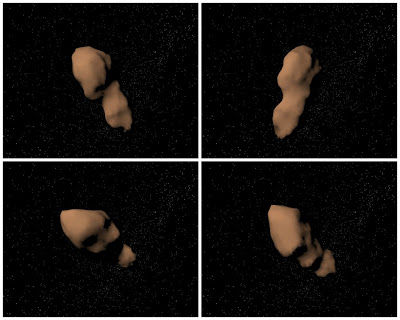
© NASAFour computer generated views of Asteroid Toutatis based on Goldstone radar imagery.
A newly discovered small asteroid named 2012 XE54 and a long-studied giant space rock named Toutatis will buzz past Earth during the next 24 hours, and astronomers are already watching the skies. While there is no danger of either hitting Earth, scientists have much to learn from both. Asteroid 2012 XE54 was discovered over the weekend on December 9 and it will safely pass between the Earth and the Moon's (see animation here) orbit at a distance of about 226,000 km (141,000 miles) or about .6 lunar distances. Closest approach will be just a few hours after this article was posted, at 10:10 UTC. But already an interesting event has aleady happened with this 28-meter-wide asteroid: it was eclipsed by Earth's shadow. This is quite a rare event, and was visible to astronomers.

Pasquale Tricarico of the Planetary Science Institute had predicted that the asteroid would pass through the Earth's shadow, creating an asteroid eclipse, an event that is similar to an eclipse of the full Moon by Earth's shadow. At 01:22 UTC on December 11 the eclipse began, and it left Earth's shadow at 02:00 UTC. Those watching the asteroid noted that the asteroid "disappeared" from its track, and then reappeared after leaving Earth's shadow.

"In two images taken at 01:30:16 and 01:31:18, 60sec exposure, 2012 XE54 appeared as a very faint and long track, then... nothing. In the following images there is no visible track. Wonderful!" wrote Elia Cozzi from the New Millennium Observatory, posting in the mpml asteroid research group message board.

We hope to have images of the event when they become available.

Galaxy

Solar system will not cross the galactic plane on 12/21/12

Image

The December 21, 2012 doomsday date is fast approaching and with it there has come an increase in worry among many people. The widely publicized end date of the ancient Mayan calendar may or may not bring about doom and destruction but one thing is for sure: it's bringing out a lot of fears.

As news that a new poll found at least 25 million Americans think the world will end on the 21 of December emerged, some are wondering just how the world will end.

There are theories that it will end with a comet colliding with earth or super solar flares and deadly CME's. Another theory is that the earth and the rest of the solar system will cross the galactic plane on or around December 21, 2012.

Comet 2

Flashback Uncomfortably close: 5.4km diameter asteroid '4179 Toutatis' to fly by Earth at just 0.046au on 12 December

Image
© NASA/JPLToutatis
Asteroid 4179 Toutatis makes closest approach at 0.046 au

= about 18.0 times distance to the moon (=ld)

This Asteroid will makes its next closest approach at 12-29-2016

It has a cycle of about 4 years and 18 days

A potentially hazardous object (PHO) is an asteroid (PHA) or comet (PHC) with an orbit such that it has the potential to make close approaches to the Earth and a size large enough to cause significant regional damage in the event of impact. These objects are monitored by NASA with contributions from others including amateurs. The reason they can become hazardous is that their trajectory can variate due to gravitional fields from Planets or Stars (ore other objects). Overall the chance of a potentially hazardous event due to these objects is about once in 10,000 years.

Comment:
Overall the chance of a potentially hazardous event due to these objects is about once in 10,000 years.
Actually, no. Professor of planetary science, John S. Lewis, found that it's more like once every 300 years:

Comet and Asteroid Impact Hazards on a Populated Earth: Computer Modeling by John S. Lewis


Sun

Hypergiant star amazes for 30 years

Image
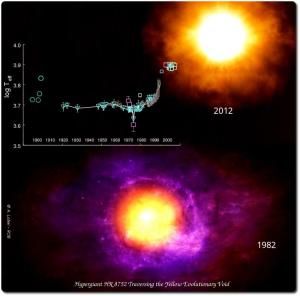
© Royal Observatory of BelgiumA team of scientists including Dr. Alex Lobel of the ROB, reported they have finalized a thirty years long investigation of a hypergiant star. In that period the surface temperature of this gigantic and extremely bright star quickly rose from five to eight thousand degrees. With this discovery a crucial 'missing link' in the evolution of hypergiant stars has been found.
A European research team has published the results of a 30-year study of an extraordinary hypergiant star. They have found that the surface temperature of the super-luminous star HR 8752 increased by about 3000 degrees in less than three decades, while it went through an extremely rare stage called the 'Yellow Evolutionary Void'. The discovery marks an important step closer to unravelling the evolution of the most massive stars.

A team of astronomers from six European countries, including the Royal Observatory of Belgium (ROB), has investigated the hypergiant star HR 8752 for 30 years while it traversed the 'Yellow Evolutionary Void'. The 'Void' is a short stage in the lives of the most massive stars when they become very unstable. The team finds that the surface temperature of HR 8752 rose surprisingly fast from 5000 to 8000 degrees in less than 30 years. The research results were very recently published in the journal Astronomy and Astrophysics. The discovery is an important step forward to resolve the enigma of the hypergiants, the most luminous and massive stars of the Galaxy.

Hypergiants can shine millions of times brighter than the Sun, and they often have a diameter several hundred times greater. HR 8752 is a quarter million times more luminous than the Sun. The powerhouse is therefore visible with normal binoculars at large distance from Earth in the Northern constellation of Cassiopeia. There are currently only 12 hypergiants known in our Galaxy.

Magnify

Structure of carbon's 'Hoyle State' revealed

Image
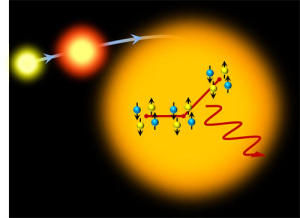
© North Carolina State UniversityAlpha clusters in the Carbon-12 nucleus forming a "bent arm" shape.
A North Carolina State University researcher has taken a "snapshot" of the way particles combine to form carbon-12, the element that makes all life on Earth possible. And the picture looks like a bent arm.

Carbon-12 can only exist when three alpha particles, or helium-4 nuclei, combine in a very specific way. This combination is known as the Hoyle state. NC State physicist Dean Lee and German colleagues Evgeny Epelbaum, Hermann Krebs and Ulf-G. Meissner had previously confirmed the existence of the Hoyle state using a numerical lattice that allowed the researchers to simulate how the protons and neutrons interact. When the researchers ran their simulations on the lattice, the Hoyle state appeared together with other observed states of carbon-12, proving the theory correct from first principles.

But they also wanted to find out how the nucleons (the protons and neutrons inside the nucleus of an atom) were arranged inside the nucleus of carbon-12. This would enable them to "see" the structure of the Hoyle state. Using the same lattice, the researchers, along with collaborator Timo Laehde, found that carbon-12's six protons and six neutrons formed three "alpha clusters" of four nucleons each. At low energy, the alpha clusters tended to clump together in a compact triangular formation. But for the Hoyle state, which is an excited energy state, the three alpha clusters combined in a "bent arm" formation.