Science & TechnologyS


Info

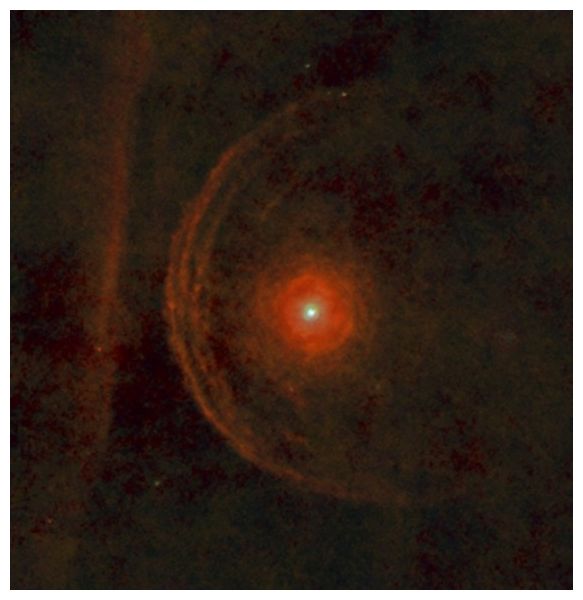
Detailed view of Betelgeuse, on a collision course with a nearby wall of dust

Betelgeuse
© Herschel/ESAA photograph of the red supergiant Betelgeuse interacting with a mysterious dusty wall.
Betelgeuse is one of my favorite objects to look at, partly because of its pure red color, and mostly because my imagination fills in the rest. That bright red star, the shoulder of Orion is a supergiant, with dozens of times the mass of the Sun, and ready to detonate as a supernova any day now (any day within the next few million years).

But look at Betelgeuse with a really powerful telescope, like the European Space Agency's Herschel telescope, and you'll see something like this: the red supergiant Betelgeuse in all its glory, smashing its ferocious solar winds into its environment.

In this photograph, just released from the European Space Agency, you can see the powerful solar winds creating a bow shock around the star as it ploughs through the interstellar medium at a speed of 30 km/s. Closer into the star there are asymmetric structures, where the star shed material in fits and starts into its surroundings, like convective bubbles randomly popping to the top of a pot of boiling water.

Comet 2

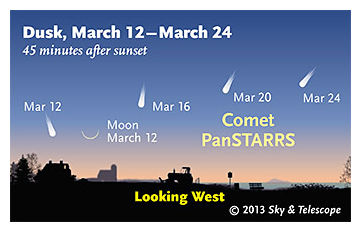
Comet PanSTARRS (C/2011 L4) punking out?

Comet PANSTARRS
© Sky&TelescopeBring binoculars to pick the comet out of the twilight low in the west. Don't expect it to look as obvious as this!
Long awaited, Comet PanSTARRS could still become a fine comet for Northern Hemisphere skywatchers. Or not.

As we report in S&T, Comet PanSTARRS (C/2011 L4) will emerge from the Sun's glare low in the western twilight in early and mid-March of 2013. But how bright will it be?

Probably fainter than we originally predicted.

Using recent brightness estimates now coming from Southern Hemisphere observers, Seiichi Yoshida, editor of Weekly Information about Bright Comets, has changed his magnitude formula for Comet PanSTARRS. His new predicted light curve has the comet peaking at only magnitude +3 in early March.

Other recent fits to the data have it reaching anywhere from 1.8 to 4.

Satellite

Company plans to mine asteroids with 'FireFlies' spacecraft

Image
A US company said Tuesday it plans to send a fleet of spacecraft into the solar system to mine asteroids for metals and other materials in the hopes of furthering exploration of the final frontier.

"Using resources harvested in space is the only way to afford permanent space development," said David Gump, chief executive of Deep Space Industries, noting that more than 900 new asteroids that pass near our planet are discovered each year.

"In this case, metals and fuel from asteroids can expand the in-space industries of this century. That is our strategy."

In a first step, the company plans to send "asteroid-prospecting spacecraft" into the solar system, with the first - 55-pound (25-kilogram) "FireFlies" - to be launched in 2015 on journeys of two to six months.

Telescope

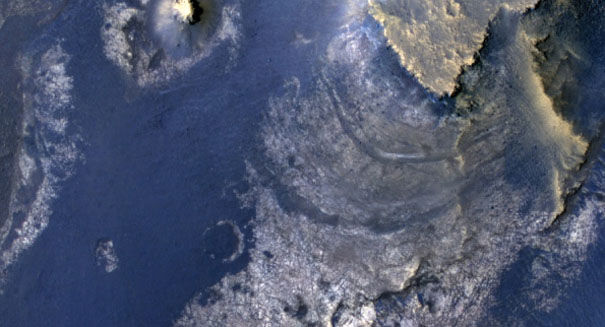
More evidence of water: NASA photo shows Mars crater was once an ancient lake

Mars lake
© NASA
It's been an exciting weekend of discoveries for NASA and its Mars Curiosity rover.

First, there was an update from NASA engineers operating the one-ton rover, who expressed excitement over a set of rocks discovered in a region dubbed "Yellowknife Bay." The rocks, which are thought to hold evidence that shows Mars was once a much wetter place, were discovered just days before a team of researchers announced findings showing that minerals found underground on Mars are the 'strongest evidence yet that water once flowed across the Red Planet. Meanwhile, on Friday, researchers working in conjunction with the NASA Mars Reconnaissance Orbiter (MRO) team announced they had identified an ancient river system - now considered one of the most important geological sites on Mars.

And that was just the weekend.

Question

Mysterious "hum" to finally be studied, will they find the source?

Mystery Hum
© WhoForted?
Back in July of 2011, we reported on an odd occurrence in Windsor, Ontario that was annoying the hell out of the city's residents: a low, droning hum, the source of which has remained unknown even to now. Well, it appears that after several years of fielding complaints, the Canadian government is finally ready to do something about the buzzing.

The University of Windsor and Western University have announced an ongoing study into the droning noise, funded by Ottawa, with an intent to discover it's source.

"Our government takes this issue seriously and is following up on our commitment to find a solution that works for the people of Windsor," parliamentary secretary for Foreign Affairs Bob Dechert said in a statement Monday.

"Our government will continue to work with the people of Windsor and others to hopefully pinpoint the source of the Windsor hum," said Dechert. "We want to protect citizens' quality of life. To get a solution, we first need to find the source. This study is a step in the right direction."

The "Hum" has been a source of frustration for years, particularly in Windsor's west end, where it's been known to buzz so loudly it rattles windows, even shaking things off of some people's walls.

Info

Save the vultures... and save thousands of people

Dead Vulture
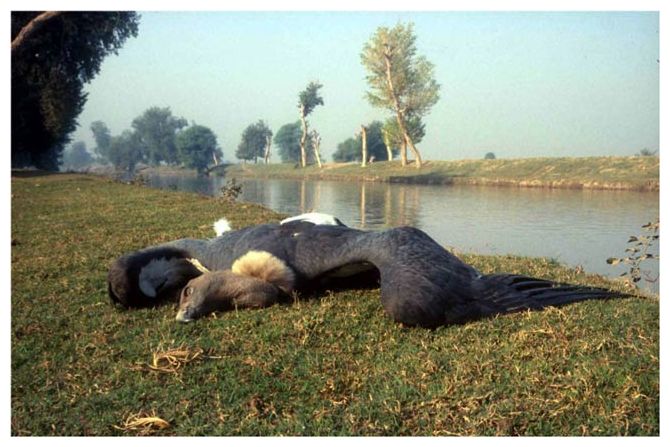
© Munir ViraniThe photo of a giant vulture in Pakistan that died after eating the drug-tainted carcass of livestock.
Vultures are more valuable than you may think, or at least they were.

In the 1980s, more than 40 million vultures existed throughout India, where they ate about 12 million tons (11 million metric tons) of rotting flesh each year, according to the environmental writer Tony Juniper. Today, however, vulture populations have been reduced to only a few tens of thousands, and three of the most important species are listed as critically endangered by the International Union for Conservation of Nature (IUCN).

They have declined largely because ranchers started giving their cattle an anti-inflammatory drug called diclofenac that is toxic to the birds, which eat dead cattle, Juniper writes. Without vultures to eat this festering morass, wild dogs have taken their place and populations have boomed. The dogs have, in turn, spread rabies by biting humans, killing an estimated 50,000 people in the last couple decades, according to Juniper.

"Deaths of course have much more than financial consequences, but they do have financial consequences, not least for the families of the dead" and the Indian economy, writes Julian Champkin at Signifance, the bimonthly magazine and website of the Royal Statistical Society. This cost is an eye-watering $34 billion, according to Juniper.

Telescope

Beautiful lunar eclipse of Jupiter

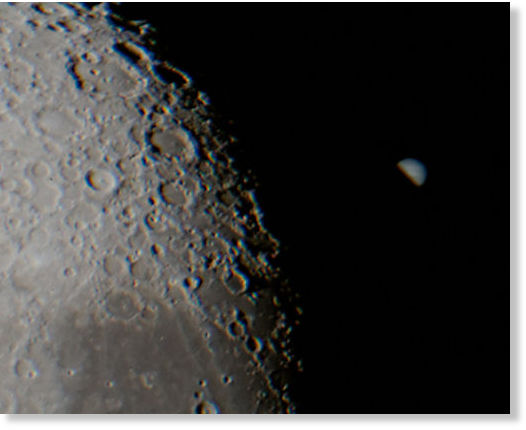
Last night, the Moon passed by Jupiter only a fraction of a degree away. In parts of South America, the close encounter was so close, it became an eclipse. Luis Argerich sends this photo from Buenos Aires, Argentina:
Image
© Luis Argerich
"I captured half a Jupiter floating next to the Moon with my telescope as the occultation was in progress," says Argerich. "It was incredible to see Jupiter disappear behind the Moon's dark limb."

Another occultation of Jupiter is less than a month away. The people of southern Australia will see it on Feb. 18th. Meanwhile, browse the photo gallery for more shots of last night's display.

Telescope

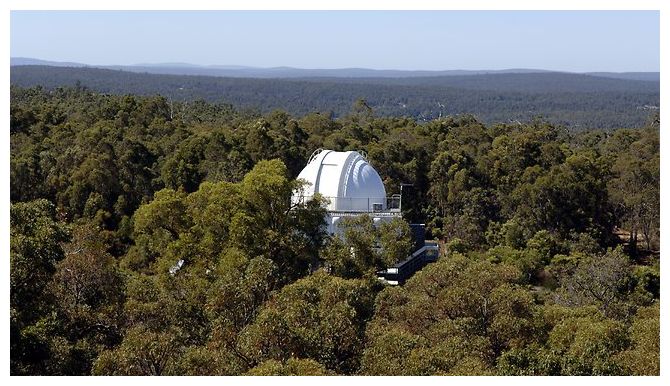
Research at Perth Observatory axed

Perth Observatory
© Allen Stewart/PerthNow Perth Observatory
Research programs at Perth Observatory have been axed as part of the WA government spending cuts, leaving the 116-year-old facility purely for public tours.

The revelation came on ABC local radio today, prompting astronomy boffins to flood talkback lines to vent their outrage.

Peter Birch, who was the observatory's senior astronomer for 35 years until 2005, told the station that the decision had "been in the wind" for several months.

"I think it's an absolute disgrace that the state government is going to cut out science at Perth Observatory altogether - it's not just being cut, it's being cancelled," he said.

"The reason that it's so important that Perth Observatory does science is that it's located in an isolated place in the southern hemisphere.

"The next observatory to the east is on the east coast of Australia and the next observatory to the west is in South Africa, so we fill a big hole as far as longitude and time goes in astronomy.

Red Flag

Harvard professor looks for 'adventurous woman' who agrees to give birth to cloned Neanderthal

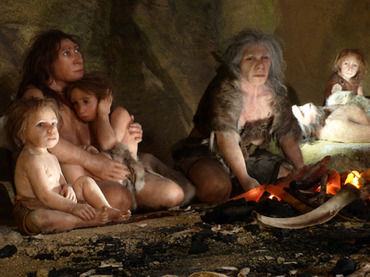
 neanderthal family
© Reuters / Nikola SolicAn exhibit shows the life of a neanderthal family in a cave in the new Neanderthal Museum
Prehistoric men may soon be walking the earth again. One of the world's leading geneticists is in search of a female volunteer to give birth to a Neanderthal - a species that went extinct more than 33,000 years ago.

Using DNA from Neanderthal bones, Harvard Medical School Professor George Church plans to resurrect the long-extinct relative of man by implanting a cloned embryo into the womb of a surrogate mother.

"We can clone all kinds of mammals, so it's very likely that we could clone a human," he told the German magazine, Der Spiegel. "Why shouldn't we be able to do so?"

Church, a 58-year-old pioneer in synthetic biology, helped create the Human Genome Project in the 1980s and has been involved in instituting numerous biotech firms. He is working toward making humans resistant to all viruses, as well as recreating the Neanderthal. Church believes he has the Neanderthal genome and the technology to bring a prehistoric man to the earth. All he needs is an "extremely adventurous female human" and laws that would make cloning legal to begin his experiment.

"It depends on a hell of a lot of things, but I think it can be done," he said.

Telescope

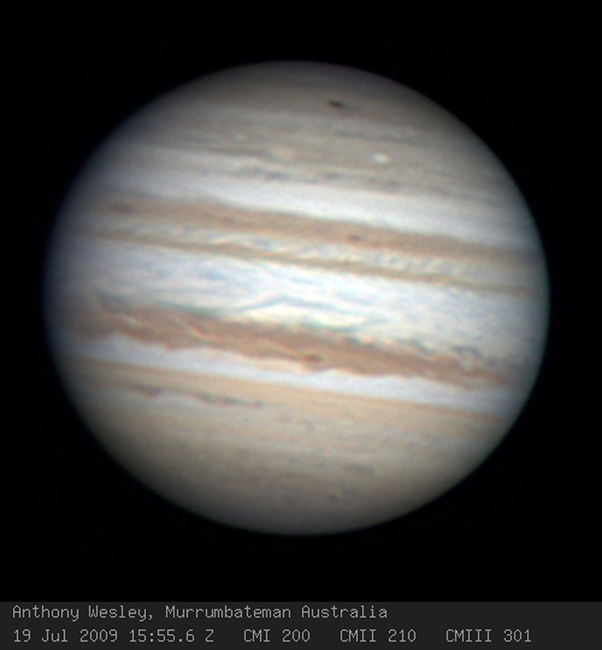
Jupiter and Moon in rare cosmic encounter on Monday night

Jupiter
© ReutersThe skywatchers over at the Slooh Space Camera website are providing unobstructed, free views of Jupiter’s brush with the moon during a 30-minute webcast beginning at 9 p.m. EST Monday.
Jupiter and the Earth's moon will engage in a rare cosmic close encounter Monday night, appearing just a finger-width apart for stargazers across North America, according to Space.com. And thanks to a free online live stream of the heavenly event, you won't need a professional telescope or perfect weather to catch this unique celestial spectacle.

The skywatchers over at the Slooh Space Camera website are providing unobstructed, free views of Jupiter's brush with the moon during a 30-minute webcast beginning at 9 p.m. EST Monday. Slooh president Patrick Paolucci, astronomer Bob Berman of Astronomy Magazine and astro-imager Matt Francis of the Prescott Observatory will present the live views of Jupiter and the moon.

According to Sky & Telescope magazine, Jupiter and the moon will appear at their closest at various times, depending on your viewing location. For Eastern North America the planets will appear closest at 11:30 p.m. EST; for further inland, it should occur at 10 p.m. CST; for observers in the Mountain Time Zone, peak viewing should hit at 8:30 p.n. MST; on the West Coast the best time to view the phenomenon should come at 7:00 p.m. PST.