
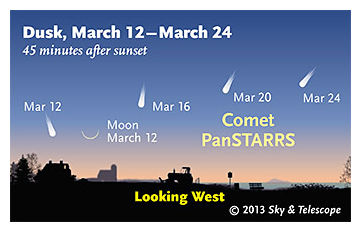
© Sky&TelescopeBring binoculars to pick the comet out of the twilight low in the west. Don't expect it to look as obvious as this!
As we report in S&T, Comet PanSTARRS (C/2011 L4) will emerge from the Sun's glare low in the western twilight in early and mid-March of 2013. But how bright will it be?
Probably fainter than we originally predicted.
Using recent brightness estimates now coming from Southern Hemisphere observers, Seiichi Yoshida, editor of Weekly Information about Bright Comets, has changed his magnitude formula for Comet PanSTARRS. His new predicted light curve has the comet peaking at only magnitude +3 in early March.
Other recent fits to the data have it reaching anywhere from 1.8 to 4.
As we warned in print, the slightly hyperbolic orbit of PanSTARRS indicates that it's a fresh comet from the outer Oort Cloud being warmed by the Sun for the first time. Such comets have quite a history of brightening early with the promise of great things to come, and then weakening after a thin, virgin coating of volatiles on the nucleus evaporates off.
As of now the comet is 8th magnitude with a short dust tail. It's visible from the Southern Hemisphere low in the sky, and will remain so until mid-February. Then it returns north.
Of course, anything could still happen. PanSTARRS seems to have reduced its rate of brightening when it was about 2.8 astronomical units from the Sun. At perihelion on March 10th its distance from the Sun will be only 0.30 a.u., where the solar heating will be nearly 100 times more intense. But plan on bringing those binoculars.
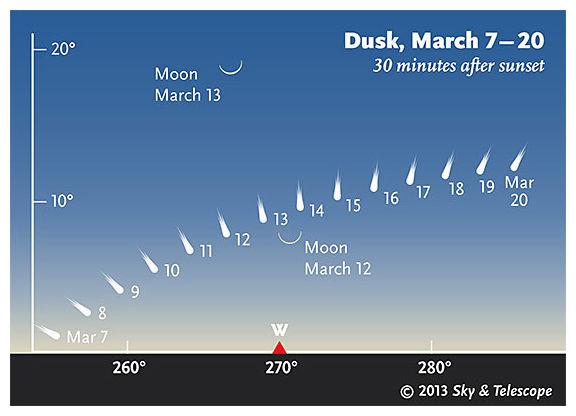
© Sky&TelescopeLook west after sunset in early and mid-March for Comet PanSTARRS. Binoculars may be needed to pick it out of the sunset glow. Look too early and the sky will be too bright; too late and the comet will be too low. On the altitude scale at left, 10° is about the width of your fist held at arm's length.
This diagram is drawn for a viewer near 40° north latitude. If you're south of there, the comet will be a little higher above your horizon early in the month than shown here. North of 40°, it will be even lower in early March than shown here, but higher than here as it fades after midmonth.
This diagram is drawn for a viewer near 40° north latitude. If you're south of there, the comet will be a little higher above your horizon early in the month than shown here. North of 40°, it will be even lower in early March than shown here, but higher than here as it fades after midmonth.



Reader Comments
to our Newsletter