Science & TechnologyS


Bulb

Scientists discover how epigenetic information could be inherited

Research reveals the mechanism of epigenetic reprogramming

New research reveals a potential way for how parents' experiences could be passed to their offspring's genes. The research was published today, 25 January, in the journal Science.

Epigenetics is a system that turns our genes on and off. The process works by chemical tags, known as epigenetic marks, attaching to DNA and telling a cell to either use or ignore a particular gene.

The most common epigenetic mark is a methyl group. When these groups fasten to DNA through a process called methylation they block the attachment of proteins which normally turn the genes on. As a result, the gene is turned off.

Scientists have witnessed epigenetic inheritance, the observation that offspring may inherit altered traits due to their parents' past experiences. For example, historical incidences of famine have resulted in health effects on the children and grandchildren of individuals who had restricted diets, possibly because of inheritance of altered epigenetic marks caused by a restricted diet.

However, it is thought that between each generation the epigenetic marks are erased in cells called primordial gene cells (PGC), the precursors to sperm and eggs. This 'reprogramming' allows all genes to be read afresh for each new person - leaving scientists to question how epigenetic inheritance could occur.

The new Cambridge study initially discovered how the DNA methylation marks are erased in PGCs, a question that has been under intense investigation over the past 10 years. The methylation marks are converted to hydroxymethylation which is then progressively diluted out as the cells divide. This process turns out to be remarkably efficient and seems to reset the genes for each new generation. Understanding the mechanism of epigenetic resetting could be exploited to deal with adult diseases linked with an accumulation of aberrant epigenetic marks, such as cancers, or in 'rejuvenating' aged cells.

Magic Wand

Giant squid scientist talks mysterious deep-ocean discovery

For the first time, scientists recently captured images of the mysterious giant squid in their natural habitat off the coast of Japan.

Edith Widder, oceanographer and marine biologist, who was involved in the expedition, said on "CBS This Morning" the breakthrough could be the beginning of many discoveries of the ocean's depths.

She said, "It's been said that we know more about the moon's behind than the ocean's bottom, and we've explored only 5 percent of our ocean's bottom. Look what's down there. ... We know so little. ... There could be cures for cancer. The Nobel Prize in 2008 was awarded for a chemical extracted from a bio-luminescent jellyfish and that's discovery has been equated to the invention of the microscope in terms of the impact it's had on science. So how do we even know? And we've spent billions on exploring outer space and only millions on exploring the deep ocean. ... I think that there will be new discoveries so long as we have the opportunity to go out with ships and submersibles."

Frog

Researchers: Pesticides causing dramatic die-off in frog population worldwide

Image
© AFP Photo
A plunge in the world's population of frogs and toads may be blamed, at least in part, on farm pesticides, researchers in Germany said on Thursday.

Tests of fungicides and insecticides, when used at recommended dilutions, killed 40 percent of frogs after seven days, and in one case, 100 percent of them after just one hour, they said.

The experiments, which entailed only a small number of animals, were carried out by a team led by Carsten Bruehl at the University of Coblenz-Landau in Germany.

They collected 150 juvenile European common frogs (Rana temporaria) to expose them to seven agricultural products, the goal being to reproduce in the lab conditions which were akin to those in the field.

The frogs were kept in large containers with soil where barley was grown. The chemical was sprayed once, delivering a volume that the researchers said was equal to the amount that would fall on a similar area of an arable field.

HAL9000

Technology killing middle-class jobs

Job seekers
© Associated Press/Paul SancyaJob seekers wait in a line at a job fair in Southfield, Mich. In the United States
Five years after the start of the Great Recession, the toll is terrifyingly clear: Millions of middle-class jobs have been lost in developed countries the world over.

And the situation is even worse than it appears.

Most of the jobs will never return, and millions more are likely to vanish as well, say experts who study the labor market. What's more, these jobs aren't just being lost to China and other developing countries, and they aren't just factory work. Increasingly, jobs are disappearing in the service sector, home to two-thirds of all workers.

They're being obliterated by technology.

Year after year, the software that runs computers and an array of other machines and devices becomes more sophisticated and powerful and capable of doing more efficiently tasks that humans have always done. For decades, science fiction warned of a future when we would be architects of our own obsolescence, replaced by our machines; an Associated Press analysis finds that the future has arrived.

R2-D2

Goodbye fast food jobs? First robot restaurant opens in China

robot restaurant
© Xinhua
Harbin is one of the most genuinely unique places in China. Though it's known for its annual ice festival, the city has many other marvels like a huge tiger park and a train that can travel faster than 300 km/h in temperatures as low as -40 degrees Celsius. These are all cool, but Harbin is apparently not a city to rest on its laurels.

The Robot Restaurant opened in Harbin in June and has taken the F&B industry in China further into the mechanized world. Robot Restaurant staffs a total of 20 robots as waiters, cooks and busboys. Turns out Noodle Bot might need to expand its repertoire if it hopes to compete with Robot Restaurant's 18 different kinds of service robots.


Comment: Coming to replace U.S jobs soon: Humanoid-stye robots will prepare hamburgers, eliminate fast food jobs


Top Secret

The pro-GM lobby's seven sins against science

Image
© communicatescience.eu
The role that genetically modified (GM) food should play in our food chain is a highly contested political issues. One interesting facet of the debate in the past year has been the pro-GM lobby's interest in staking the 'scientific high-ground'; simultaneously positioning itself as the voice of reason and progress, while painting its opponents as unsophisticated 'anti-science' luddites, whose arguments are full of dogma and emotion, but lack scientific rigor. In this essay Peter Melchett explores how such crude characterizations are themselves based on logic that is itself profoundly damaging to the concept and representation of 'science' in our national culture.

Powerful forces in Western society have been promoting genetic engineering (now usually genetic modification - GM) in agricultural crops since the mid-1990s. They have included many governments, in particular those of the USA and UK, powerful individual politicians like George Bush and Tony Blair, scientific bodies like the UK's Royal Society, research councils, successive UK Government chief scientists, many individual scientists, and companies selling GM products. They have ignored the views of citizens, and most sales of GM food have relied on secrecy - denying consumers information on what they are buying (20 US States are currently embroiled in fierce battles over GM labelling, strenuously opposed by Monsanto). Worse, they have consistently promoted GM in ways which are not only unscientific, but which have been positively damaging to the integrity of science.

This is, of course, an argument usually aimed at those who, like me, are opposed to GM crops. We are accused of being 'anti-science', emotional and irrational, and more recently, of being as bad as 'Nazi book burners' by the President of the National Farmers' Union. This criticism has been effective in framing the debate about GM crops in the media in the UK, where the conflict over GM is routinely presented as a debate between those who are pro and those who are anti-science. This is reinforced by the fact that those selected to speak in favour of GM are usually themselves scientists (albeit often working for GM companies, or funded to work on GM crops), and those selected to oppose GM crops are usually environmentalists, farmers, or citizens concerned about the safety of the food they eat. Scientists who are critical of GM crops are almost never interviewed by the media.

Wolf

Genetic analysis reveals how wolves evolved into dogs

Image
© Shutterstock
Genetic sequencing of wolves and domesticated dogs has revealed a key insight into how that evolutionary change happened, finding that it has to do more with human diets than previously expected.

To many dog owners, it probably won't come as a surprise that food motivation has been a key driver in their pet's makings, but scientists writing this week for the journal Nature explained that there's genetic evidence to back up what's long been mostly anecdotal knowledge of man's best friend.

Researchers took DNA samples from wolves and dogs and compared the differences, finding a segment of 10 genes among the differentiation that account for dogs' ability to digest starchy and fatty foods that humans love.

Sun

Australian heat wave could lead to mass die-offs of birds

Image
Budgerigars drop dead in the heat in Western Australia
Heat waves can be deadly for birds

As the heat wave in Australia continues, many birds may no longer be able to take the heat and large numbers could die as a result, researchers at the Universities of Cape Town and Pretoria warn.

"Heat waves in 2009 and 2010, which did not reach the intensity of the current record-breaking heat wave, led to large die-offs of birds in parts of Australia" says Prof. Andrew McKechnie. Over the last few days, people are beginning to report finding dead birds in their backyards on Twitter. Conditions are likely worsening as the heat wave wears on.

An international research team, led by researchers at the Percy FitzPatrick Instutute of African Ornithology at the University of Cape Town, are investigating how heat waves affect the physiology and behaviour of birds. They are on high alert for reports of impacts of the current Australian heat wave as such events will be valuable for predicting how climate change will affect birds.

Info

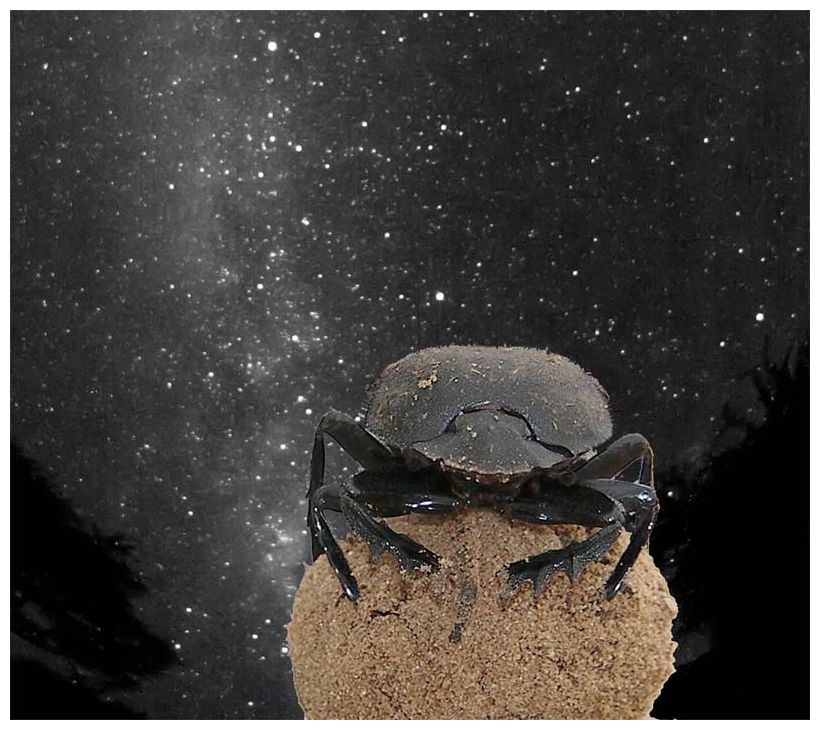
Wow! Dung beetles navigate by the stars

Dung Beetle_1
© Emily BairdDung beetles use the glow of the Milky Way galaxy to navigate.
Despite having tiny brains, dung beetles are surprisingly decent navigators, able to follow straight paths as they roll poo balls they've collected away from a dung source. But it seems the insects' abilities are more remarkable than previously believed. Like ancient seafarers, dung beetles can navigate using the starry sky and the glow from the Milky Way, new research shows.

"This is the first time where we see animals using the Milky Way for orientation," said lead researcher Marie Dacke, a biologist at Lund University in Sweden. "It's also the first time we see that insects can use the stars."

After locating a fresh pile of feces, dung beetles will often collect and roll away a large piece of spherical dung. Last year, Dacke and her colleagues discovered the beetles climb on their dung balls and dance around in circles before taking off. This dance is not one of joy, however; the insects are checking out the sky to get their bearings.

"The dorsal (upper) parts of the dung beetles' eyes are specialized to be able to analyze the direction of light polarization - the direction that light vibrates in," Dacke told LiveScience. So when a beetle looks up, it's taking in the sun, the moon and the pattern of ambient polarized light. These celestial cues help the beetle avoid accidentally circling back to the poo pile, where other beetles may try to steal its food, Dacke said.

Syringe

Scientists resume controversial mutant bird flu research

Image
© AFP Photo
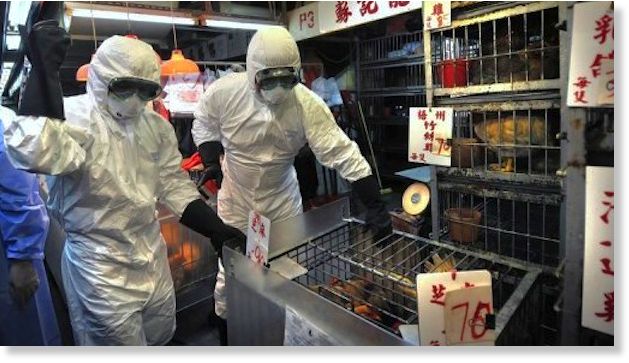
Scientists who created a mutant bird flu virus said Wednesday they will resume the controversial research after taking a 12-month break to allay fears of the bug escaping the lab or falling into terrorist hands.

Citing a "public health responsibility" to continue the work, the teams said research will resume in countries whose governments had given the go-ahead, but not in the United States, which is mulling safety guidelines, nor at US-sponsored research projects in other countries.

"We declare an end to the voluntary moratorium on avian-flu transmission studies," said an announcement published jointly in the US-based journal Science and its British counterpart Nature and signed by 40 scientists from research institutions in a dozen countries.

Teams in the United States and the Netherlands announced in December 2011 they had engineered a hybrid of the H5N1 bird flu virus that was transmissible by air among mammals - in this case ferrets, which are considered a good research model for humans.

Publication of their results was delayed by months and their work halted for a year amid concerns that terrorists may lay their hands on the data.