Science & TechnologyS


Fireball 4

Record setting asteroid flyby

Talk about a close shave. On Feb. 15th an asteroid about half the size of a football field will fly past Earth only 17,200 miles above our planet's surface. There's no danger of a collision, but the space rock, designated 2012 DA14, has NASA's attention.

"This is a record-setting close approach," says Don Yeomans of NASA's Near Earth Object Program at JPL. "Since regular sky surveys began in the 1990s, we've never seen an object this big get so close to Earth."


Earth's neighborhood is littered with asteroids of all shapes and sizes, ranging from fragments smaller than beach balls to mountainous rocks many kilometers wide. Many of these objects hail from the asteroid belt, while others may be corpses of long-dead, burnt out comets. NASA's Near-Earth Object Program helps find and keep track of them, especially the ones that come close to our planet.

2012 DA14 is a fairly typical near-Earth asteroid. It measures some 50 meters wide, neither very large nor very small, and is probably made of stone, as opposed to metal or ice. Yeomans estimates that an asteroid like 2012 DA14 flies past Earth, on average, every 40 years, yet actually strikes our planet only every 1200 years or so.

Binoculars

US shale revolution seen from space

Image
© AFP Photo / Mladen Antonov
Productions at US major shale formations flare off so much gas it can be clearly seen from space.

The lights of the flares burning in North Dakota's Bakken and Texas' Eagle Ford shale fields can clearly be seen in night-time satellite photography, Financial Times reported Monday.

Oil companies working there waste enough gas to power all the homes in Chicago and Washngton combined, the newsoutlet reports, what fuels growing concerns about damage to environment and waste of resources.

Galaxy

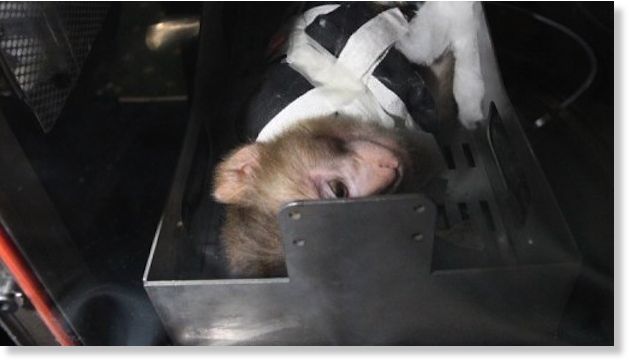
Iran claims it sent a live monkey into space

Image
© AFP Photo
Iran on Monday sent a capsule containing a live monkey into space and later retrieved the "shipment" intact, the Tehran-based Arab-language Al-Alam channel said, quoting an official statement.

A previous attempt in 2011 by the Islamic republic to put a monkey into space failed. No official explanation was given.

"Iran successfully launched a capsule, codenamed Pishgam (Pioneer), containing a monkey and recovered the shipment on the ground intact," said the statement by the defence ministry's aerospace department.

Sherlock

Cities affect weather thousands of kilometers away: study

Image
© AFP Photo
Heat from large cities alters local streams of high-altitude winds, potentially affecting weather in locations thousands of kilometres (miles) away, researchers said on Sunday.

The findings could explain a long-running puzzle in climate change - why some regions in the northern hemisphere are strangely experiencing warmer winters than computer models have forecast.

Cities generate vast amounts of waste heat, from cars, buildings and power stations, which burn oil, gas and coal for transport, heating or air conditioning.

This phenomenon, known as the "urban heat island," has been known for years, but until now has mainly been thought to affect only city dwellers, especially in summer heatwaves.

Comet

Comet Lemmon from the Southern Hemisphere

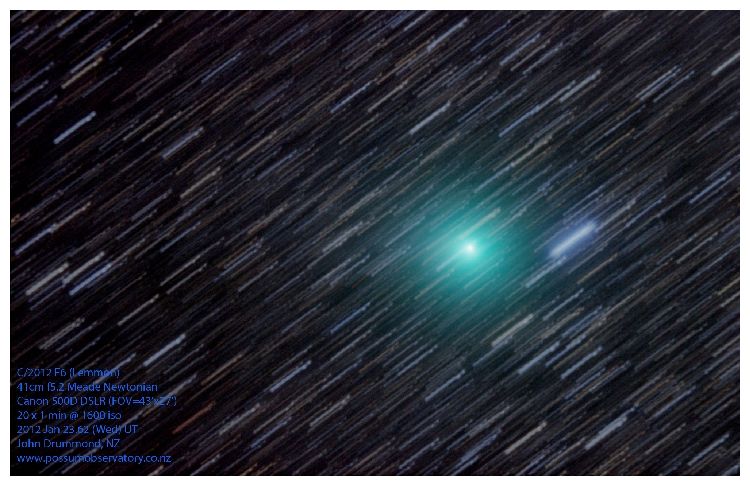
2013 could be the Year of the Comet. Comet Pan-STARRS is set to become a naked eye object in march, followed by possibly-Great Comet ISON in November. Now we must add to that list green Comet Lemmon (C/2012 F6). "Comet Lemmon is putting on a great show for us down in the southern hemisphere," reports John Drummond, who sends this picture from Gisborne, New Zealand
Comet Lemmon
© John Drummond
"I took the picture using a 41 cm (16 in) Meade reflector," says Drummond. "It is a stack of twenty 1 minute exposures." That much time was required for a good view of the comet's approximately 7th-magnitude coma ("coma"=cloud of gas surrounding the comet's nucleus).

Beaker

Neanderthal cloning media hysteria highlights scientific illiteracy

Image
© newsdaily.com
After spending the weekend reading blog posts claiming that he was seeking an "extremely adventurous female human" to bear a cloned Neanderthal baby - which was news to him - Harvard geneticist George Church said it may be time for society to give some thought to scientific literacy.

Church became the subject of dozens of posts and tabloid newspaper articles calling him a "mad scientist" after giving an interview to the German magazine Der Spiegel.

In the interview, Church discussed the technical challenges scientists would face if they tried to clone a Neanderthal, though neither he nor the Der Spiegel article, which was presented as a question and answer exchange, said he intended to do so.

"Harvard professor seeks mother for cloned cave baby," read one headline, on the website of London's Daily Mail.

But Church explained on Wednesday that he was simply theorizing.

Robot

Autonomous medical robot: FDA gives green light to RP-VITA hospital robot

RP Vita Robot
© Unknown
The FDA has approved RP-VITA from iRobot and InTouch Health. This is an autonomous medical robot which will be able to make its rounds of hospital corridors in the U.S. within the next few months. The RP-VITA robot, to cost hospitals between $4,000 and $6,000 a month to operate, has the distinction of being an autonomous moving, telepresence robot that can allow doctors remotely to interact with their hospital patients.

Autonomous movement is a key feature, as now doctors remotely can direct the robot to anywhere in a hospital. Analysts see this as an important step in the potential use of robots in real-world settings beyond the military. The robot is seen as helping busy hospitals leverage remote presence as part of their routine. The RP-Vita has built-in mapping, obstacle detection, avoidance technology. Translation: the RP-VITA avoids smashing into objects and people through its use of lasers, sonar, and sensors. The human-sized robot is a 5-foot-6-inch device, and its "face" is a screen.

Comet

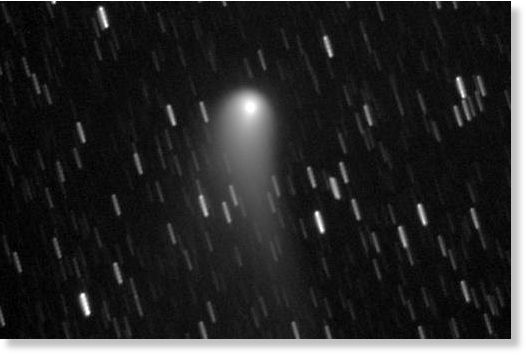
Comet PanSTARRS will emerge glowing about as brightly as a 3rd magnitude star after March 10

INCOMING COMET: In little more than a month, Comet PanSTARRS will cross the orbit of Mercury and probably brighten to naked-eye visibility as it absorbs the heat of the nearby sun. Sky watchers around the world will be looking for it in the sunset skies of early March, when it passes closest to the sun and to Earth. Until then a telescope is required; here is the view last night through a 0.3-meter-diameter reflector in Argentina:

Image

Solar Flares

Astronomers witness possible birth of a quasar

Quasar
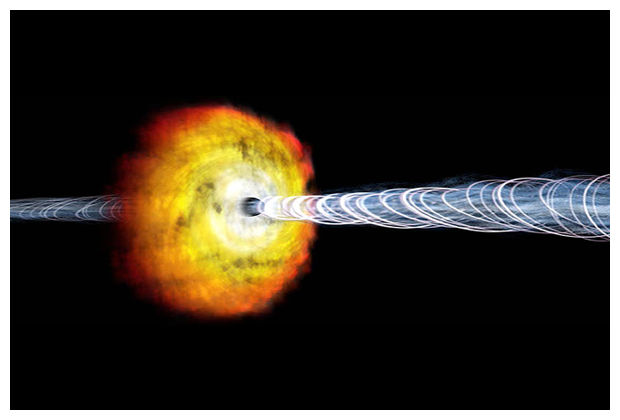
© NASAAn artist's impression of an active quasar.
Scientists in Australia believe they've identified a quasar in the process of lighting up, for the very first time.

This discovery could help scientists answer lingering questions about how these exceptionally bright celestial bodies form, and how they helped the ancient universe shape today's galaxies.

"I don't think we've really seen one of these objects in this stage," said Ray Norris, an astrophysicist at the Australia Telescope National Facility and leader of the research team. "We don't understand how they evolve or form."

Quasars are mostly found in far reaches of the ancient universe. Some formed only a few hundred million years after the Big Bang, making it difficult to observe their creation.

Though quasars shine, they're not stars. They're intensely bright spots near the edge of a supermassive black hole. While no light can escape from the black hole itself, its accretion disk -- the churning mass of dust and gas spiraling down into the black hole -- can shine brightly.

As dust and gas fall into the black hole, the mass speeds up, like water draining down a whirlpool. Simultaneously, matter smashes against other matter also falling into the black hole and heats up due to friction. Once the hot material is corkscrewing downward near the speed of light, it reaches millions of degrees and energized charged particles shoot off in enormous jets perpendicular to the spiraling disk.

Hearts

Dolphins form 'life raft' to help dying friend

Image
Scientists have observed a group of dolphins in the Sea of Japan using their bodies as a life raft to buoy up a dying friend. In this video from NewScientist.com, the pod of dolphins was seen to hold a struggling female up at the surface of the water in order to help her breathe.

In an article to be published in February's edition of the journal Marine Mammal Science, but which is currently available online, the group of scientists discussed what they called "An unusual case of care-giving" among the dolphins.

Biologist Kyum Park of the Cetacean Research Institute in Ulsan, South Korea, and fellow scientists were surveying cetaceans in the Sea of Japan in June 2008. They spent a day following a group of about 400 long-beaked common dolphins (Delphinus capensis).