Science & TechnologyS


Satellite

NASA denies the report that Voyager left solar system

voyager
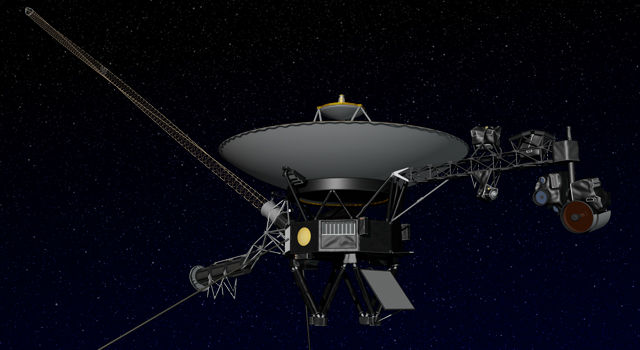
© NASA/JPL-CaltechArtist's concept of NASA's Voyager spacecraft
The US space agency on Wednesday denied a claim made in a scientific study that its Voyager 1 spacecraft had left the solar system, describing the report as "premature."

Scientists are eagerly awaiting signs that the craft, which was launched in 1977 on a mission to study planets, has become the first man-made object to leave the boundaries of our solar system. A scientific paper that purported to describe this departure appeared on the American Geophysical Union's web site.

It said Voyager 1 "appears to have traveled beyond the influence of the Sun and exited the heliosphere," or the magnetic bubble of charged particles that surround the solar system. Researcher Bill Webber, one of the article's authors, acknowledged that the actual location of the spacecraft - whether in interstellar space or just an unknown region beyond the solar system - remained a matter of debate.

"It's outside the normal heliosphere, I would say that," said Webber, professor emeritus of astronomy at New Mexico State University in Las Cruces, according to the AGU's web site. "We're in a new region. And everything we're measuring is different and exciting." Shortly after the study appeared, NASA spokesman Dwayne Brown told AFP the report was "premature and incorrect."

Info

Ancient giant trees found petrified in Thailand

Petrified Tree
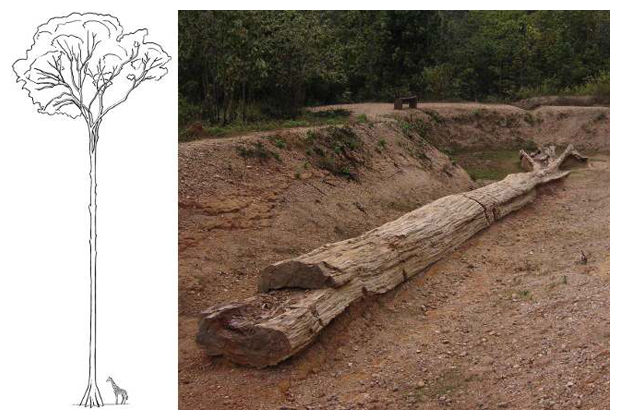
© Marc Philippe, Université de LyonThe largest unbroken petrified tree trunk in the world (right). The reconstructed tree with a modern giraffe beside it for scale.
Fossil trees that approached the heights of today's tallest redwoods have been found in northern Thailand. The longest petrified log measures 72.2 meters (237 feet), which suggest the original tree towered to more than 100 meters (330 feet) in a wet tropical forest some 800,000 years ago.

The trees appear to have been closely related to a species alive today called Koompassia elegans, which belongs to the same family as beans, peas and black locust trees, explained lead author of the study, Marc Philippe of France's University of Lyon. That is to say, the ancient trees are not closely related to today's tallest trees, which are the Eucalyptus (gum trees) of Australia and Sequoia (redwoods) of California. Both of those living trees can reach about 130 meters (425 feet) in height.

Interestingly, there are no trees living today in Thailand that approach the size of the ancients.

"Highest trees nowadays in Thailand are almost 60 meters (200 feet)," wrote Philippe in response to my email query about his new paper coming out in the April issue of the journal Quaternary Science Reviews. "To my knowledge the highest tree yet recorded in Thailand is a Krabak tree, belonging to the Dipterocarpaceae ('tropical oaks'), 58 meters (190 feet) tall."

Einstein

Complete Neanderthal genome published by German researchers

Image
A group of German researchers announced this week that they have completed sequencing of a Neanderthal genome. The scientists say that the high-quality sequencing will be made available online for other researchers and scientists to study. The researchers were able to produce the genome using a toe bone found in a Siberian cave.

This published genome is said to be far more detailed than a previous "draft" Neanderthal genome was sequenced three years ago by the same team. The group of researchers operate from the Max Planck Institute for Evolutionary Anthropology in Leipzig, Germany. The researchers say that the new genome allows individual inherited traits from the Neanderthal's mother and father to be distinguished.

Info

Sound waves focused into laserlike beam

Sound Waves
© Imran Mahboob/NTT Basic Research Laboratories
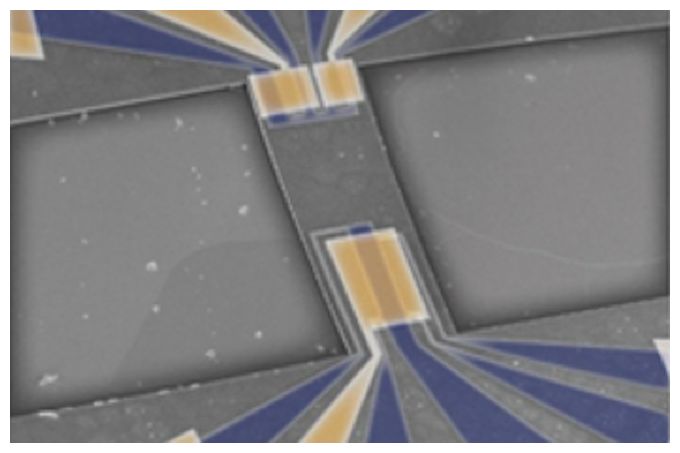
We've all seen laser beams - narrow and powerful beams of light used in everything from CD players to weapons. Now researchers have found a way to make sound waves that, like light waves in a laser, travel in step. They call it a phaser and it could open up applications as wide-ranging as precision timer circuits and better ultrasound scans.

The researchers from NTT Basic Laboratories in Japan call their device a phaser because it uses phonons, waves of sound that require a medium, such as a gas, liquid or solid, to travel.

To create the beam, they started with a tiny drum just a few nanometers across, and put it inside a cavity, which acted like a resonator. They vibrated the drum, which transmitted energy to the cavity, and created the phonons. The cavity confined the sound waves. At a certain frequency, called the resonant frequency, the material of the cavity relaxed in a very specific way, creating vibrations that transferred energy back into the drum. Those vibrations are at a specific frequency and if one connected the resonator to a solid material those vibrations would travel away in a narrow beam. That traveling wave is the "laser" sound beam. Since the sound waves are all in step with each other, they would go in straight lines and wouldn't spread out.

Eye 1

Orwellian Google augmented reality glasses 'will make us their agents'

Google glasses
© AP
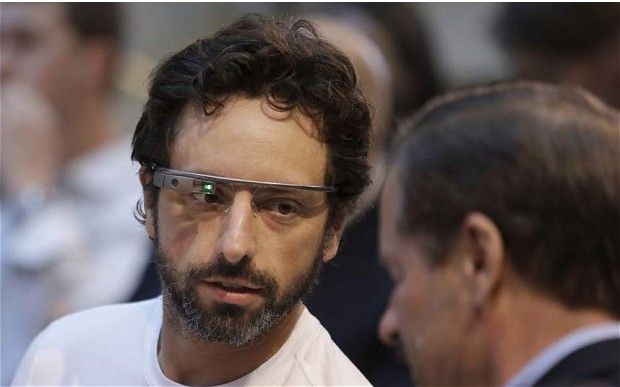
Sergey Brin showing off Google Glass augmented reality spectacles

Google glasses will make us all agents for Google. Nick Pickles, Director of Big Brother Watch, says the implications for privacy are profoundly worrying.


In the online world - for now, at least - it's the advertisers that make the world go round. If you're Google, they represent more than 90% of your revenue and without them you would cease to exist.

So how do you reconcile the fact that there is a finite amount of data to be gathered online with the need to expand your data collection to keep ahead of your competitors?

There are two main routes. Firstly, try as hard as is legally possible to monopolise the data streams you already have, and hope regulators fine you less than the profit it generated. Secondly, you need to get up from behind the computer and hit the streets.

Google Glass is the first major salvo in an arms race that is going to see increasingly intrusive efforts made to join up our real lives with the digital businesses we have become accustomed to handing over huge amounts of personal data to.

The principles that underpin everyday consumer interactions - choice, informed consent, control - are at risk in a way that cannot be healthy. Our ability to walk away from a service depends on having a choice in the first place and knowing what data is collected and how it is used before we sign up.

Question

Pluto could have ten moons?

Pluto's Moons
© S. Keyon, NASA
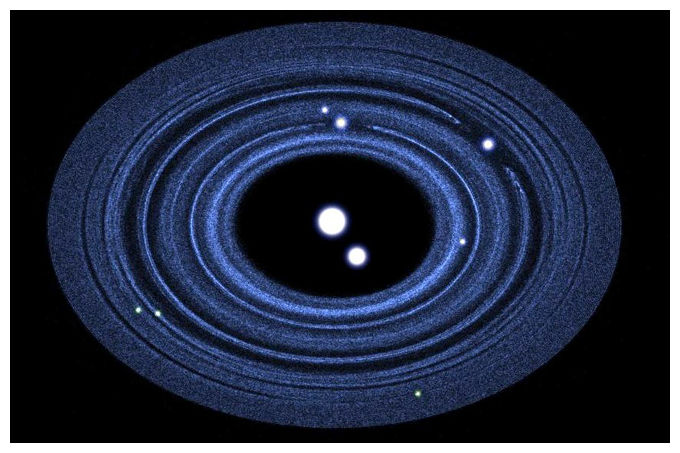
A recent simulation predicts that NASA's New Horizons probe could slam into a rocky killing field encircling the "binary planet" Pluto-Charon, during its 2015 flyby.

That's according to a new theoretical dynamical simulation that predicts there could be as many as 10 moons circling the distant world - plus one or more ring systems.

The Hubble Space Telescope has discovered four small moons to date circling Pluto-Charon, but the other predicted moons many be so small and dim that they are undetectable even with Hubble's super-deep vision. The moons would lie beyond the orbit of the outermost known moon in the system, according to the simulation.

The discovered moons are Nix, Hydra, and two others have been publicly voted to be named Cerberus and Vulcan, though official naming body, the International Astronomical Union (IAU), has yet to sanction the names.

This latest theoretical simulation by Scott Keyon of Center for Astrophysics at Harvard and Benjamin Bromley of the University of Utah could influence how NASA mission planners choose from several flyby options - ranging from "conservative" to "more risky but closer in to the icy dwarf."

The dilemma is that if New Horzons is shotgun-blasted by dust traveling at a relative speed of 35,000 mph, it will be destroyed before only a fraction of the flyby data as been downloaded to Earth.

Blue Planet

Study: Birds evolve shorter wings to survive highway traffic

Image
© Shutterstock
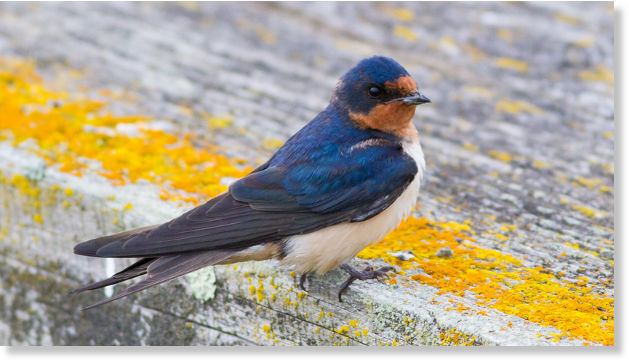
Cliff swallows that nest in highway overpasses have evolved shorter wingspans over the last 30 years to help them survive close encounters with highway traffic, according to a new study in scientific journal Current Biology.

The conclusion was reached by Charles Brown, a University of Tulsa researcher who's spent the last three decades picking dead birds off roadways, New Scientist noted.

Sherlock

Researchers find microbial life at the bottom of the Mariana Trench

Image
© Wikimedia creative commons/ Dcfleck
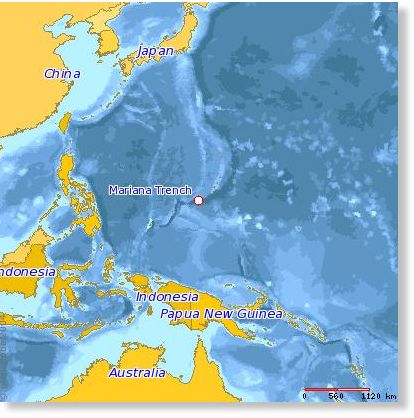
Researchers have found microbes in the deepest oceanic trench on Earth - the Mariana Trench, which is located at nearly 7 miles or 11 kilometers below sea level in the western Pacific.

The study of life in this inaccessible site revealed a community of bacteria that live in extreme pressures, which is 1,000 times higher than the pressure at the sea surface.

The expedition to Mariana Trench took place in the year 2010. Researchers have also sent a robot to bring data from the Japan Trench and the Kermadec-Tonga Trench near Fiji in the Pacific.

Einstein

'Smart bra' detects breast cancer years earlier than mammograms

Image
A new "smart bra" currently undergoing clinical trials can detect cell mutations in the breasts up to six years earlier than traditional mammograms, according to the company that made the device.

The so-called "First Warning System" likely saved the life of Nedra Lindsay, a nurse who discovered she had breast cancer nearly 20 years ago, at the age of 24, after she tried out an early prototype of the device before it was in bra-form. Lindsay was featured Monday in a report by CBS Boston, saying the sensors that are now in the bra showed "proof positive that I had cancer."

Gold Bar

Scientists discover earthquakes can create new 'economic-grade gold deposits'

Image
© Shutterstock
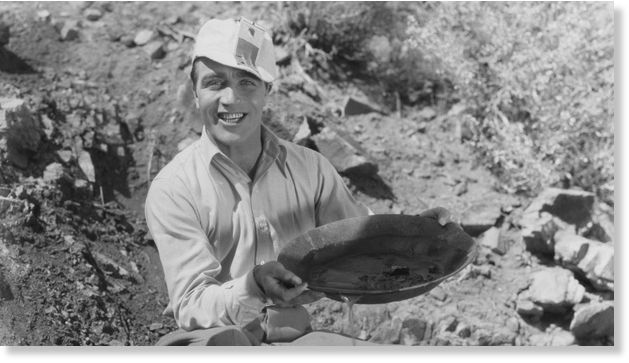
Solid gold can be deposited in Earth's crust "almost instantaneously" during earthquakes, said a study published in the journal Nature Geoscience on Sunday.

The gold is formed when a tremor splits open a fluid-filled cavity in the Earth's crust, causing a sudden drop in pressure, according to a team of Australian researchers.

This, in turn, causes the fluid to expand rapidly and evaporate, and any gold particles that had been dissolved in it to "precipitate almost immediately", said a Nature press release.

"Repeated earthquakes could therefore lead to the build up of economic-grade gold deposits."

The researchers said much of the world's known gold was derived from quartz veins that were formed during geological periods of mountain building as long as three billion years ago.