Best of the Web:


Fire

Best of the Web: Hawaii State of Emergency: Small Tsunami Followed Strongest Quake Since 1975 - SIX Fissures Have Opened up, Forcing Evacuations

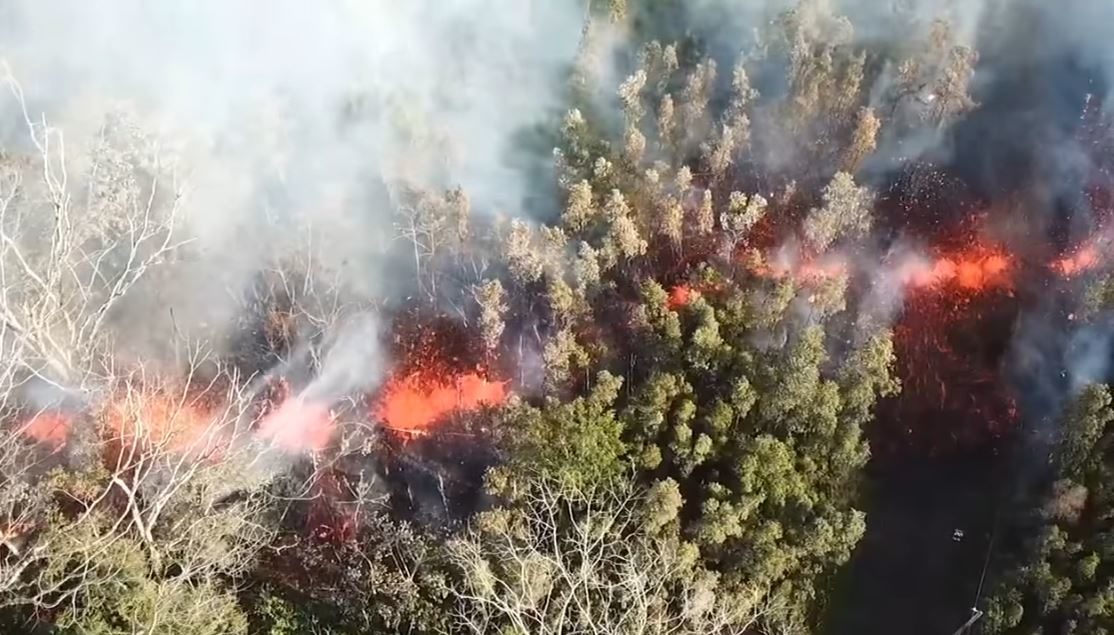
hawaii lava fissure
A large, 6.9-magnitude quake jolted Hawaii Island on Friday afternoon, just an hour after another sizable quake, amid an ongoing eruption of Kilauea that's triggered mandatory evacuations in Leilani Estates, sent lava spewing into streets and threatened homes.

Six fissures - each several hundred yard longs - have been confirmed in the Puna subdivision, officials say.

The extent of the damage isn't yet known, but officials did say at least two structures were significantly damaged and a number of roads have been covered in lava or severely cracked.

"Everything is still elevated," said Talmadge Magno, administrator of Hawaii County Civil Defense. "It kind of gets you nervous."

The 6.9-magnitude quake, which happened about 12:30 p.m., was the largest in Hawaii since 1975 and generated small tsunami waves around the Big Island. Hawaii County Civil Defense said sea fluctuations ranged from 8 inches in Hilo to 16 inches at Kapoho.


Ambulance

Best of the Web: America's post-9/11 wars in Libya, Syria, Somalia, Yemen: How many have been killed?

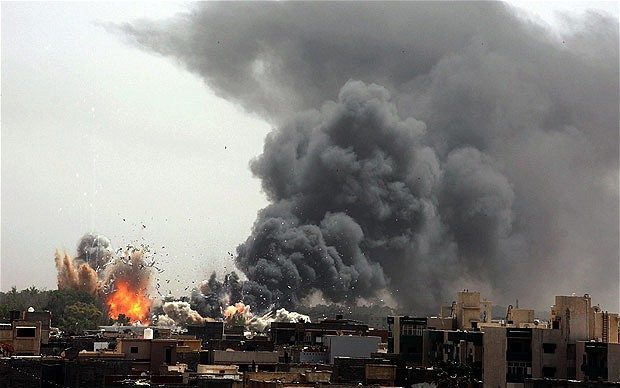
tripoli nato airstrike smoke
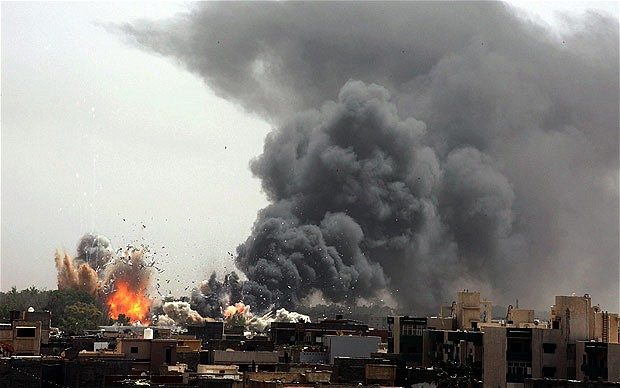
© REXSmoke is seen after an NATO airstrikes hit Tripoli, Libya
In the first two parts of this report, I have estimated that about 2.4 million people have been killed as a result of the U.S. invasion of Iraq, while about 1.2 million have been killed in Afghanistan and Pakistan as a result of the U.S.-led war in Afghanistan. In the third and final part of this report, I will estimate how many people have been killed as a result of U.S. military and CIA interventions in Libya, Syria, Somalia and Yemen.

Of the countries that the U.S. has attacked and destabilized since 2001, only Iraq has been the subject of comprehensive "active" mortality studies that can reveal otherwise unreported deaths. An "active" mortality study is one that "actively" surveys households to find deaths that have not previously been reported by news reports or other published sources.

These studies are often carried out by people who work in the field of public health, like Les Roberts at Columbia University, Gilbert Burnham at Johns Hopkins and Riyadh Lafta at Mustansiriya University in Baghdad, who co-authored the 2006 Lancet study of Iraq war mortality. In defending their studies in Iraq and their results, they emphasized that their Iraqi survey teams were independent of the occupation government and that that was an important factor in the objectivity of their studies and the willingness of people in Iraq to talk honestly with them.

Comprehensive mortality studies in other war-torn countries (like Angola, Bosnia, the Democratic Republic of Congo, Guatemala, Iraq, Kosovo, Rwanda, Sudan and Uganda) have revealed total numbers of deaths that are 5 to 20 times those previously revealed by "passive" reporting based on news reports, hospital records and/or human rights investigations.

In the absence of such comprehensive studies in Afghanistan, Pakistan, Libya, Syria, Somalia and Yemen, I have evaluated passive reports of war deaths and tried to assess what proportion of actual deaths these passive reports are likely to have counted by the methods they have used, based on ratios of actual deaths to passively reported deaths found in other war-zones.

Beaker

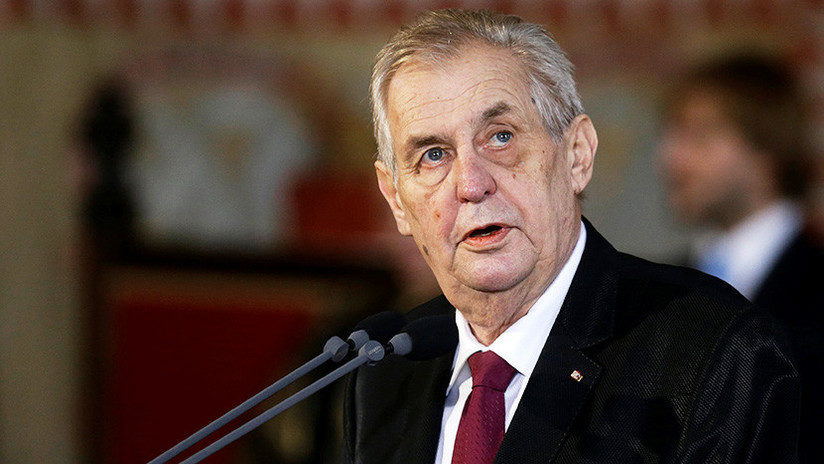
Best of the Web: Czech president admits Republic tested Novichok, confirming Russian claims and further weakening UK accusations against Russia

Presidente checo, Milos Zeman
© David W Cerny - Reuters
The Czech Republic has apparently produced and tested a nerve agent of the so-called Novichok family, the country's president Milos Zeman told state media. His statement follows an inquiry conducted by the Czech security services.

"One has to conclude that our country produced and tested Novichok, even though [it was produced] only in small quantities and then destroyed," the Czech leader told the Barrandov TV Channel. "It would be hypocritical to pretend it is not so," he said, adding that "there is no need to lie."

The president said that he based his conclusions on a report provided by Czech military intelligence. The report showed that a nerve agent known as A230, which was produced by the Czech Military Research Institute located in the city of Brno, was, in fact, Novichok.

Another report, which was provided by the Czech Security Service (BIS) said, however, that the nerve agent produced and tested in Brno was not Novichok but some other substance. After studying both papers, Zeman still decided to agree with the opinion of the military intelligence, Czech media report.


Comment: Russian senator Aleksey Pushkov pointed out the obvious on Twitter:
"Novichok was produced and stored in the Czech territory in some small quantities. This fact is a crushing blow to London's theory that is already falling apart at the seams," Russian Senator Aleksey Pushkov said in a Twitter post, commenting on the recent revelations made by the Czech President Milos Zeman. "London is confused: Its whole construct is crumbling," the Russian politician added.
But the British media are silent. D-notice, perhaps??


Russian Flag

Best of the Web: Russia's strength and innovation is a deterrent against NATO aggression

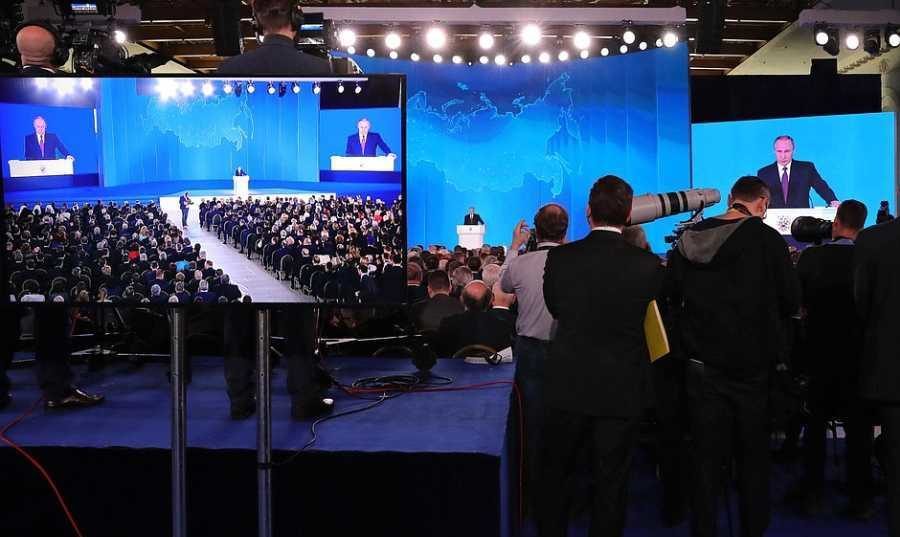
russia putin
As recent events in Syria suggest, Russia has found an effective way of keeping aggressive Western powers at bay with state-of-the-art missile systems and electronic warfare methods - much of it reportedly developed by young scientists and on the cheap.

War is rarely a pleasant topic, and even less so when it is known that particular conflicts - most regrettably in Iraq in 2003 and Libya in 2011, for example - were triggered due to the shameless machinations of foreign players and mercenaries.

Now the world is being held captive audience to yet another predictable Western rerun starring the usual suspects - the US, UK and France. These NATO members, willfully ignoring bona-fide terrorist groups in Syria, are blaming the 'Assad regime' for a series of chemical attacks against civilians - without evidence and formal investigation. To quote Thomas Paine, speaking on a different matter from a much earlier age, "These are the times that try men's souls."

These are also the times, we might add, that challenge men to find ways to address the threat. After all, how many more sovereign states must fall to the Western regime-change fanatics? How long before the regime change juggernaut arrives at Russia's front door? With NATO forces moving inexorably towards Russia's border, these are no idle questions. Thus it was with no small amount of enthusiasm and optimism that an April 13th assault on Syria by the US, UK and France was met with surprisingly successful resistance: According to the Russian military, Syrian government forces, using Soviet-era surface-to-air missile systems, including the S-200 and Buk, shot down 71 of 103 missiles launched by the Western powers.

The Pentagon has denied the claim.

Comment: With a 10th of the US military budget, Russia was able to meet and exceed the military capabilities of the West and still be able to fund social programs and infrastructure. A demonstration of the types of things that are possible when good leadership and careful management of resources are a core feature of its policies. See also:


Network

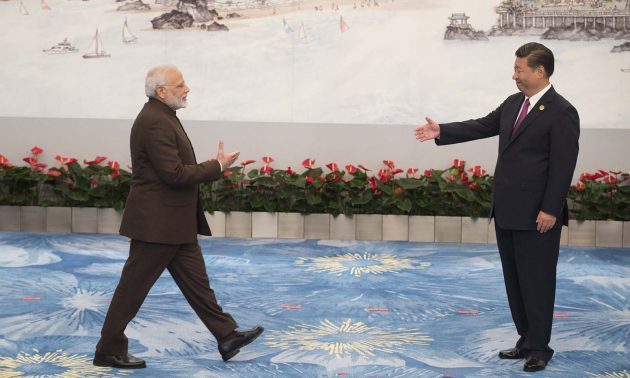
Best of the Web: Wuhan summit between India and China another sign of faltering US global hegemony

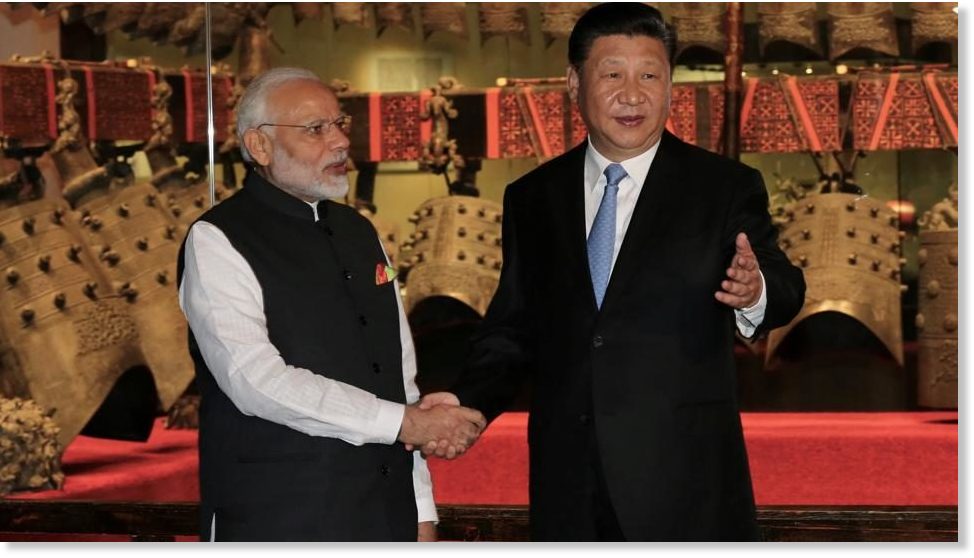
xi jinping narendra modi
The anxiety syndrome in the American write-ups on the Wuhan summit is truly tragi-comic. An analyst at the Brookings Institution confidently predicted even before the summit between Prime Minister Narendra Modi and Chinese President Xi Jinping that the event was much ado about nothing. The US government-funded Voice of America in an analysis has now arrived at the same conclusion, after the summit. Why are these American analysts in such tearing hurry to debunk the Wuhan meeting?

It's geopolitics, stupid! The prestigious Stockholm International Peace Research Institute (SIPRI) released a report today which says amongst other things that India's defence spending rose by 5.5 per cent to US$63.9 billion in 2017, overtaking that of France as one of the world's top five military spenders. The report estimates that one of the main motivations behind India's plans to expand, modernise and enhance the operational capability of its armed forces lies in its tense relations with China.

From the US perspective, the situation is ideal to advance the business interests of America's vendors of weaponry. Last year, business deals worth $15 billion were chalked up. Any improvement in India-China relations will profoundly hurt American interests. Fueling India-China tensions is a major objective of the US' regional strategy.

Blue Planet

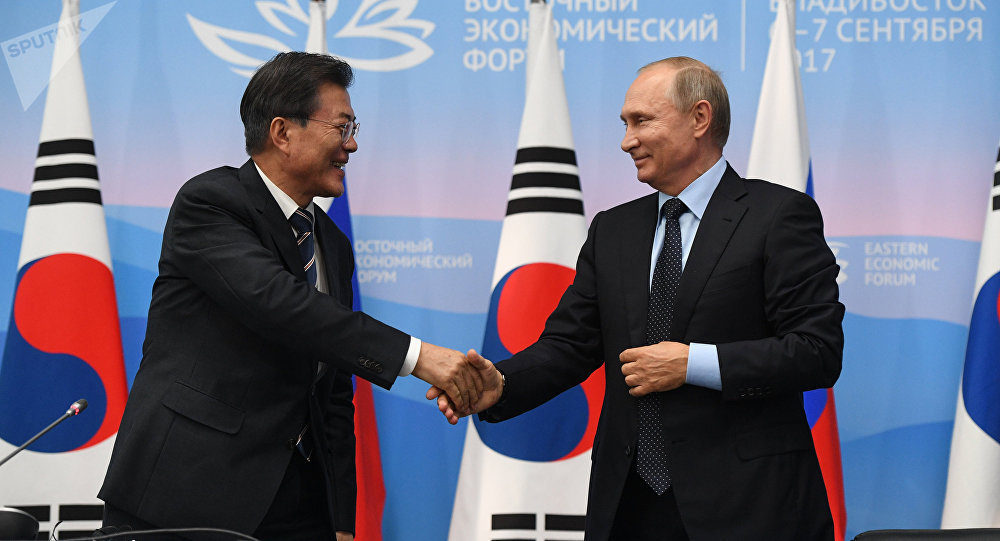
Best of the Web: Russia-DPRK-ROK 'peace pipeline' gaining traction thanks to Korean thaw

Moon Jae-in and Vladimir Putin
© Sputnik / Grigoriy Sisoev
The two "peace pipelines" - one carrying Iranian natural gas via Pakistan to India and a second transporting Russian gas via North Korea to South Korea - surfaced as tantalizing ideas roughly a decade ago. They were promptly lampooned as "pipedreams". But the Russia-DPRK-ROK pipeline (RDR) is having the last laugh on its detractors, thanks to the "thaw" on the Korean Peninsula.

The South Korean President Moon Jae-in telephoned Russian President Vladimir Putin on Sunday to personally brief him on the outcome of the inter-Korean summit in Panmunjom last Friday. The Russian readout says that during the conversation, Putin "reaffirmed Russia's readiness to continue facilitating practical cooperation between the Republic of Korea and the DPRK, including through major trilateral projects in infrastructure and energy."

The South Korean media reported that Putin "stressed the need to take advantage of the success of the inter-Korean summit to launch economic cooperation projects between the two Koreas and Russia" and flagged, in particular, that "connecting railways, gas pipelines, and electric power transmission between Russia and the Korean Peninsula via Siberia will contribute to the stability and prosperity of the Korean Peninsula."

Earlier, in a statement in Moscow on Friday, Russian Foreign Ministry had welcomed the Panmunjom summit as "a significant step by Seoul and Pyongyang to national reconciliation and the establishment of strong relationships of independent value." The statement said, "We are ready to facilitate the establishment of practical cooperation between the DPRK and the Republic of Korea, including through the development of tripartite cooperation in the railway, electricity, gas and other industries."

Recycle

Best of the Web: Xi and Modi meet at SCO Summit: It's the Belt and Road Initiative against Washington's Indo-Pacific strategy all over again

Xi Jinping Narendra Modi China India
© AFP/Fred DufourChinese President Xi Jinping welcomes Indian Prime Minister Narendra Modi during the BRICS Summit in Xiamen on September 4, 2017.


Modi and Xi meeting could have a crucial SCO subplot focusing on security and economic cooperation


All bets are off on the outcome of India Prime Minister Narendra Modi's potentially ground-breaking meeting with Chinese President Xi Jinping this Friday and Saturday in Wuhan.

Things have not exactly started in auspicious mode.

After a meeting in Beijing of foreign ministers represented at the Shanghai Cooperation Organization (SCO), India, once again refused to support the New Silk Roads, known as the Belt and Road Initiative (BRI) in the final communiqué.

Every other SCO member - represented by the foreign ministers of Russia, Kazakhstan, Kyrgyzstan, Uzbekistan, Tajikistan and Pakistan - did.

So here we go again - back to the interminable, intractable India-Pakistan soap opera.

Comment: This puts Trump's threats to scrap the JCPOA and Netanyahu's accusations against Iran in a new light.

As for India, money talks, at the end of the day. If it's committed to INSTC, it'll find solutions to Kashmir, sooner or later.


Life Preserver

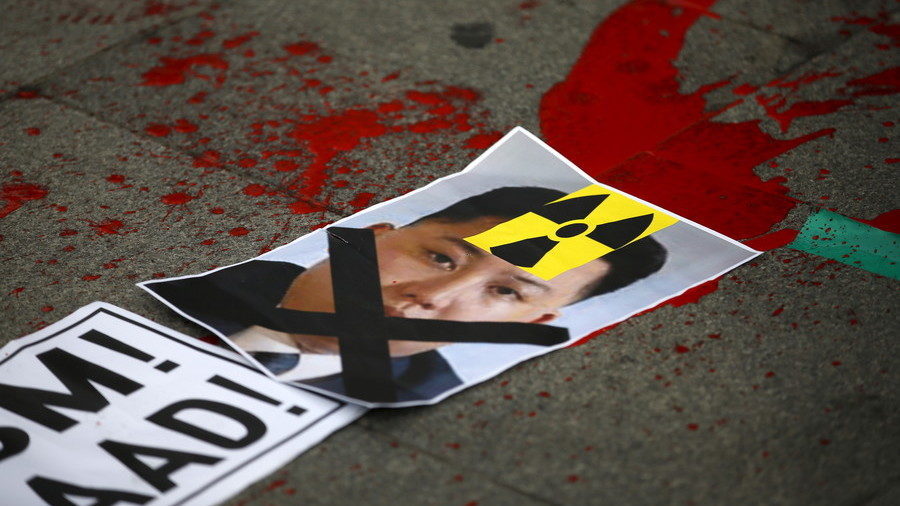
Best of the Web: Should North Korea think twice about ditching nukes after what happened to Libya? (VIDEO)

Kim Jong Un North Korea nukes
© Kim Hong-Ji / ReutersA poster with the image of North Korean leader Kim Jong-un during an anti-North Korea rally in central Seoul, South Korea, February 11, 2016.
The US says North Korean denuclearization should proceed along the Libyan scenario. RT's Murad Gazdiev remembers how Muammar Gaddafi was killed by US-backed rebels a few years after ditching nukes, and asks - is that a good idea?

There was a time when tales of Gaddafi's death had Kim Jong-un keeping his both hands on the nuclear button, which, by his own admission, he cautiously kept on his desk.

Now US President Donald Trump, who not long ago had been erratically tweeting away about his own shiny red button, is suddenly an advocate for peace, welcoming Kim's push to ditch nukes. RT's Murad Gazdiev believes this bears the question - is Libya's history about to be repeated?

And when US officials speak about the "Libyan model", they mean the 2003 denuclearization, not the devastating West-assisted civil war of 2011. Don't they?


Binoculars

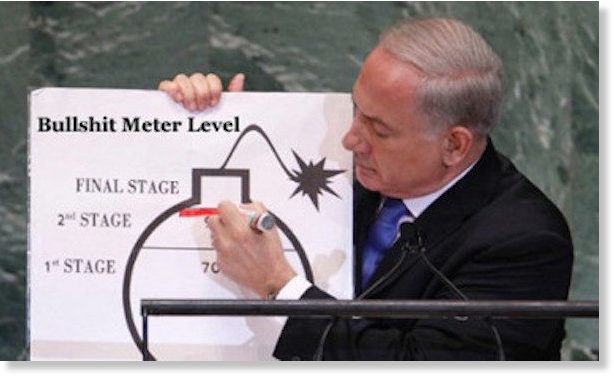
Best of the Web: The truth about Netanyahu's 'Iran files': Well known, old, purloined from Vienna

netanyahu
Netanbullshit
The dog and pony show the Israeli Prime Minister Netanyahoo provided yesterday (video, slideshow) was not based on material Israeli secret services acquired in Iran, but most likely from data Iran provided to the International Atomic Energy Agency (IAEA) during the implementation period of the Joint Comprehensive Plan of Action (JCPOA, pdf).

Ali Vaez, director of the Iran Project at the Crisis Group, was the first to propose this thesis:
Ali Vaez @AliVaez - 18:06 UTC - 30 Apr 2018
5/ It appears to me that what Israel has done is that it has probably hacked the @iaeaorg and gathered some new details from what Iran responded to the agency to close the outstanding issues in 2015: IAEA Board Adopts Landmark Resolution on Iran PMD Case
Several nuclear proliferation experts point out that there was nothing new in Netanyahoo's presentation:
Jeffrey Lewis @ArmsControlWonk - 00:14 UTC- 1 May 2018
Let's go through Netanyahu's dog-and-pony show. As you will see, everything he said was already known to the IAEA and published in IAEA GOV/2015/68 (2015). There is literally nothing new here and nothing that changes the wisdom of the JCPOA. 1/10
All the graphics, pictures and technical details Netanyahoo quoted were known to the IAEA and the negotiators of the agreement with Iran.

Comment: See also:


Che Guevara

Best of the Web: May Day: World Lefties' Temper-Tantrum Day! Annual Riot Hits Paris

may day riot paris
© Thomas Samson / AFPProtesters at the annual May Day workers' rally, in Paris, on May 1, 2018.
Police in Paris have used water cannons to break up a tumultuous rally. Amid May Day demonstrations, hooded individuals have been throwing smoke bombs and setting vehicles on fire in the French capital.

Live feeds from Paris showed chaotic scenes, as police attempt to disperse violent protesters while redirecting crowds of peaceful marchers to side streets. Loud bangs are heard in the background as smoke and tear gas billow down the streets.

Police pushed back against the rioters, peppering the crowd with tear gas grenades from behind riot shields and hitting the crowd with water cannon. Protesters lobbed firecrackers at the advancing force, as well as picking up and throwing back some of the gas canisters. Armored police vans and fire trucks are backed up advance.


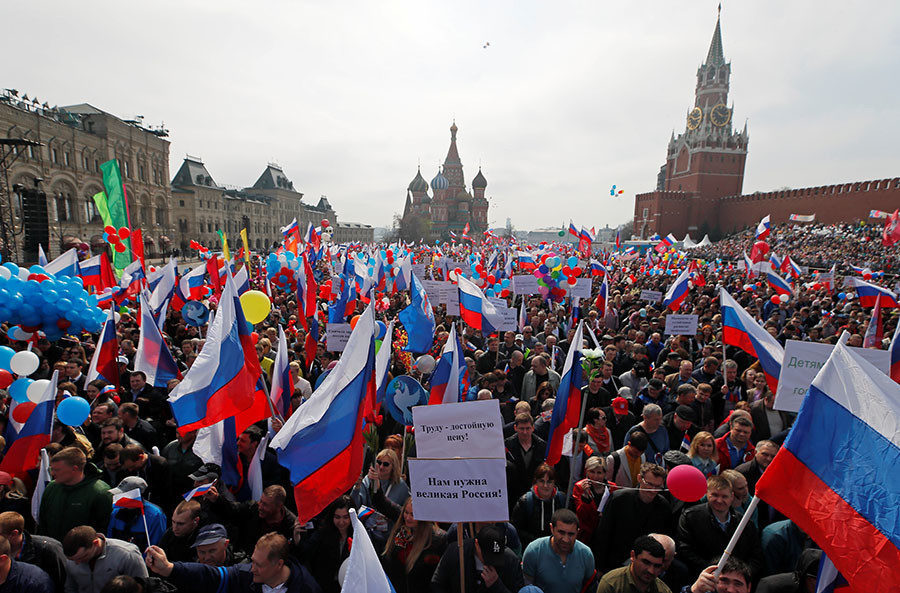
Comment: In fairness, Labor Day is not a riot everywhere. In Russia, for example, which has 'been there, got the t-shirt' with respect to implementing extremist ideology, Labor Day is a family affair at which national flags, not Karl Marx banners, are waved:

may day moscow
© Maxim Shemetov / ReutersMay Day rally at Red Square in Moscow, Russia May 1, 2018.