
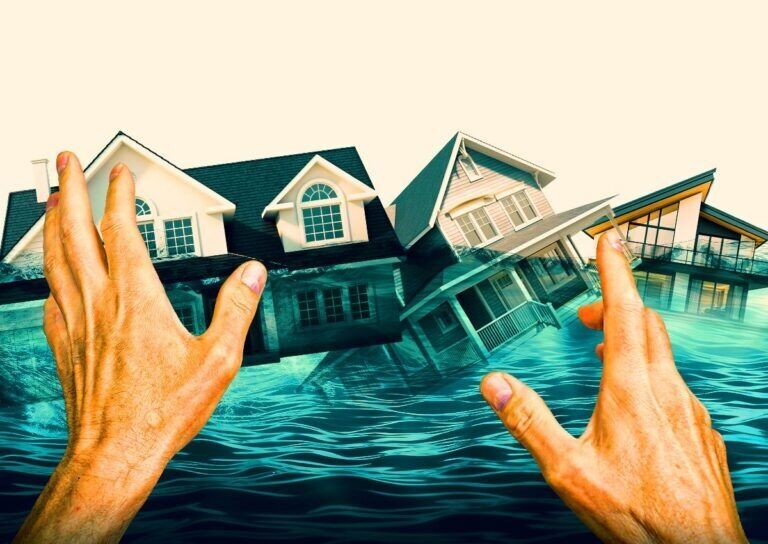
This is a subject for another article but it represents a reversal in traditional consumer behavior; a sea change that needs to be examined because it reflects greater underlying social and economic struggles.
This struggle is not only happening in the US; all across the western world from Australia to Canada to most of Europe people are facing the worst home price inflation in decades and they're scrambling to find ways to adapt.
However, just as in physics, there are rules of motion that still apply to markets regardless of government or central bank intervention. What goes up must inevitably come down. There's been an interesting development in the past year, specifically on the sellers side of the housing equation, and it signals big changes in the near term.
Because of the pandemic, the relocation panic, Covid stimulus and corporate buyers, prices were juiced across the board and the average cost of a home skyrocketed by 50% or more from 2019 to 2024.
A large portion of this buying involved people trying to escape draconian blue state mandates, but there were a lot of speculators trying to play the market and make a quick buck in the expectation that prices would continue rising. Instead, demand has crashed and there are limited buyers to meet the supply.
Google searches for "can't sell my house" hit an all time high last month surpassing the peak of the crash of 2008. Housing sales have dropped by 32% from 2020 to 2026 while supply has spiked. Realtors have been warning of a massive slowdown, with many sellers refusing to read the room and cut prices as they struggle to find interested buyers.
The reason for the impasse and the frozen market is largely because of debt. In 2008, the crash was caused by easy mortgage loans to people who did not have the income to cover costs attached to ARM mortgages that ratcheted up interest rates over time. Millions of homes were sold to people that didn't have the income to buy and they defaulted all at once, crashing the system and the derivatives tied to it.
Today, millions of homeowners are locked into ultra-low mortgage rates from previous years. Selling would mean giving up a 3% loan and replacing it with one closer to 6.5%. So they don't sell.
Beyond that, too many owners bought at the peak of the pandemic rush and the peak of pricing. Now they are stuck trying to sell $250,000 homes for $600,000, and $500,000 homes for over a million dollars. To sell at a steep discount would be essentially the same as accruing even more debt.
The problem is, NO ONE wants to buy a house for $600,000 when they know it's only going to be worth $250,000 in a few years. In the end, the speculators are left holding the bag and there's only two options left - Put their excess homes on the rental market, or, cut their prices dramatically and take the loss. I believe this is going to start happening in an accelerated fashion within the next year, even if there is a government or central bank intervention.
Inflationary stimulus is not going to save the housing market this time.
This means considerable losses in home equity and the overall net worth of the population, not to mention a heavy decrease in mortgage loans and credit liquidity. Less credit access means a consumer slowdown. In the case of corporate buyers and banks, a stimulus package might protect them, but not average citizens.
Where there is no liquidity, there is a crash. For now money seems to be moving at a healthy pace, but this is largely in the stock market which is not representative of a stable economy. Stocks are not a leading indicator of crisis; they are always late to the party. By extension, stocks are not going to signal a future crash in housing, nor are they going to pick up on the throttling of buyers taking place right now.
Can this eventual plunge be managed? Yes, to a point, but not at a global level, only at a national level. And, even then it's not going to change the ultimate outcome, which is concrete losses in liquidity and a spike in debt.
For people waiting to purchase a home this could be good news. Price cuts of 30% to 50% are possible and well overdue. That said, buyers will likely wait out the storm until they think prices have hit bottom. In the meantime there is a danger of post-crash systemic risk to stocks and credit markets. Investors will be looking for a safe haven alternative.
This brings us to a trend that's been developing over the past couple years that we have not seem since the crash of 2008-2012. That crash coincided with a historic gold and silver surge and the same pattern is surfacing again. During narrow periods of heightened uncertainty, property might no longer represent a secure place for people to park their cash. When markets are in a panic and other hard assets are in decline, precious metals become the go-to investment.
Despite the wild fluctuations in the past couple months, gold is still up 270% since 2019 and is likely to continue climbing even as housing markets fall. The reason is simple: Consumer debt has continued to grow despite central bank interventions and increased interest rates. These measures were supposedly meant to reduce consumer borrowing, but that didn't happen.
And, as debt grows, precious metal values invariably climb (inflation through stimulus does not need to be present, but it usually is).
US housing debt has shot up 38% since 2019. US consumer credit card debt has climbed 35% since 2019. The US national debt has climbed 71% since 2019. Property used to offer a safe haven for debt- exposed markets, but this is ending. There are very few secure places left in this environment. IF stock markets take hit (as they probably will), precious metals is one of last bastions of security.
There is definitely a correlation trend taking place which seems to echo the 2008-2012 crisis. Every time US housing prices dip or slow sharply, gold and silver prices typically rise.
As noted, it's not just the US facing a housing market crash. Reports suggest conditions are even worse in Canada, Australia, the UK and most of Europe. In Canada, for example, leftists from the US have gone in search of alternative residency in order to "flee the Trump regime" only to come crawling back in desperation after dealing with unprecedented housing costs.
In the UK, housing for median income earners barely exists, even if they want to rent. In Australia, the median home price is around $700,000 (in the US, the median home price is $415,000). There's really no escaping this trend unless you want to live in a third world country. And, ironically, those people are not too happy to see westerners moving into their backyards right now.
On top of the inflationary conditions for home buyers, there's the mass invasion of illegal migrants into the west over the past decade and this has eaten up the rental markets and driven up prices further. Deportations could help alleviate some of the pressure, but this will also act as a catalyst to speed up housing depreciation. For home owners, a substantial loss of equity should be expected.
In the end the pain is necessary; something has to give. There needs to be a debt reconciliation and the economy needs to take its medicine (a deflationary event). Currently, buying has stabilized after years of decline, but we still have a long way to go before demand and supply are balanced.
It's doubtful that central banks, built entirely on Keynesian interventionism, will allow this to occur without interference. They will eventually step in with more stimulus, which, again, means ever increasing gold and silver values. For now, the smart move for people looking to buy property (or protect their savings) is to rent until this process plays out, and perhaps invest in precious metals in the meantime as a hedge.
Homeowners should also think about investing a portion of savings into precious metals to offset losses caused by plunging property values. The status quo is ripe for an earthquake.
If you would like to support the work that Alt-Market does while also receiving content on advanced tactics for defeating the globalist agenda, subscribe to our exclusive newsletter The Wild Bunch Dispatch. Learn more about it HERE.



Reader Comments
I/we bought the block we live on (Sydney North Western Suburbs), it is 810 square metre’s, paid for in one year (1970) 2 lower than average incomes, it cost $2,300 plus legals, today if you can find one it will cost no less than $ 800,000 for a block less than half that size.
1970 vs. 2026.
We paid $2,300 on two lower-than-average incomes.
In 1970, the average annual earnings were roughly $4,000. Thus 810sqm block for about 60% of one person's annual wage.
Paying it off in a single year was a tangible, achievable goal.
Today…For a smaller block (let's say 400sqm) at $800,000, and an average Australian salary hovering around $95,000, that same piece of land now costs over 8 times a single annual salary.
Today, a young couple can work twice as hard, with higher qualifications, and still find themselves "renting" that land from the bank for 30 years rather than owning it in one year.
The above is a criminal situation to bestow on your son’s and daughters ability to get ahead, they often blame inflation, my figures above say otherwise, it’s BS big time, one year versus 30 years, in this equation aside from having to put a house on it, the lost opportunity cost is incalculable.
In real money gas currently less then 2 dimes where I live. I can see it going for less as paper continues to be inflated to zero. (the hidden tax intended to steal everything you thought you had)
Feel bad for any that saves in paper instead of the real thing. Never made cents to me to hoard paper as a means to save as it is continually printed into oblivion.
Centuries old history repeating itself. Silly they still have the central bank worthless coinage made with the serrated edges still what is the point it ain’t worth a copper cent.
1. Now is a good time to sell your place and hope a buyer foolish emerges. (Of course this council has been incorrect so many times - so take it with a grain of salt as Chuckie used to say....)
2. Just as in 2008 let the buyer get the place and be over their heads so to speak - but sell what you got now if you want to get the profit from it - cause a "top" is forming in real-estate.
~~~
Makes one wonder all this real-estate been acquired and falsely held in high value - what the folks who "have it" are gonna do when the market crashes as it will likely do - just like happened in 2008 time-frame, but this time coupled with all the other "imbalances" in the market there are going to be some who are left with lots of debt on the books that can't be paid off.....so sell it now if you can. Cause later - it will be too late.
[Link]
~
Relax - just do it! I mean don't do it....relax and let the fools be released from their funds mis-spent.
Fools are a dime a dozen.
Let me see if I can find that article.
Meanwhile - check this out - from the "ai" - I quote: Here is the link I think:
[Link]
Talk about a death spiral for the Federal Reserve - and truly what entity is more deserving of a death spiral I inquire.
So sell your property NOW if you want to profit off inflation, but soon deflation is in the cards most likely when the US $ is recognized as NOT a trustworthy investment.
And once this is recognized, then frankly - all bets are off.
Missed you.
I would do as you suggest but in my position it's untenable, if it where different I would do it tomorrow if not yesterday.
Peace my friend.
Tis tough in the world of finance, but that is that - the US is proven Paper Tiger - and when Trump meets Xi I suspect the message will be delivered - and that is that.
So my council to one and all - and I take this to heart - is be debt free!
~
And the cold hard reality is the us of a is full of debt from the Federal Reserve - which is neither federal nor does it have any reserve - all it holds is debt - tis a house of cards.
~
So anybody with wisdom ought realize - tis time to get your house in order. The us of a is a house in "disorder" no doubt - and that spells upcoming chaos - cause a choice was made to attack a sovereign country - and little did the effing "Trump-team" realize they attacked a place been around a lot longer than the us of a has been - and now a hornets nest has been released.