
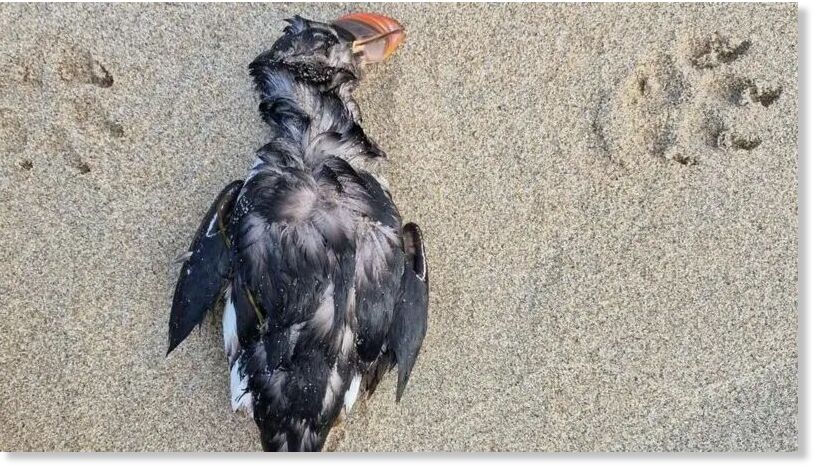
© Cornwall Wildlife TrustPuffins wintering at sea have been unable to feed due to storms
The majority of the birds are puffins which had become starved and exhausted due to not being able to feed during the recent storms.
Alderney Wildlife Trust (AWT) said it had received reports of puffins stranded on the island's beaches and more than 10,000 of the birds had perished and washed up on beaches in France, Spain and Portugal.
Cornwall Wildlife Trust (CWT) said 262 puffins had washed up on Cornish beaches in January and February while only two had been reported last year.
The south west coast has been battered by storms since January with Goretti, Ingrid and Chandra all causing floods and devastation for both humans and wildlife.
Roland Gauvain, the chief executive of AWT, said the Channel Islands had "so far been reasonably lucky".
He said there had been a major seabird wreck (the term for a mass-mortality event) in 2014 when 54,000 birds were recorded washed up, of which about 30,000 to 36,000 were puffins.
He added colleagues in France had also collected data for Spain and Portugal and found thousands of dead seabirds had been recorded.
"It seems the wreck has reached over 10,000 at this point, though there is a lot of proving figures to be done. That's probably an underestimate of what has been found so we're looking at a major seabird wreck," he said.
Puffins rely on their eyesight to hunt and need clear water to find food but rough seas had made it difficult for them to feed, Gauvain explained.
'Already dead or dying'
"Those populations will most likely be UK and northern European breeding populations that have been wintering out at sea and have been picked up in the storms during the last couple of months and bashed around the place," he added.
"Finally they are making their way back on shore where, unfortunately, a lot of them are already dead or dying as they approach the coastlines and get into rougher coastal waters.
"The south, southerly and southwesterly winds seem to have kept this event more along the French coastlines.
"If the wind comes more to the west, I think we're likely to see increasing numbers in our region."
Bex Allen who runs Cornwall Wildlife Trust's (CWT) Marine Strandings Network said it had received more than 40 calls a day about seabird deaths.
She said the trust was waiting for post-mortem results but believed it was the continuous bad weather that had affected wildlife including seabirds.
"They're beautiful and to see them washing up especially in these numbers is really heartbreaking," she said. "It hasn't shown any let up at the moment I'm afraid.
"It's like it's progressed around the coast so I'm expecting them to come in a bit further north, maybe working up into north Devon over the next few days. We just have to see really."
She said the following number of stranded seabirds had been reported to the trust during January and February:
262 puffins
21 guillemot
5 cormorant
4 razorbill
3 Manx shearwater
2 gulls
2 kittewake
1 black backed gull
1 great Northern diver
1 little auk
1 shag
During 2025 two puffins were reported during the year and 14 were recorded in 2024.
Cadi Penny at Rosemullion Veterinary Practice in Falmouth has cared for two puffins which were stranded at nearby beaches. She said the birds were fed with fish paste by syringe.
"Once we had two days of getting them both well fed we could then pass them on to an appropriate rehab person to help us out.
"They're doing brilliantly, they're putting on weight every day and doing really well, so hopefully will be released soon."



Reader Comments
to our Newsletter