
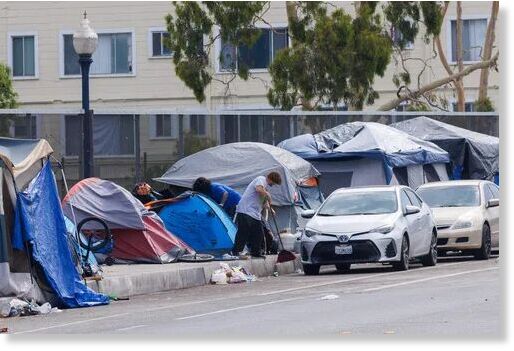
© Mike Blake/Reuters
Under an executive order Trump is prepared to sign on July 24, the president will direct Attorney General Pam Bondi to "reverse judicial precedents and end consent decrees" that limit local and state governments' ability to move homeless people from streets and encampments into treatment centers, according to a White House summary of the order reviewed by USA TODAY.
Trump's signature will redirect federal funds to ensure the homeless people impacted are transferred to rehabilitation, treatment and other facilities, the White House said, though it was not immediately clear how much money would be allocated.
The order, which the White House has dubbed "Ending Vagrancy and Restoring Order," further requires Bondi to work with the secretaries of Health and Human Services, Housing and Urban Development and Transportation to prioritize federal grants to states and cities that "enforce prohibitions on open illicit drug use, urban camping and loitering, and urban squatting, and track the location of sex offenders."
White House press secretary Karoline Leavitt, in a statement to USA TODAY, said Trump is "delivering on his commitment to Make America Safe Again and end homelessness across America."
"By removing vagrant criminals from our streets and redirecting resources toward substance abuse programs, the Trump Administration will ensure that Americans feel safe in their own communities and that individuals suffering from addiction or mental health struggles are able to get the help they need," Leavitt said.
Trump's action comes after the Supreme Court ruled in June that that people without homes can be arrested and fined for sleeping in public spaces, overturning a lower court's ruling that enforcing camping bans when shelter is lacking is cruel and unusual punishment.
The 6-3 decision, split among ideological lines in the conservative-majority court, upheld a ban in Grant Pass, Oregon, prohibiting homeless residents from sleeping outdoors. Homeless residents of the southern Oregon city of 38,000 face fines starting at $250 and jail time for repeat offenses.
Across the U.S., more than 771,800 people lived without housing in 2024, according to a HUD count taken annually on a single night in January. It was the highest tally ever recorded, a 18.1% jump than in 2023, when officials counted about 650,000 people living in homeless shelters or in parks and on streets.
Many cities have struggled to build more affordable housing in recent years, while some communities have pushed for harsher laws banning tents and sleeping in public spaces.
Trump has often expressed his distaste of homeless camps, singling out the removal of encampments on parks and federal land in Washington as a priority.
Trump, in a 2023 campaign video, said: "We will use every tool, lever, and authority to get the homeless off our streets. We want to take care of them, but they have to be off our streets."
Other items in Trump's order include language that seeks to ensure that grants intended for substance use disorder prevention and recovery don't fund drug injection sites or illicit drug use.
The White House said the order also prohibits convicted sex offenders who receive homeless assistance from being housed with children and supports new homeless programs to exclusively house women and children.



Reader Comments
This is a step toward removing drug trafficking and hopefully giving the homeless an opportunity to rejoin society. It has to begin somewhere.
[Link]