
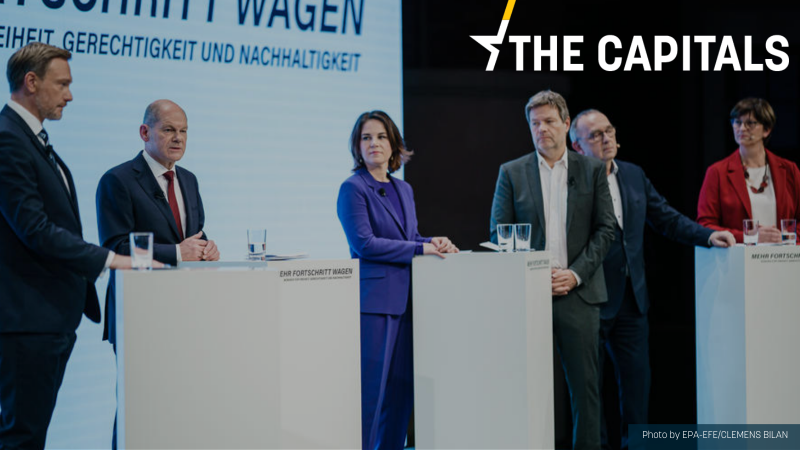
© EPA-EFE/CLEMENS BILANAccording to the coalition agreement that was presented on Wednesday, the coalition wants to use the ongoing Conference on the Future of Europe as a starting point to reform the EU.
According to the coalition agreement presented on Wednesday, the coalition wants to use the ongoing Conference on the Future of Europe as a starting point to reform the EU.
The conference should lead to a constitutional process and ultimately to the "development of a federal European state," the document reads.
"A sovereign Europe is the key for our foreign policy," said Olaf Scholz, who will likely be inaugurated as chancellor in the second week of December.
"As an economically strong and the most populous country in the heart of Europe, it is our mission to enable, foster and advance a sovereign Europe," he added.
The traffic light coalition also plans to strengthen the European Parliament by giving it the right to initiate legislation, a privilege currently reserved for the European Commission.
Udo Bullmann, who led the coalition negotiations on European affairs for the SPD, emphasised that the proposal is a strong "signal" on how the three parties want to develop the Union further.
Further integration steps are necessary as the "time is calling for it" and the "people are waiting for it," Bullmann said.
Comment: On the contrary, few citizens are calling for further integration, instead there are growing movements of people who want to leave the EU, or at the very least to loosen Brussels' stranglehold.
While it is still a long and rocky road to get all member states on board to launch a constituent process for Europe, the coalition also wants to tap into the potential of existing procedures.
So far, the Council - which consists of the ministers of the EU member states - has often decided on a consensus basis, even if the treaties would allow for qualified majority voting.
In areas where it is already possible, "we want to use the qualified majority in the Council," Bullmann stated.
Comment: Meaning some nations will be dragged into it whether they like it or not.
'Timely' reactions to rule of law breaches
Another hot topic in the German coalition agreement is the departure from incumbent chancellor Angela Merkel's more conciliatory approach towards the breach of the rule of law in Hungary and Poland.
The future coalition wants to call on the European Commission to use the existing rule of law instruments timelier and more rigorously.
Comment: Meaning any countries that try to priorities their nations best interests will be punished, like the EU is doing to Hungary and Poland: Hungary blasts 'arrogant' Brussels threats to penalize Poland for judicial reform, accuses EU of empire-building
Nicola Beer, who co-negotiated the Europe section of the coalition agreement for the FDP, stressed that "everybody who has joined the club has subscribed to adhere to the rules of the club, and this definitely includes the independence of the judiciary," she said.
Comment: Doublespeak.
This will also apply to the pandemic recovery fund, where the traffic light coalition wants to make the payments conditional on the rule of law.
If the "mistakes in the area of the rule of law" are not sufficiently addressed, then Poland should not receive any money from the Recovery Fund, Beer said.
However, Beer also emphasised that the future German government will take a double-sided approach towards Poland that will address rule of law issues more rigorously while also intensifying the relationship in other areas, like migration.
"And I have hope that this combination will lead to better results than the laissez-faire approach of the past years," she concluded.






Comment: Germany was at the forefront of the weaponised mass migration campaign; by conceding to US diktats and blocking Nord Stream II it has threatened a gas supply that Europe desperately needs; and it's now enforcing some of the most draconian lockdown restrictions in the EU; one can clearly see what kind of future it has in mind for the people of Europe:
- The NATOstan Clown Show
- The AUKUS issue is not over
- German Chancellor Merkel finally steps down after 16 years: Gives farewell address at strange torch-lit military ceremony
Also check out SOTT radio's: NewsReal: COVID And Mind Control - Do People Fear The Virus, Or Their Government?