
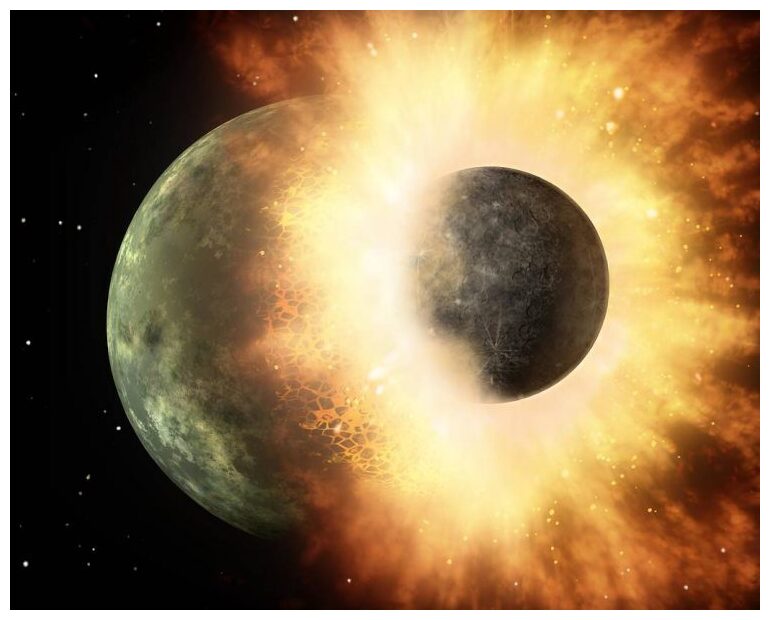
Researchers out of Arizona State University (ASU) made their case in a great piece of planetary forensics presented at the virtual 52nd Lunar and Planetary Science Conference. Their study posits that the large Theia impactor that struck Earth early on in its history, leading to the Moon's formation, might have left large, dense masses deep in our planet's mantle today. The study will appear in Geophysical Research Letters.
THE THEIA HYPOTHESIS
The leading theory for the formation of the Moon is that a roughly Mars-size object, dubbed Theia (named for the Titan who was mother to the moon goddess Selene), struck young Earth around 4.5 billion years ago. The abundance of indirect evidence for this cataclysmic event includes the high angular velocity seen in the Earth-Moon system today, as well as the Moon's tiny iron core and high mass ratio relative to Earth. Stable isotope samples brought back by Apollo astronauts also suggest a common origin for Earth and the Moon.
But direct evidence for Theia hypothesis has so far been lacking. While the cores of Earth and Theia probably merged right away, where did the rest of the rogue impactor go?
An animation of LLSVP regions deep within the Earth, based on seismic tomography. Sanne Cottaar / Wikimedia Commons.Graduate student Qian Yuan (ASU) and colleagues looked at continent-size features deep in Earth's mantle, known as large, low shear velocity provinces (LLSVPs). These two large masses, 1,000 kilometers tall and several thousand kilometers wide, sit on either side of the Earth's core like a giant set of earmuffs, one under Africa and the other under the Pacific Ocean.
While seismic waves traversing the interior of our planet have revealed these denser regions of the mantle, their origin remains unclear. There are a few different ways in which the LLSVPs might have formed, but the ASU team suspected they could be the remnants of Theia.
Recently, geologists sampled volcanic rocks in Samoa and Iceland, thought to have come from the deep mantle based on chemical studies. Based on those samples, the LLSVPs date back to at least 4.45 billion years ago — right around the time of the suspected Theia impact event.
Yuan and his colleagues simulated the impact and followed the evolution of Theia's remains over time. They found that the its mantle was denser than Earth's, so rather than mixing in, it piled up at the bottom of the mantle against the outer core.
The simulations suggest that Theia might have been much larger than previously suspected, perhaps four times as massive as Mars, and denser too. The Apollo samples support the high density. Lunar rocks exhibit a relatively low ratio of heavy hydrogen (deuterium) to light hydrogen, from which the team calculates that Theia's mantle must have been between 2% and 3.5% denser than Earth in order to retain the light gas. This estimate is consistent with the high density required by their simulations.
LUMPS IN THE GRAVY
The fact remains, though, that we still don't understand the exact nature of the LLSVPs. "We don't know what they (the LLSVPs) are," says seismologist Jennifer Jenkins (Durham University, UK), who was not involved in the study. "They could be piles of subducted oceanic tectonic plates, iron enriched remnants of a basal magma ocean from early in Earth's history when the mantle was still cooling and solidifying, or closely spaced hot thermal upwellings within the convecting mantle that get blurred together into one big 'blob'."
Part of the problem is that the primary method for studying LLSVPs involves examining low-frequency seismic waves, but these paint a fuzzy picture. The masses deep within our planet might be riddled with structure. "There may be holes in them," seismologist Barbara Romanowicz (UC Berkeley) told Science. "There may be a bundle of tubes." If so, it could throw the Theia-remnant assertion into doubt.
New techniques, such as utilizing the Moon's tidal pull on Earth, may eventually help narrow down the LLSVPs' structure.
Future lunar sample returns may also help settle the mystery. The Apollo missions sampled equatorial sites on the lunar nearside, but doubts linger over the deuterium-to-hydrogen ratio measured there, mainly due to possible interaction with the solar wind. Scientists would like to resample in the South Pole-Aitken basin, near the lunar south pole. A later impact might have exposed mantle on the basin floor, so it's an ideal site for pristine samples of the lunar interior.
China's Chang'e 4 mission is currently exploring Von Kármán Crater within the basin, and a south pole site will also be the target for NASA's VIPER rover launching in 2023. The crewed Artemis initiative could also pay it a visit in coming years.
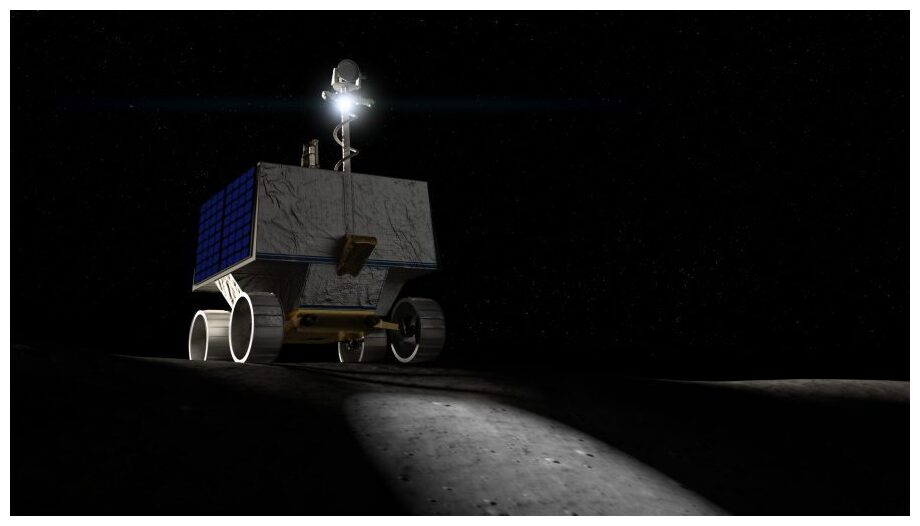
© NASAAn artist's conception of VIPER on the Moon



Reader Comments
Also, as re the animation, I didn't know that 4 billion years ago that they had orchestras.
R.C.
The moon is not composed of the elements the Earth is composed of. Its density is 60% that of the Earth, Venus 64%, Mercury 62%, and Mars 85%. Its rotational inertia is >21 times that of earth's, and its retardation is >457 times. Clearly there is no correlation at all between the Moon's make up and that of Earth's. In fact, it is different from ALL other solar system bodies, tending to confirm what many investigators have come to believe it was an "engineered" orb deliberately placed in orbit about the Earth. Its orbital radius from Earth (which is governed by it mass vs diameter, where gravitation is quantized) and its diameter have a relationship unique among all satellites--eclipse of the Sun that leaves the corona visible.
These "researchers' need to start seeing and understanding the data that is right before their eyes, and stop doing what Tesla accused Einstein of doing.
I can see this as a reason to pay attention to what you write.
Have you ever read Jim Marrs' 'Alien Agenda'? In it, his first chapter is about 'the biggest UFO issue' - the moon.
Very informative.
RC
... and if anyone here needs an ark welder, well... i noah guy.
🤦♂️
cheers eh
all we do is look up part numbers an swap them out.
that is why I will ask you.. no I WILL BEG YOU! please do not call me out until you and ALL of your buddies have youtubed it.
you do realize of course, that I will know if this is the case when I look at it. right?
go ahead, play pretend that you need HVAC service and call for it. and you might gain a better respect for today's tradesmen.