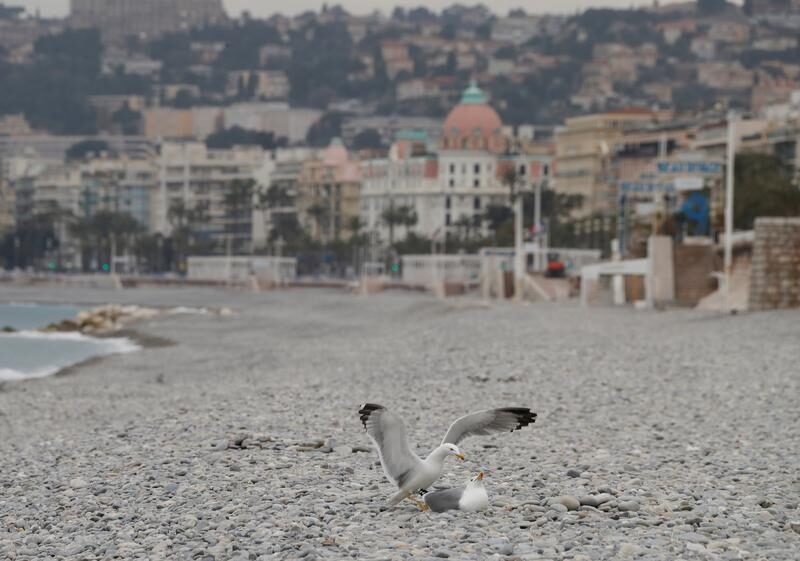
© REUTERS/Eric GaillardSeagulls are seen on an empty beach of the Promenade des Anglais during the first local weekend lockdown imposed to slow the rate of the coronavirus disease (COVID-19) contagion, in Nice, France, February 27, 2021.
The French government will impose tougher restrictions for some regions including Paris from this weekend to counter the accelerating spread of COVID-19 infections, spokesman Gabriel Attal said on Wednesday after a cabinet meeting.
The announcement paves the way for new curbs in the greater Paris region, where intensive care wards are full and the hospital system is buckling with an incident rate of more than 400 cases per 100,000 inhabitants.
Attal said the new measures for Paris could include some form of confinement. Weekend lockdowns have already been imposed on top of a nationwide nightly curfew along parts of the Mediterranean Riviera and some areas of the north.President Emmanuel Macron had hoped a vaccination drive could stave off a new pandemic wave triggered by more contagious variants, and prevent France from resorting to more measures that risk slowing the economy and cooping up citizens.
That approach is now being tested. The vaccine rollout has been slowed by an onerous European Union procurement process, supply difficulties, public scepticism and most recently the suspension of vaccinations using AstraZeneca shots in more than a dozen EU states including France.
Macron on Wednesday defended the EU COVID-19 vaccine strategy and said that within a few months Europe would be among the regions producing the most doses.
"We are living through the hardest weeks now. We know it," Macron said after welcoming Poland's prime minister at the Elysee Palace.
The new restrictions will be announced by the prime minister on Thursday.
They will not include school closures, Attal said.The head of public hospitals in Paris earlier warned that the virus was running amok in the capital and surrounding departments, an area that accounts for about a third of economic activity."The virus is not under control," Martin Hirsch said.
Comment: Despite the growing body evidence that
lockdowns don't work, another 'wave' of lockdowns is starting in the EU.
Poland:
The Polish health minister has announced a new national lockdown, to come into force on Saturday, as the government looks to slow surging infections across the country and deal with more contagious Covid-19 variants.
Speaking on Wednesday, minister Adam Niedzielski said the situation had deteriorated to such an extent in recent days that the government had been obliged to act.
"Last week, we were above 20,000 [cases per day], but the pace is not slowing down. The third wave is accelerating, and we have to take decisive steps," he stated.
[...]
Despite infection rates being higher in the north, Niedzielski said there was a clear reason for introducing measures on a national scale. The new restrictions, which come into force on Saturday, will see shopping malls, cinemas, theaters, swimming pools, and saunas being closed once again, and pupils in grades one to three returning to distance-learning until April 9, although kindergartens would remain open. The minister also advised people to work from home where possible.
He said that if these measures failed to make an impact on infection rates, a more "typical" lockdown would be enforced.
Germany:
Intensive care doctors in Germany warned on Monday (Mar 15) that the country would need to make an "immediate return" to partial lockdown if it is to avoid stumbling into a dangerous third wave of the coronavirus pandemic.
"From the data we currently have and with the spread of the British mutation, we would argue strongly to return immediately into a lockdown to avoid a strong third wave," Christian Karagiannidis, director of Germany's intensive care register, told broadcaster RBB.
"We won't gain much from staying open for the next one or two weeks, because that will quickly bring us to a high level and make it twice as hard to push the numbers down again," said Karagiannidis, who works for the German Interdisciplinary Association for Intensive and Emergency Medicine (DIVI), which tracks intensive care capacities in German hospitals.
Germany has seen a rise in cases since it began a gradual easing of coronavirus measures in late February, allowing schools, hairdressers and other businesses to partially reopen.






Comment: Despite the growing body evidence that lockdowns don't work, another 'wave' of lockdowns is starting in the EU.
Poland: Germany: