
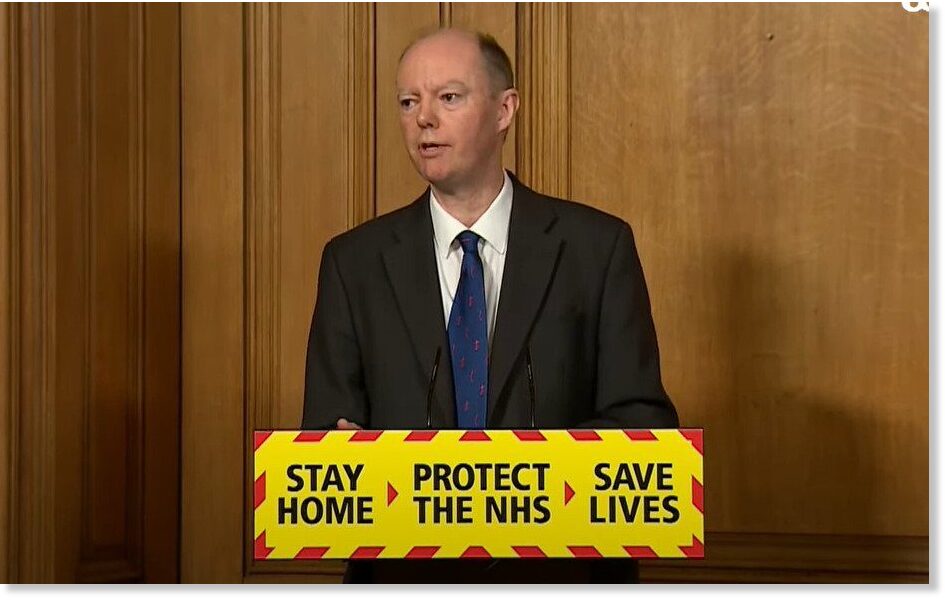
Chief Medical Adviser Professor Chris Whitty addresses the Downing Street coronavirus press conference.
The UK is "past the peak" of the current wave of the pandemic but infection rates are still high, England's Chief Medical Officer says.Chris Whitty seems a little late to the party here. Data from the ZOE Covid Symptom App show infections in the UK peaked over three weeks ago, on January 12th, and are now well on the way down.
Prof Chris Whitty said the number of cases, hospitalisations and deaths were on a "downward slope" but that did not mean there would not be another peak.
Boris Johnson praised the "colossal" effort to vaccinate 10 million people, including 90% of those aged over 75. But he said the NHS was still under "huge pressure".
Speaking at a Downing Street briefing, Prof Whitty said while the number of people in hospital with COVID-19 had reduced "quite noticeably", it was still above that of the first peak in April 2020. "So this is still a very major problem, but it is one that is heading the right way," he said.
Prof Whitty said infection rates were "coming down but they are still incredibly high". If the rate was to increase again "from the very high levels we are at the moment the NHS will get back into trouble extraordinarily fast", he added.
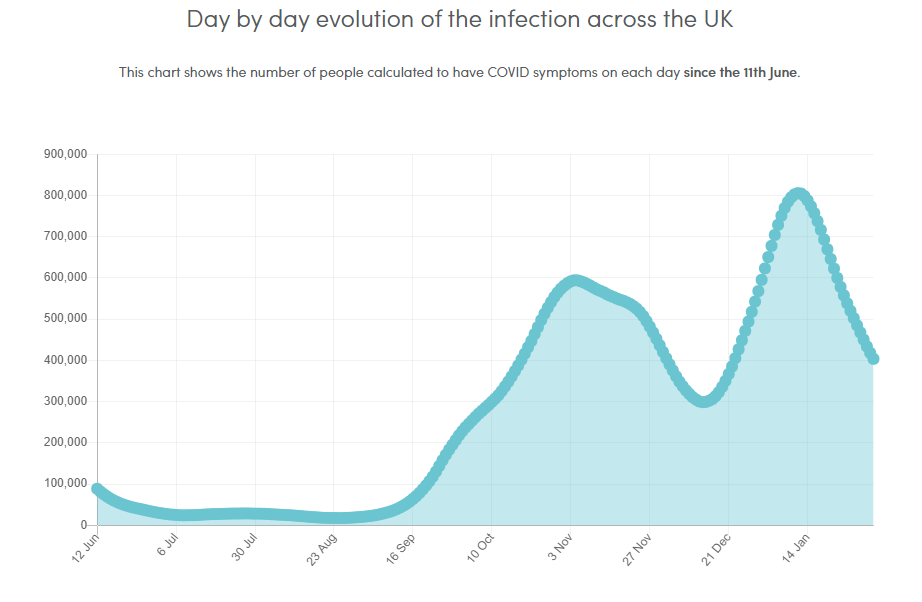
© ZOE Covid Symptom App
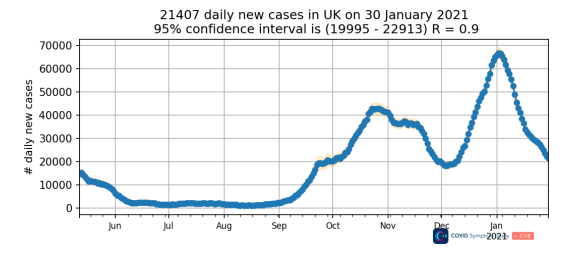
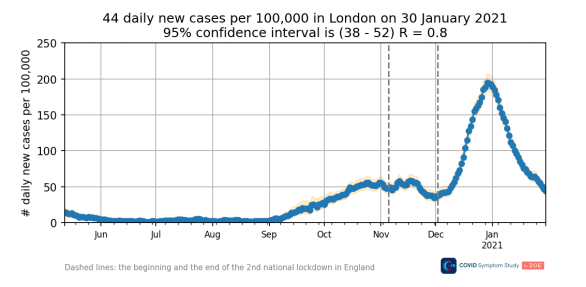
111 Covid triage data agrees.
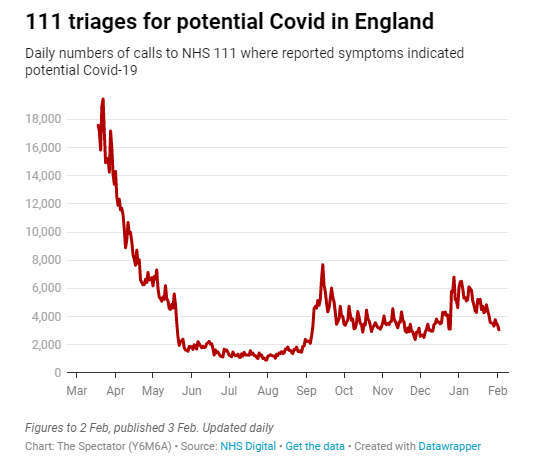
© Spectator Covid Data Tracker
Yet despite this clear evidence that the peak and decline in infections kicked in well before the start of the January lockdown, the Government and its advisers continue to assert that it is only the restrictions keeping infections down. This explains why Boris continues to take the go-slow approach to opening up, despite the immense and permanent harm restrictions cause to children, jobs, mental health and so on.
Despite coming under pressure to join Scotland and Wales in opening schools sooner than March, the Prime Minister yesterday reiterated his original schedule, saying he "hoped" schools in England would be able to "begin" reopening from March 8th, and that the Government would outline a "route map" out of lockdown on February 22nd.
Yet the idea that it is Government restrictions that are keeping the virus at bay grows more implausible by the day.
Take a look at the graph below, which shows that the decline in infections from around January 12th kicked in not just in the UK but right across the world, regardless of what non-pharmaceutical interventions governments made or the stage of their vaccination programmes.

© Our World in Data
Why the winter (and in some places like South Africa, summer) epidemic went into decline around the same point in mid-January in countries all round the world is not entirely clear, though is likely to be linked to the progress of immunity in the population.
Yet more evidence that it is not primarily human interventions that drive the ebb and flow of this virus.
Stop Press: The Mail has picked up on the global drop, asking "Why ARE coronavirus cases plummeting? New infections have fallen 44% in the US and 30% globally in the past three weeks and experts say vaccine is NOT the main driver because only 8% of Americans and 13% people worldwide have received their first dose". The main explanation offered by "officials" is population immunity. Another suggestion is the end of the so-called Christmas surge - though even the BBC has pointed out there is no evidence for this idea.
Why Hand Sanitisers Do More Harm Than Good
We're publishing today a new piece by regular contributor and medical historian Dr Irina Metzler questioning the public health wisdom of all this obsessive germ blitzing. Here's a taster.
Hand sanitisers, or hand satanisers as I prefer to dyslexise, are as ubiquitous a part of the pandemic as the masks. Unlike the masks, which will cause mainly individual problems (if you wear a mask, you're restricting your own breathing, not someone else's), hand sanitiser use at the level we've been seeing for the past 10 months is going to become one helluva headache in the none too distant future. That's because apart from destroying your own, personal microbiome we've got a bigger picture to consider.It has a permanent place on our right-hand menu. Worth reading in full.
Antimicrobial resistance across the board had been getting worse already before the pandemic hit. Already in 2018 it was noted that alcohol-based hand sanitisers in particular were turning bacteria into the next level of 'superbug', namely VRE (vancomycin resistant enterococci), one of the leading causes of infections in hospitals.
"We have to be careful about this new trend towards heavy reliance on alcohol-based hand sanitisers. Soap and water should be our number-one protection" - both in hospitals and for personal use. The next question is whether the bacteria will continue to evolve and tolerate higher and higher doses of alcohol - or even stop responding entirely. "Is it possible for these organisms to develop complete resistance to alcohol?" These questions were also raised by researchers years before the advent of SARS-CoV-2 and the ubiquitous little bottles of hand gels.
The Government is Gambling With People's Lives
In a new piece that we're publishing today, philosopher Ben Hawkins takes a look at lockdown through the lens of the "trolley problem". What should you do when faced with a peril for which you are not personally responsible - what is it acceptable for you to sacrifice to try to avert it? Ben explains:
Imagine you are walking across a bridge over a rail line. Suddenly you hear screams coming from under the bridge. You look down and see that four people are tied to the tracks. What's worse, you look up and see what looks like a runaway train carriage hurtling towards them. The carriage doesn't look that big - if you could push a large object over the bridge in front of the carriage, you figure that it would be enough to stop the carriage and save the four people tied to the line. Looking around for such an object, you see an incredibly fat man stood at the edge of the bridge. He looks big enough to stop the carriage. Do you push him, knowing that falling from such a height and being hit by the carriage will almost certainly kill him? Do you sacrifice one life, to save four others?Worth reading in full.
This is an example of a trolley problem, a hypothetical scenario designed by ethicists to examine how we should behave in different situations. The above example is tricky, because whilst we would usually agree that four lives are more important than one life, the positive act of killing someone goes against many of our moral intuitions. Most people, when asked what they would do in this scenario, say they wouldn't push the fat man.
Such abstract scenarios may seem irrelevant to real life. We certainly never expect to find ourselves in situations like the one described above - we don't live in a world where people are frequently tied to train tracks, or where runaway train carriages can be stopped by pushing fat men off bridges. But the point isn't to understand how we would behave in this particular situation, but to understand how we should behave when analogous situations arise in real life. And, in fact, we have such a real life situation to which such considerations can be applied. Lockdown.
Why Face Masks Don't Protect the Wearer
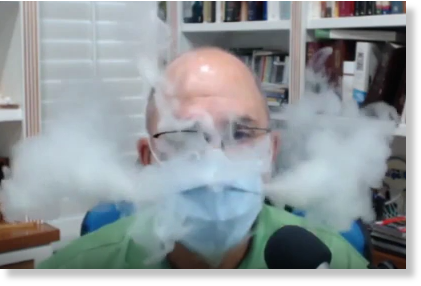
A demonstration of how surgical masks do not inhibit the passage of aerosols
"Why Face Masks Don't Work: A Revealing Review of Their Inadequacies" is the title, not as you might think of a recent article by a lockdown sceptic, but a piece written in 2016 by dentist John Hardie in Oral Health magazine. He begins:
For at least three decades a face mask has been deemed an essential component of the personal protective equipment worn by dental personnel. A current article, "Face Mask Performance: Are You Protected" gives the impression that masks are capable of providing an acceptable level of protection from airborne pathogens. Studies of recent diseases such as Severe Acute Respiratory Syndrome (SARS), Middle Eastern Respiratory Syndrome (MERS) and the Ebola Crisis combined with those of seasonal influenza and drug resistant tuberculosis have promoted a better understanding of how respiratory diseases are transmitted. Concurrently, with this appreciation, there have been a number of clinical investigations into the efficacy of protective devices such as face masks. This article will describe how the findings of such studies lead to a rethinking of the benefits of wearing a mask during the practice of dentistry. It will begin by describing new concepts relating to infection control especially personal protective equipment (PPE).Hardie concludes:
The primary reason for mandating the wearing of face masks is to protect dental personnel from airborne pathogens. This review has established that face masks are incapable of providing such a level of protection. Unless the Centers for Disease Control and Prevention, national and provincial dental associations and regulatory agencies publicly admit this fact, they will be guilty of perpetuating a myth which will be a disservice to the dental profession and its patients.Prescient, you might think, and depressing that these lessons, of the need for rigorous testing of infection control measures and of the ineffectiveness of masks, were not learned.
It would be beneficial if, as a consequence of the review, all present infection control recommendations were subjected to the same rigorous testing as any new clinical intervention. Professional associations and governing bodies must ensure the clinical efficacy of quality improvement procedures prior to them being mandated. It is heartening to know that such a trend is gaining a momentum which might reveal the inadequacies of other long held dental infection control assumptions.
Too prescient, it seems. For this article has been taken down from the publisher's website, with just a note left in its place.
If you are looking for "Why Face Masks Don't Work: A Revealing Review" by John Hardie, BDS, MSc, PhD, FRCDC, it has been removed. The content was published in 2016 and is no longer relevant in our current climate.Censorship and erasure of the past to try to shore up the flimsy case for face masks. Not exactly a sign of confidence in the evidence.
Please note that the content from Oral Health Group is primarily intended to educate and inform dental professionals.
Lockdown Sceptics is pleased to make the article available to the public again. You can find it here.
SAGE Admits Masks Do Little to Help
SAGE quietly released a document on January 13th which admits that masks are no protection for the wearer, are though intended to protect others aren't even very good at that. An independent researcher has taken a closer look for Lockdown Sceptics and explains further.
SAGE released a document in January prepared by a sub-committee, which it endorsed, saying that masks were primarily a source control (cloth and surgical masks are thought to offer the wearer little protection) and citing an estimate for their typical impact on transmission of 6-15% (possibly as high as 45%).
That document says in relation to source control: "Analysis of regional level data in several countries suggest this impact is typically around 6 - 15% (Cowling and Leung, 2020, Public Health England 2021) but could be as high as 45% (Mitze et al., 2020)."
A 6 - 15% reduction seems to be a lot lower than NERVTAG, SAGE and the Government have previously suggested - barely relevant. Moreover, the Cowling & Leung paper says: "While most research on face masks has involved surgical type face masks, it should be presumed that reusable cloth masks could provide similar benefits if they have a sufficient number of layers and preferably a filter." So the 6 - 15% estimate seems to be for surgical masks. Cloth masks in reality usually have few layers (maybe only one) and no filter. So their effect is likely smaller still.
The Cowling & Leung paper is here. It is an editorial not a research paper in its own right.
The 6 - 15% estimate actually comes from a December 2020 review paper by Brainard et al.
They say: "Conclusion: Wearing face masks may reduce primary respiratory infection risk, probably by 6-15%. It is important to balance evidence from RCTs and observational studies when their conclusions widely differ and both are at risk of significant bias. COVID-19-specific studies are required." They also say "The environmental and economic costs of regularly using face masks are notable, and only partly abated by reuse."
Not exactly strong support for wearing masks!



Reader Comments
to our Newsletter