
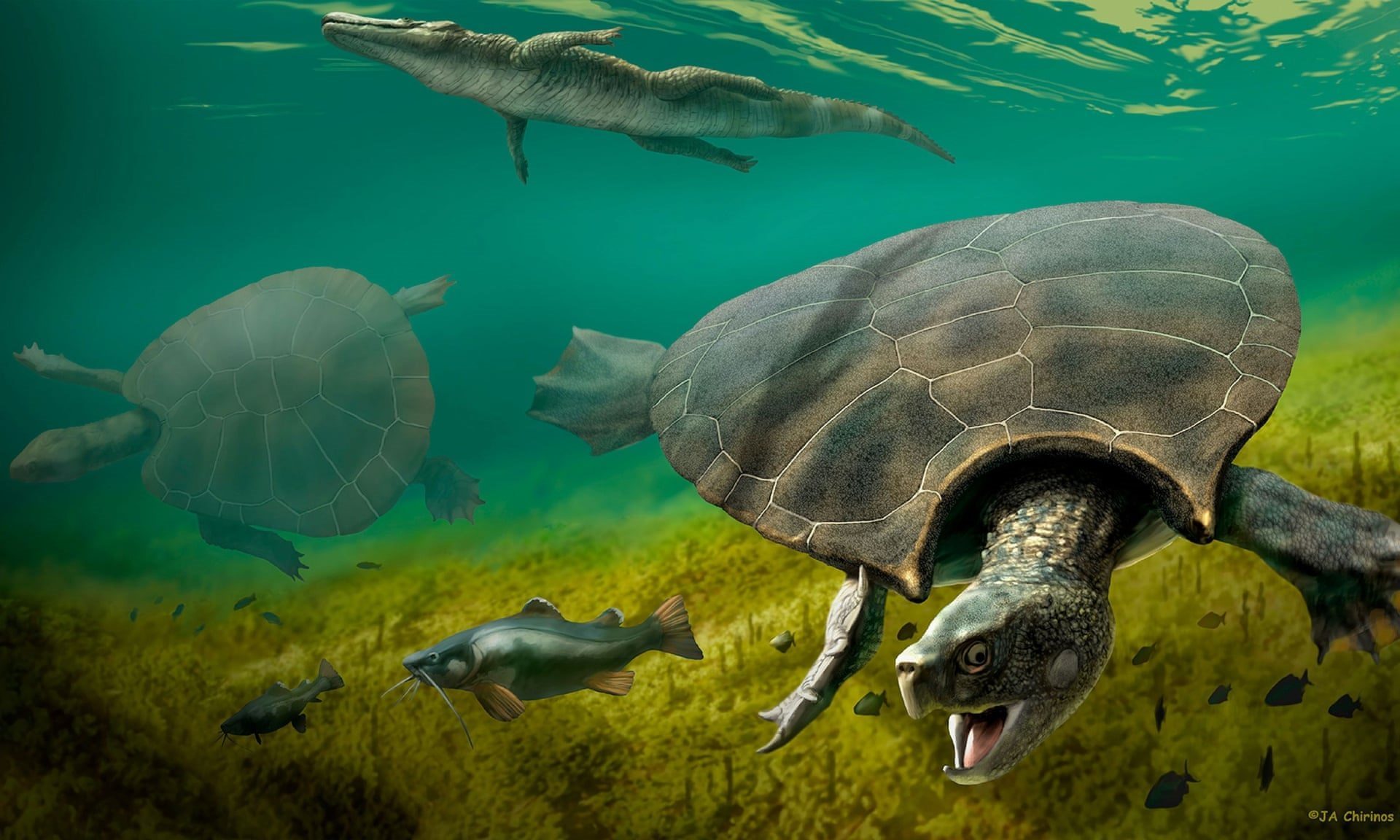
© JA Chirinos/ReutersThe huge extinct freshwater turtle Stupendemys geographicus, that lived in lakes and rivers in northern South America during the Miocene Epoch, is seen in an illustration.
The fossils of the turtle - Stupendemys geographicus - were found in Colombia's Tatacoa Desert and Venezuela's Urumaco region, and for the first time provide a comprehensive understanding of the creature which grew up to 13ft (4 meters) long and 1.25 tons in weight.
Stupendemys males boasted sturdy front-facing horns on both sides of its shell very close to the neck. Deep scars detected in the fossils indicated that these horns may have been used like a lance for fighting with other Stupendemys males over mates or territory. Females did not have the horns.
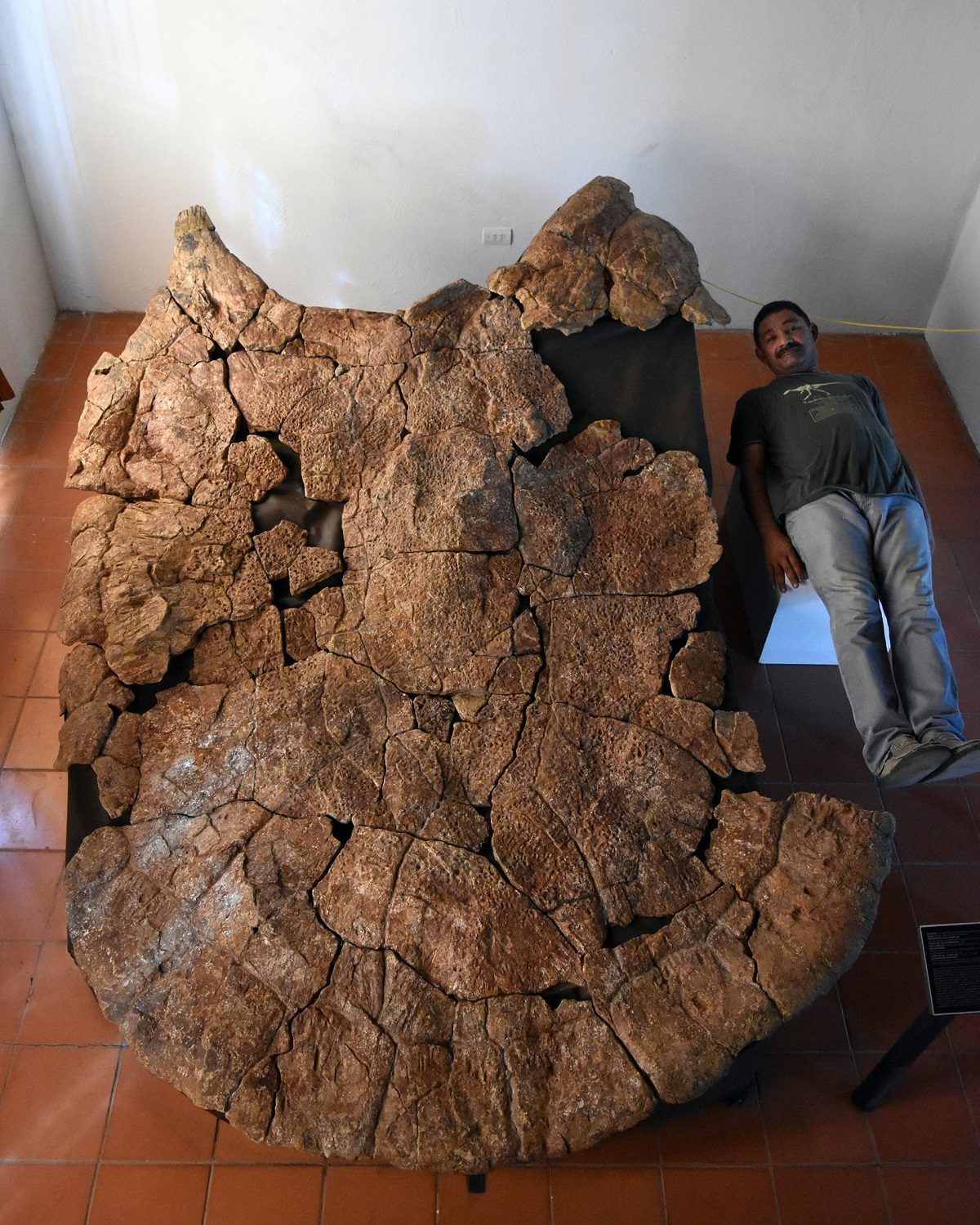
© University of Zurich/Edwin Cadena/PAPalaeontologist Rodolfo Sanchez lies alongside a carapace of the giant turtle Stupendemys geographicus, from Urumaco, Venezuela.
Stupendemys is the second-largest known turtle, behind seagoing Archelon, which lived roughly 70m years ago at the end of the age of dinosaurs and reached about 15ft (4.6 meters) in length.
The first Stupendemys fossils were found in the 1970s but many mysteries remained about the animal. The new fossils included the largest-known turtle shell - 9.4ft (2.86 meters) long, even larger than Archelon's shell - and the first lower jaw remains, which gave clues about its diet.
"Stupendemys geographicus was huge and heavy. The largest individuals of this species were about the size and length of a sedan automobile if we take into account the head, neck, shell and limbs," Cadena said.

© Edwin Cadena/ReutersColombian and Venezuelan paleontologists work together during the excavation of the giant turtle Stupendemys geographicus in northern Venezuela.
Stupendemys - meaning "stupendous turtle" - inhabited a colossal wetlands system spanning what is now Colombia, Venezuela, Brazil and Peru before the Amazon and Orinoco rivers were formed.
Its large size may have been crucial in defending against formidable predators. It shared the environment with giant crocodilians including the 36ft-long (11-meter-long) caiman Purussaurus and the 33ft-long (10-meter-long) gavial relative Gryposuchus. One of the Stupendemys fossils was found with a two-inch-long (5cm) crocodile tooth embedded in it.
Source: Reuters






But only ONE time did I come across a mama Leatherback, the world's largest turtle. Her carapace was >5.5 feet long. She was just finishing up digging her nest, and I sat downwind of her as she laid her soft flat mucousy ping pong balls. I escorted her back to the ocean. I only touched her once - at the instant she'd started getting weignt neutral / floating (about knee deep.) She could feel the soft touch and swun her flippers faster. (I was always out of her view and smell.) R.C.