
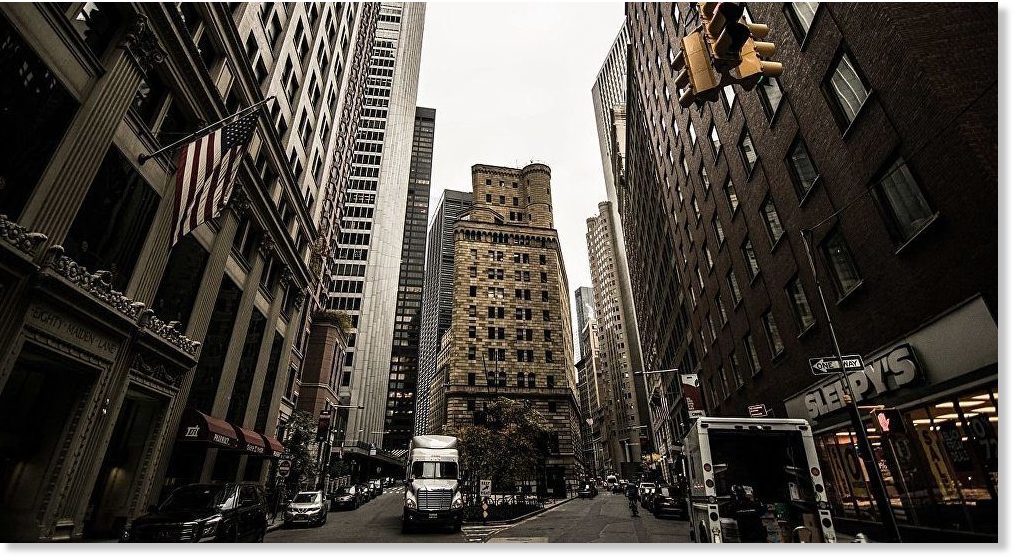
© CC BY-SA 4.0 / 0x010C / Federal Reserve Bank of New York
The publication cites other means of pressure that the US administration could resort to, such as refusing to re-issue waivers on sanctions against Iran. Washington currently allows Iraq to import Iranian gas to fuel generators that supply a large portion of the country's power, despite sanctions, but the arrangement is set to expire in February.
An official in Adel Abdul-Mahdi's office is cited as saying the Prime Minister received a warning regarding the bank account, which holds billions from oil revenues, during a phone call on Wednesday, 8 January.
Iraq, like numerous other countries, maintains government accounts at the New York Fed, via which it manages its national finances, including revenue from oil sales; it takes out that money to pay government salaries and contracts.
While there is no information as to how much of Iraq's money the Fed currently holds, according to WSJ it had $3 billion in overnight deposits from the country's central bank at the end of 2018.
The threatened measure, which could inflict significant damage to the country's economy, is believed to have left some members of the Iraqi government stressing the need to maintain friendly ties with the US.
Comment: Nothing like a good old fashioned threat to bully the vassals into submission. The U.S. no longer has a legitimate presence in Iraq. It is a military occupation. National Security Adviser O'Brien has revealed what will be acceptable to the Empire:
"The president said we want to be out of the Middle East. But what we need to do is leave on our terms, and we need to leave in a fashion in which ISIS/Daesh has been fully eliminated. We took care of the physical caliphate and we're working very hard now to mop up the rest of ISIS," O'Brien said, speaking to Chris Wallace on Fox News Sunday.Meanwhile, Iraq is considering acquiring some Russian S-400 systems:
"I think we'll come up with a resolution, we had a team from NATO this week. I think you're going to see far more NATO involvement in Iraq," O'Brien added.
Pressed on whether the US would respect Iraq's sovereign choice, O'Brien said that the US looked forward "to leaving an Iraq that's safe and that's secure and that's independent, and that's what the Iraqis want as well."
Commenting on the Iraqi parliament's resolution demanding the complete withdrawal of all foreign forces from the country, O'Brien downplayed its significance.
"With respect to the resolution you're talking about that was a non-binding resolution, so it seems they've learned something from our democracy with non-binding resolutions...This was a non-binding resolution passed by a Shia-only group of legislators. The Sunnis boycotted it, the Kurds boycotted it."
Baghdad is considering the purchase of S-400 advanced Russian missile systems amid fears that the US may stop supporting Iraq, the Wall Street Journal quoted Karim Elaiwi, a member of the Iraqi parliament's Security and Defence Committee as saying. "We are talking to Russia about the S-400 missiles but no contracts have been signed yet. We need to get these missiles, especially after Americans have disappointed us many times by not helping us in getting proper weapons," Elaiwi underscored.
The Iraqi Defence Ministry as well as the Pentagon and US State Department have yet to comment on the matter.
Another Iraqi parliament defence committee member, Abdul Khaleq al-Azzawi, confirmed Baghdad's move to negotiate the purchase of the air defence systems from Moscow. "We authorised the [Iraqi] Prime Minister to get air defence weapons from any country he wants and we authorised him to spend the money for it, from any country. From Russia or anyone," al-Azzawi pointed out.
The statement was preceded by the head of the Iraqi parliament's Security and Defence Committee Mohammad Reza stating earlier this week that Baghdad had resumed talks with Russia on buying S-300 air defence systems. He declined to elaborate.
The officials are cited as emphasising that international pressure on Iraq's economy would not sit well with Baghdad's efforts to answer its citizens, as protesters gathered in Baghdad and southern Iraq on Friday to demand that both Iran and the US stop meddling in Iraqi politics.
"The US Fed basically has a stranglehold on the entire [Iraqi] economy," Shwan Taha, chairman of Iraqi investment bank Rabee Securities, was quoted telling the publication.
Others, like the Prime Minister's adviser Abd al-Hassanein al-Hanein, reportedly held the opinion that the Trump administration was bluffing.
"If the U. does that, it will lose Iraq forever," the WSJ cites Mahdi's adviser as saying.
There has not yet been any official comment from the Federal Reserve Bank of New York, or the US State and Treasury departments.
Neither has there been an official response from Iraq's prime minister.
The currently implied move by the Washington administration is not unprecedented, writes The WSJ, recalling that in 2015, it halted Iraq's access to its funds at the Fed for a succession of weeks amid suspicions the money was being funnelled towards funding Daesh.
The Federal Reserve has the power to cut off access to funds for countries under sanctions or if it suspects the money could violate US law, says the publication.

Reader Comments
This is one of the reasons the US did the coup in a Ukraine and the US tried doing the cordon sanitaire of Russia by severing EU - Russian ties. From preventing Europe from adopting 5G cooperation with China.
It's easy for the US to control the world as long as the world is divided and cut up into small pieces. And so you need perpetual "troublesome" hotspots in strategic areas on Earth to keep this division alive. We see this with US attempts with Iran and how the EU wants to work with Iran and the US doesn't. NK as well.
And with these S400s you're gonna need Russian assistance.
So the US is carving up the world between East and West. It failed with Turkey since the cordon sanitaire is supposed to extend from the European borders with Russia, there US wanted to control the Baltics, Poland, Ukraine all the way down to Turkey.