
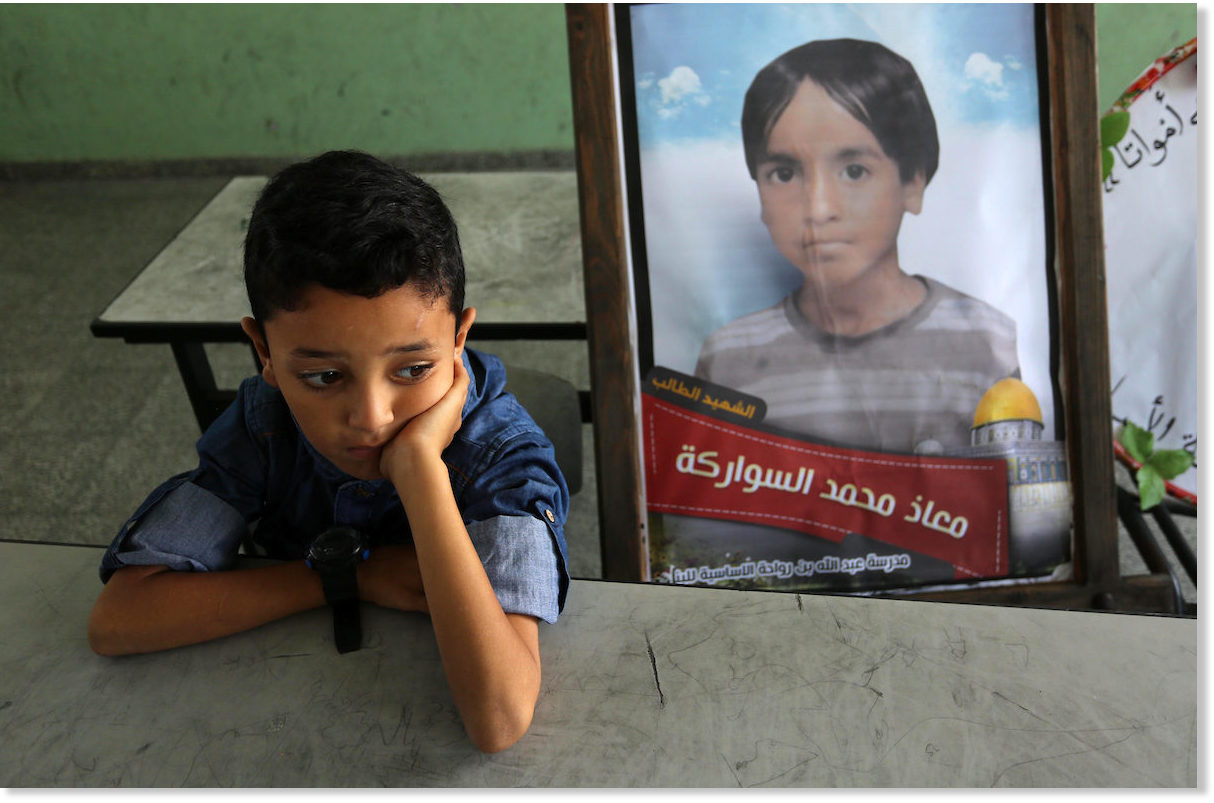
© Ashraf Amra/APA ImagesA picture of a Palestinian student, Moath Al Sawarka, who was killed in an Israeli airstrike on the Gaza Strip
On November 14, Israeli airstrikes targeted the homes of Rasmi Sawarka and his brother Mahmoud, who according to media reports, lived in tin shacks in the Deir al-Balah area of central Gaza.
According to a statement from the Israeli army on Tuesday, an internal investigation concluded that the Sawarkas' home was mislabeled in the army database as a "military compound" used by Islamic Jihad.
The bombing happened in the midst of tensions between Israel and Islamic Jihad in Gaza, following Israel's assassination of senior Islamic Jihad leader Bahaa Abu al-Atta.
A series of Israeli airstrikes resulted in the death of over thirty Palestinians, including the Sawarka family. The bombing of the families' makeshift homes shook the local community, who told local media at the time that the Sawarkas were "simple, poor people."
The victims were identified as Rasmi Sawarka, his second wife Maryam, 45, and three of his children: Salim, 3, Muhannad, 12, and a baby named Firas, who was three months old.
Rasmi's brother Mohammed's wife Yusra, 39, was killed in the strike, along with two of their sons, Muaz, 7, and Waseem, 13. Mohammed later succumbed to his wounds sustained in the airstrike.
"This was a very simple, poor family, who lives from hand to mouth in a tin shack, with no water or electricity," the family's neighbor told Haaretz at the time. "They lived off herding sheep and were known as simple, poor people. Is this the way the head of a rocket unit or a senior Islamic Jihadist lives?
Other locals who reportedly knew the family denied Israeli allegations that Rasmi al-Sawarka was involved with Islamic Jihad in any way, noting he was an employee of the Palestinian Authority (PA).
UN special envoy United Nations envoy Nickolay Mladenov condemned the attack, tweeting "There is no justification to attacking civilians in Gaza, or elsewhere! Such a tragedy! My heartfelt condolences to the family of Al-Sawarkah & I wish a speedy recovery to the injured. I call on Israel to move swiftly with its investigation."
The army immediately admitted its potential fault in the situation the day after the attack, though it stressed that "we undertake great intelligence and operational efforts not to harm non-combatants over the course of thwarting terror activities."
However, the conclusion of the month-long investigation into the incident, revealed on Tuesday, found that the Sawarkas could still be alive, had the military not misidentified their home in its database.
The investigation concluded that the Sawarka home should have been marked as a civilian complex "with some military activity," which would have warranted a warning shot signalling for civilians to evacuate the premises: which didn't happen in the family's case.
The military statement went on to place blame on the Palestinian political factions in Gaza, saying the latter "are using civilian population, deliberately operating from within," while the military tries its best to minimize civilian casualties in "such complex conditions."
In a separate investigation carried out by Haaretz, the Israeli newspaper found that leading up to the strike on the Sawarka home, "at no stage was the area checked for the presence of civilians."
Israel has long been criticized for its use of excessive force against Palestinians, and has been accused of knowingly targeting civilians, specifically in Gaza.


Reader Comments
to our Newsletter