

© Katherine Jacobsen/AA sign warns people not to enter the town of Ozersk near the Mayak nuclear facility in Russia.
The isotope is often made when reprocessing nuclear fuel.
Georg Steinhauser, a professor at the University of Hanover in Germany who is part of the group, told Business Insider in August:
"We were stunned. We did not have any anticipation that there might be some radioactivity in the air. We were just measuring air filters as we do on a weekly basis, 52 times a year, and suddenly there was an unexpected result."The Ring of Five, which had been monitoring Europe's atmosphere for elevated levels of radiation since the mid-'80s, spent the next two years looking for the cause of the spike.
The culprit, they said in a study released in July, was an undisclosed nuclear accident at the Mayak nuclear facility in Russia, which was once the centre of the Soviet nuclear-weapons program. Mayak was also the site of the 1957 Kyshtym explosion, the third-worst nuclear accident; more than 10,000 nearby residents were forced to evacuate.
Russia has never acknowledged that any nuclear accident happened at the Mayak facility in 2017 and has not responded to any findings from the Ring of Five.
But now the scientists have unravelled the mystery even further. A second study published last month offers even more evidence that an accident occurred at Mayak in 2017. It even pinpoints a timeline: Most of the ruthenium was emitted on September 26, 2017.
Tracing a radioactive plume across Europe
The Ring of Five is so named because the group was originally made up of scientists from five nations - Sweden, Germany, Finland, Norway, and Denmark - but it now includes researchers from 22 countries. Their monitoring work takes place 24 hours a day, 365 days a year.
The new study suggests that the Mayak facility likely released 250 terabecquerels (a measurement of radioactivity) of ruthenium into the atmosphere. The Kyshtym explosion, by comparison, released about 2,700 terabecquerels of ruthenium. The world's worst nuclear accident, Chernobyl, released about 5.3 million terabecquerels of radioactive material, a 2013 analysis found.

© Katherine Jacobsen/APThe Techa River, where the Mayak nuclear complex has reportedly dumped waste from spent nuclear fuel.
The scientists determined that the plume started in the Southern Urals, where the Mayak facility is, then was driven toward southwestern Russia. It arrived in Romania on September 29, then split in two.
The main part of the plume spread toward central Europe, where it encountered rain in Bulgaria; plant and soil samples from the country showed elevated levels of ruthenium at the time. After that, the plume moved north toward Scandinavia before arriving in Italy on October 2, 2017. That day, Italian scientists sent an alert to the Ring of Five about elevated levels of ruthenium in Milan.
Steinhauser called this the "single greatest release from nuclear-fuel reprocessing that has ever happened."
Russia has not responded to the Ring of 5's findings
In late 2017, Russian officials said the Mayak facility wasn't the source of the release, even though the nation showed elevated levels of ruthenium. Instead, they attributed the radiation to a satellite that burned up in the atmosphere.
Russia hasn't responded to either of the studies the Ring of Five published this year.
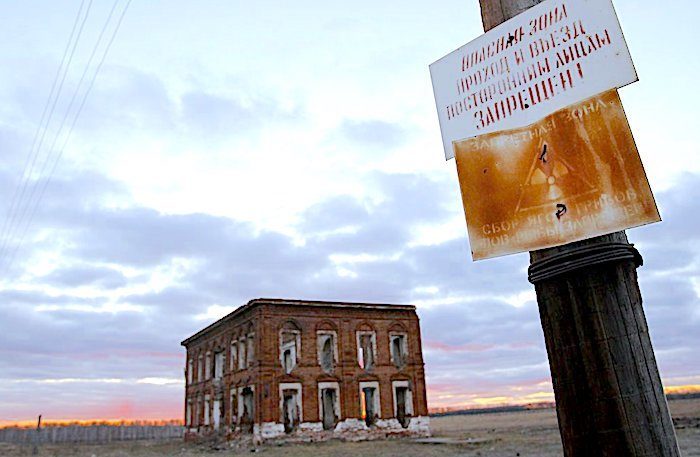
© Denis Sinyakov/ReutersA school in Muslyumovo was abandoned after the Kyshtym explosion in Russia.
The scientists don't consider the levels of radiation they detected to be an immediate threat to people's health. Last year, France's Institute for Radiological Protection and Nuclear Safety determined that the levels of ruthenium-106 in the atmosphere did not pose a danger to human health or the environment. But the long-term consequences are unknown.
Another unanswered question, Steinhauser said, is whether the population near the Mayak facility breathed any radiation into their lungs. He added that there could be reason to monitor food safety if radiation leaked into the soil and water.
"We would like to get some more in-depth information on what actually happened," he said. "There's a good chance that we'll catch every single accident - but, in the present case, surprise was on our side."



Comment: See also:
River of radiation: Life in the area of the world's 3rd-worst nuclear disaster