
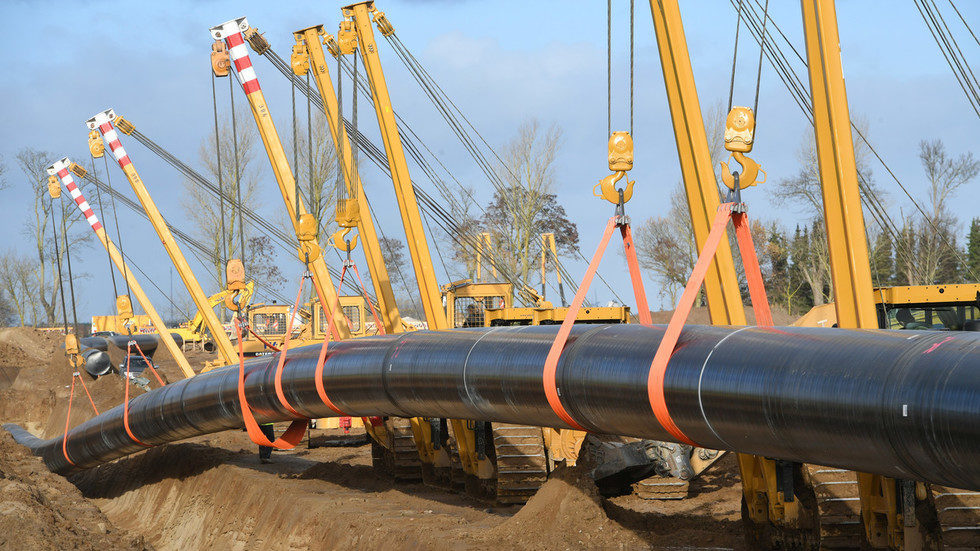
© Global Look Press / Stefan SauerFILE PHOTO: A section of the Eugal pipeline, which will feed the Nord Stream 2 into the European gas grid
"[It's] something that I've been looking at and I'm thinking about," the US president said, answering a reporter's question about using sanctions to block the project.
He added that he was the one who'd brought up "the pipeline problem," referring to his earlier attacks against Russia's energy supplies to Europe, and Germany in particular, as it is the entry point of the new export gas pipeline.
"You know this gas is going into Germany. I say, 'How can you do that?' So, we're protecting Germany from Russia," he went on.
However, Washington's protective services seem to be about how Berlin spends its cash. As Moscow gets "billions" from Germany for energy, US LNG (liquefied natural gas) supplies, are "really the way if they want to spend a tremendous amount of money," according to Trump.
The US has been gradually boosting LNG shipments to Europe, which have been up 272 percent since last July. In March, EU-US trade in LNG reached the highest volume ever - more than 1.4 billion cubic meters. All this came amid constant allegations against Russian energy exports and claims that Moscow wants to use these to control other states, allegations that have repeatedly been rebuffed by Russian officials at all levels.
The Nord Stream 2 pipeline, aimed at doubling the existing pipeline's capacity of 55 billion cubic meters annually, is a joint venture of Russia's Gazprom and five European energy majors. Despite Washington's threats to sanction those involved in the project, it has already attracted more than 670 firms from 25 countries.
On Wednesday, Trump insisted that Germany itself has the power block the pipeline just by "not buying it," but noted that this should be the country's own decision. So far, Berlin has been shrugging off the criticism, stressing that the Nord Stream 2 pipeline would only contribute to the diversity of the gas supply to Europe.
"Any additional steps taken by the US against the project would be counterproductive and undermine the European agreement reached on this difficult issue involving energy security policy," German Ambassador to Washington Emily Haber said in May.


Comment: While those in the political class may be willing to sell out their countries and pay more for gas to appease the US but European businesses, and more particularly the citizens of Europe, who are already struggling to heat their homes in winter, will not be best pleased to see their bills increase even further just so that the US economy can scrape by for a little longer:
- NOT satire: US Energy Department rebrands LNG 'Freedom Gas', looks forward to 'exporting molecules of US freedom around the world'
- Greece interested in buying Russian LNG - Adviser to Greek PM
- European Parliament Elections 2019: Big Wins For Nationalist Parties in The UK, France, And Italy
- Switzerland to sign on to China's One Belt One Road
Also check out SOTT radio's: NewsReal #26: Globalization vs Nationalism - The Hidden Causes of The Yellow Vest Protests in France