
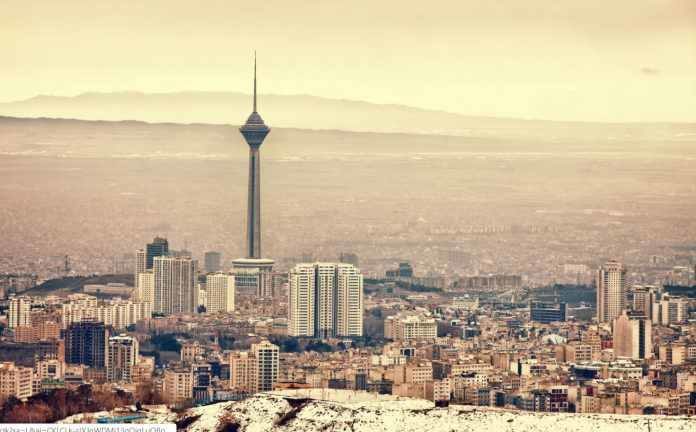
© ShuttershockThe ground is shifting and sinking under Iran’s capital, Tehran.
A recent study based on analyzed satellite data shows that the Iranian capital is sinking at a rate of 10 inches per year
Tehran is sinking. This is not a metaphor connected to American sanctions or the drop in oil prices, but the conclusions of a recent study that analyzed satellite data about the Iranian capital. It found that some parts of the city are sinking into the ground at a rate of up to 25 centimeters (nearly 10 inches) a year. The researchers also found that the sinking areas are expanding and could reach the city's international airport.
The research by two scientists from the GFZ German Research Center for Geosciences at Potsdam was accepted for publication by the scientific journal Remote Sensing of Environment. The findings were also published on the website of the journal Nature. The researchers used satellite tracking data from 2003 to 2017 to track the rate of land subsidence in Tehran. A previous study linked the sinkage to the depletion of the groundwater aquifers under the city, which are being pumped to irrigate the fields surrounding the capital and to supply water to the city's 13 million residents.
The new study describes the extent of the trouble. The western Tehran Plain, which includes the western city's urban areas, farmland and suburbs, is sinking at a rate of 25 centimeters per year. The Varamin Plain, an agricultural area southeast of the city, is sinking at a similar pace. The international airport, southwest of Tehran, is also sinking, albeit at a slower rate of 5 centimeters a year. Overall, the researchers estimate, about 10 percent of Tehran's urban area is affected by the sinking.
The subsidence rate in Tehran is among the highest documented in an urban area, although this is a widespread global problem. Earlier studies have shown that Jakarta, the capital of Indonesia, is sinking at a rate of 20 centimeters a year, while California's San Joaquin Valley, whose cities include Stockton and Fresno are located, is sinking by as much as 60 centimeters a year.
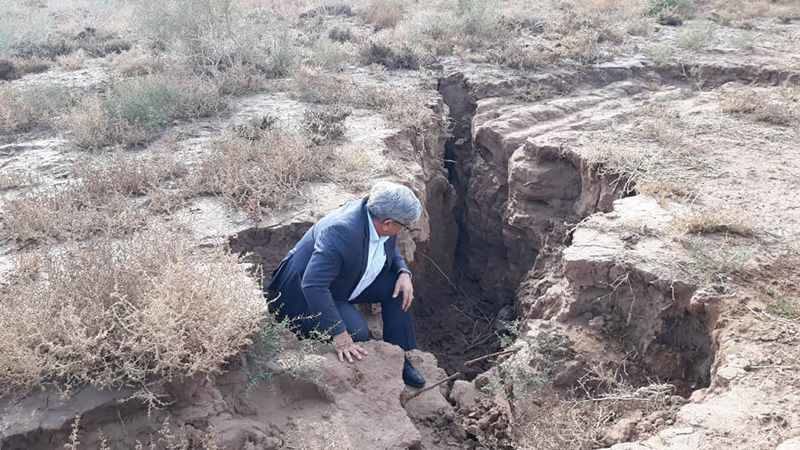
© Building and Housing Research Center in TehranThe growth of underground cracks sometimes produces sudden sinkholes in the ground.
In an effort to slow the subsidence, the authorities are trying to restrict groundwater pumping. It is estimated that some 100,000 illegal wells across Iran have been sealed in recent years, but in metropolitan Tehran alone there are 30,000 such wells operating.
The researchers say the subsidence may be irreversible. Groundwater measurements show that the land does not rise back up when the groundwater increases, after a heavy rain, for example. The findings show that the rock under the soil also loses some of its porosity when the ground sinks. This change could lead to another worrisome phenomenon - more intense flooding because rainwater is not seeping into the ground.



Comment: Sinkholes, giant earth cracks and general instability of the earth beneath our feet seems to be increasing. Not all of which is related to the depletion of groundwater aquifers or to areas with historical mining activity. Yellowstone has shown a surge in activity recently.
Why is it that all of a sudden, all over the world, the ground has become so unstable? See also:
- 136 sinkholes opened up on Rome streets in first 10 months of 2018
- Giant cracks appear on banks of river in Argentina - Evacuations ordered
- Gaping fissures and sinkhole open up around school in Ireland, children evacuated
- "Earth splits in two" - Huge fissures appears in the ground in Saudi Arabia (VIDEO)
- 2 French rivers disappear - Geologists suspect through cracks in the ground
- Monster cracks appear in the ground after landslide and heavy rains destroy over 100 buildings in Cusco, Peru (PHOTOS, VIDEO)
- 8 dead as massive sinkhole swallows eight-lane road in Foshan, China (PHOTOS, VIDEO)
View also this short informative video: Sinkholes: The groundbreaking truth