
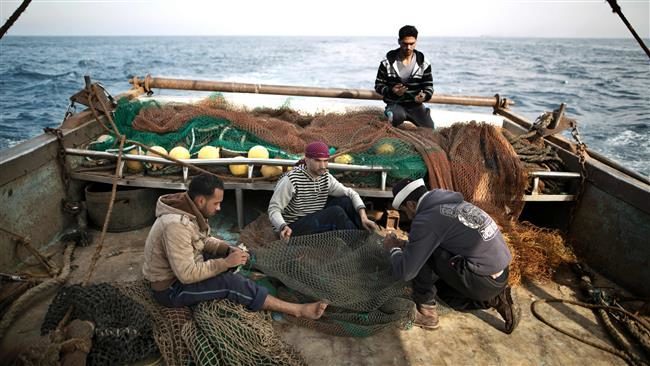
© AFPPalestinian fishermen fix nets on a boat as they start fishing off the coast of the Gaza Strip. Despite the signed agreements between Palestinians and Israel, which allow fishermen to go 12 nautical miles inside the Mediterranean Sea, Israeli navy targets Gaza fishermen almost daily and does not allow them to go further than three nautical miles, which the fishermen say is not enough to catch fish.
I have spent my entire adult life committed to the protection and preservation of the Nez Perce way of life and culture that has largely included fighting to free the flooded and barricaded lower Snake River along with improving habitat for ESA/Treaty fisheries resources.
I have learned that with many issues, whether it be the struggle of Native Americans or the struggle of Palestinians, it comes down to the tug and pull of scarce resources that are often sacred to one or more groups of people inhabiting the same area and based on various cultural or political views. In these struggles, it can often mean that a group of people is deprived of the right to use a valuable resource that they have known to have accessed for thousands of years. This difference in culture and religion along with strong and adverse political views has been the cause of millions upon millions of groups of people being killed for their resources.
When it comes to Palestinian issues, there is no difference. It is another indigenous group of people being kept from their own waterways, resources and ways of life. The history of that area has proven to be brutal over the course of hundreds of years including our most recent century making major changes to the formation of the state of Israel. This is exactly like the United States coming in and making all these treaties that have been broken within months and just a few years of enacting and also making all these States that form the United States of American, all on indigenous land. This has changed the way of life for our people to this day.
What the Palestinians are fighting for is to be who they are intended to be by the Creator. No different than my people, we want to be upon the land that we came from and fish the waters that our forefathers fished and be good stewards of the land, protecting it for our next seven generations. We, much like the Palestinians, have the problem of who gets the land now and how the resources are managed on that land. This creates a firestorm of issues that are in direct conflict with one another.
The issues of Israeli citizenship also cut deep within the Palestinians as much like my people, those types of privileges are not the same for Indian people but are made to protect those in power. It has meant institutional colonialism and racism toward the Palestinians.
There are strong parallels not just with Palestinians, but with all indigenous cultures of the world. We have all been here for thousands of years. We know how to manage our resources and land under the highest protection while living in an entire state of Peace. This seems so foreign when countries are overrun. Peace. I want to communicate the similarities we share as people along with the sense of camaraderie that we must help each other and stick together as our issues are the same.
We are no different. I would love to see a world where justice can mean peace for both the Israeli and Palestinian people and it can be accepted by both sides. This includes the ability for Palestinians to be able to freely be able to resettle in their homelands and also have the financial resources to assist the millions and millions of refugees in re-establishing themselves in their own homeland.
Until we can find some common ground, these battles will continue.
I hope any act, small or large, on my part, can lead toward an end with Peace and Justice for all.
Rebecca Miles is currently serving as the Executive Director of the Nez Perce tribe. She was formerly the first Woman Chair of the Nez Perce Tribe, along with serving as the youngest person to hold that position. She has a Bachelor's degree in Criminal Justice from Washington State University and a Master's degree in Organization Leadership from Gonzaga University. Rebecca was a prestigious German Marshall Memorial Fellow in 2007 and received a National River Hero Award through the National River Network.



Reader Comments
to our Newsletter