
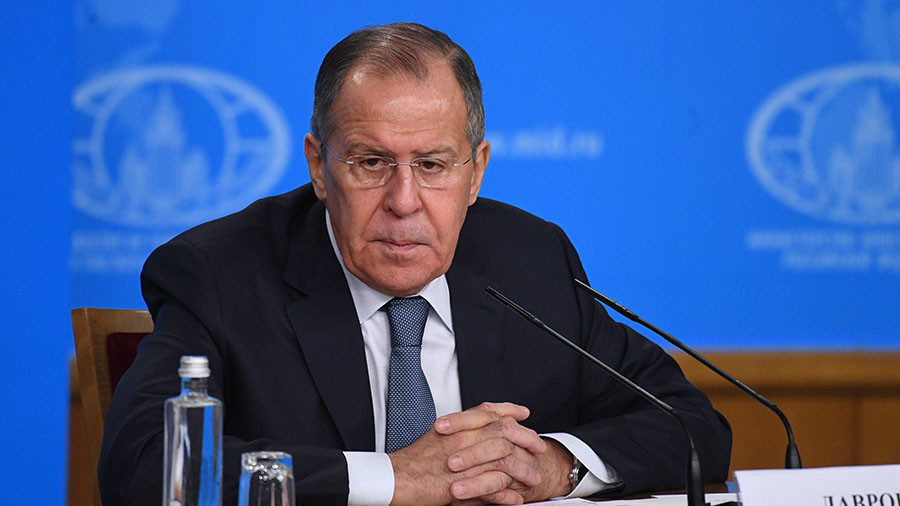
© Grigoriy Sisoev / SputnikRussian Foreign Minister Sergey Lavrov
15 January 2018
16:20 GMT
Julian Assange tweeted a video of RT's Ilya Petrenko asking Sergey Lavrov about his stance on the WikiLeaks co-founder's six-year exile, and if Russia would give him citizenship. While the question is "purely hypothetical," Lavrov responded that Russia focuses on the humanitarian side of Assange's fate and urges all the sides to "show goodwill and fix the problem at last."
09:29 GMT
Just under two-and-a-half hours after he started, Lavrov brings the session to a close.Plenty to reflect on from the foreign minister's comments.
09:25 GMT
A closing question on ties with Estonia.Lavrov says a treaty between the two that is still waiting to be signed will be ratified, but for that to happen Estonia should stop being one of the main promoters of Russophobia in NATO.
09:17 GMT
A question from Japan on a potential Lavrov visit and whether this could take place before the March 2018 presidential election in Russia. Also - US missile defenses being installed in Japan - what is Russia's view? "Good things first," Lavrov says. "We are looking forward to Prime Minister Shinzo Abe's visit to Russia [in 2018]."Lavrov says the two sides are cooperating at many levels, including diplomatic, military, economic and cultural. Lavrov says, however: "The missile defense issue is a dark cloud in our relations." "They said the US Aegis system in Japan will be different from that in South Korea... but we don't have this information... We heard supposedly Japan will control it, not the US, but we have our doubts about this - we would like more substantial assurances.
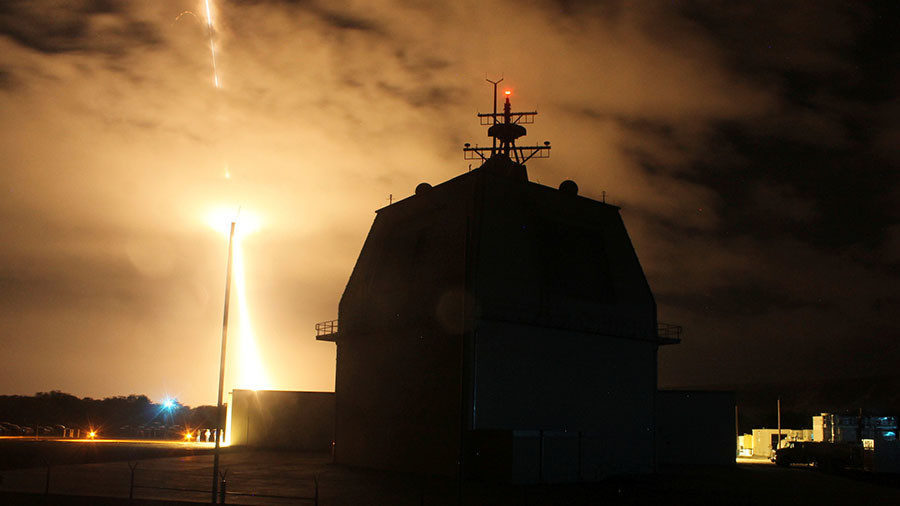
© Reuters/FileA land-based Aegis Ballistic Missile Defense weapon system.
09:15 GMT
Lavrov is asked by a journalist from the Dozhd TV station about Russian casualties in Ukraine and Russian citizens missing there - can Lavrov talk about private Russian security companies operating abroad? Lavrov says Russia always responds to reports of missing people abroad, and that the military often investigates these case. If there is any news, the press will be informed, the foreign minister says.
09:13 GMT
On the naming row between Greece and Macedonia, Lavrov says Russia would abide by any decision made in the Macedonian constitution, should that happen.
09:10 GMT
On US gas activities in Greece, Lavrov says these steps show that Washington is afraid of Russia and cannot compete, so is forcing European states into spending more on US gas. Lavrov cites Russian gas projects - Turkish Stream and North Stream - as well as the South Stream project - which show Russia can supply Europe with gas. Russia needs iron-clad EU guarantees that the operation of the North Stream project will be able to proceed, Lavrov says, however.
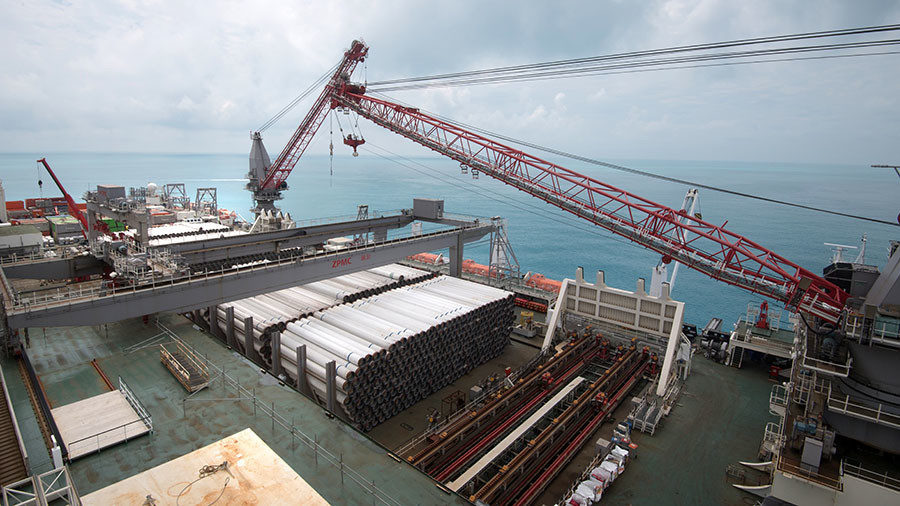
© SputnikThe work on the Turkish Stream gas pipeline project.
Moving onto the final questions, more than two hours after the session began. Lavrov is asked about US activities in Greece - especially gas export facilities. This is seen as an attempt by the US to block Russia - could this damage Greece-Russia ties? And what is Russia's position on the row between Greece and Macedonia over the latter's official name?
09:05 GMT
A Pakistani journalist asks about ties between the two nations. Lavrov says Russia wants to work with Pakistan to neutralize the terrorist threat, and the agreement to supply military equipment is evidence of that.
09:01 GMT
Back to the Middle East. Lavrov says that Russia has already commented on the destabilizing effect of the Trump decision to recognize Jerusalem as Israel's capital. Russia has sympathy for the Palestinians, Lavrov says, adding that Palestinians have been making unilateral attempts to push the peace process forward, but these have not been reciprocated."We cannot allow the situation to drift," he says. "I hope we are able to find a way out."
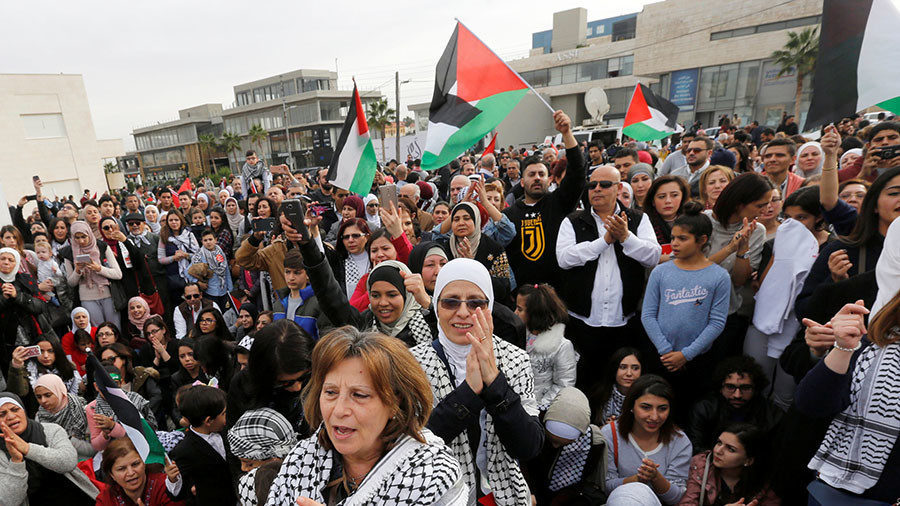
© ReutersProtesters interact as Palestinian dancers of the Hanouneh troupe perform, as part of a sit-in protest against U.S. President Donald Trump's recognition of Jerusalem as Israel's capital, near the U.S. Embassy in Amman, Jordan December 22, 2017.
A question for Lavrov on Russia's position regarding US ties with Central Asian countries, in particular the US' new Central Asia initiative, the C5+1."We have nothing against our Central Asian neighbors having a diverse range of ties, but we hope that this will be done with respect to collective security and economic agreements," he says."We are aware the US would like to abuse that system," Lavrov warns.Lavrov says caution should be exercised because the US often only seeks to further its own interests.
08:49 GMT
A journalist asks about Russian ties with Latin America, especially as US ties with its southern neighbors are "not that great." Lavrov says Russia is looking forward to welcoming Latin American countries for the football World Cup this summer. He also notes the visa-free regime with many Latin American states. "We have well-developed bilateral relations with almost all countries in Latin America, our turnover is more than $10bn, especially in high-tech areas... but there are a lot of new projects as well. "We have shared positions on UN-related issues with many Latin American countries," Lavrov adds. "Latin America has a principle, almost a law, that it's wrong to back unconstitutional coups...," Lavrov adds.
08:45 GMT
The discussion turns to Russian borders and controls with Belarus - a reporter says border controls are in place that technically should not be there. Lavrov says that seems strange, and that Russia favors a "no border" approach with Belarus. He notes, however, that there is a terrorist threat, and that people could enter Russia through Belarus from outside countries, which complicates the situation.
08:43 GMT
A question on Russia-Poland ties: "Warsaw has a lot of grievances with Moscow - Moscow says it's a partner, but Poland keeps saying Russia is an enemy - how can we build ties?" "Russia is ready for a pragmatic approach with Poland," Lavrov says. "We've always had good cultural ties with Poland... I think that speaks volumes about the close relationship between our peoples... "But you are right - we are branded as enemies by Poland... it's trying to promote Russophobia as a national idea... tear down monuments to Russian soldiers..., "Lavov says. "We're ready for dialogue, but Poland need to know that it's a two-way street, they cannot dictate based on backing from hawks in Washington and elsewhere."
08:40 GMT
Lavrov is asked about the French allegations of 'fake news' by Russian media. Lavrov says that, as far as he knows, there is only one body that will decide in France what 'fake news' is, so it's like a judge deciding without hearing testimony.
08:36 GMT
More on Ukraine: Could Lavrov clarify what Russia plans to do regarding the self-proclaimed People's Republics of Lugansk and Donetsk? Lavrov cites the Minsk agreements, and how Ukraine has rejected the chance to take up commitments it made on these regions, and is essentially ignoring them. "Kiev has called people terrorists who are not terrorists," he says. "We are interested in the full implementation of the Minsk accords," he adds.
08:33 GMT
A Canadian reporter asks about two issues: Ukraine and North Korea. On the latter, Lavrov reiterates that Russia and China were not invited to the meeting in Vancouver on North Korea, and that he expects little to come from these talks. On Ukraine and a potential Canadian role in peacekeeping there, Lavrov says the reporter should ask the combatants about this possibility.
08:30 GMT
A question about the Eurasia Economic Union - which encompasses Armenia, Belarus, Kazakhstan, Kyrgyzstan and Russia - and in particular the frosty EU attitude to it. The EU was originally unwilling to accept this union, Lavrov says, but it appears to have softened its stance slightly on this.
08:27 GMT
Lavrov is asked about Russia's ties with the Vatican, and lists a range of areas in which the two are working together - keeping things positive. The discussion then takes a sharp turn, and he is asked about Russia's official opinion on the Russo-Finnish conflict of 1939 and who started it. "Historians should sort this out, diplomats should not answer this question on what was a difficult period," he says.
08:24 GMT
The foreign minister receives a question on Libya and Russia's role. "The planned elections are important," he says. "We've been working with all the parties in Libya... it's necessary to bring all the key players to the table."
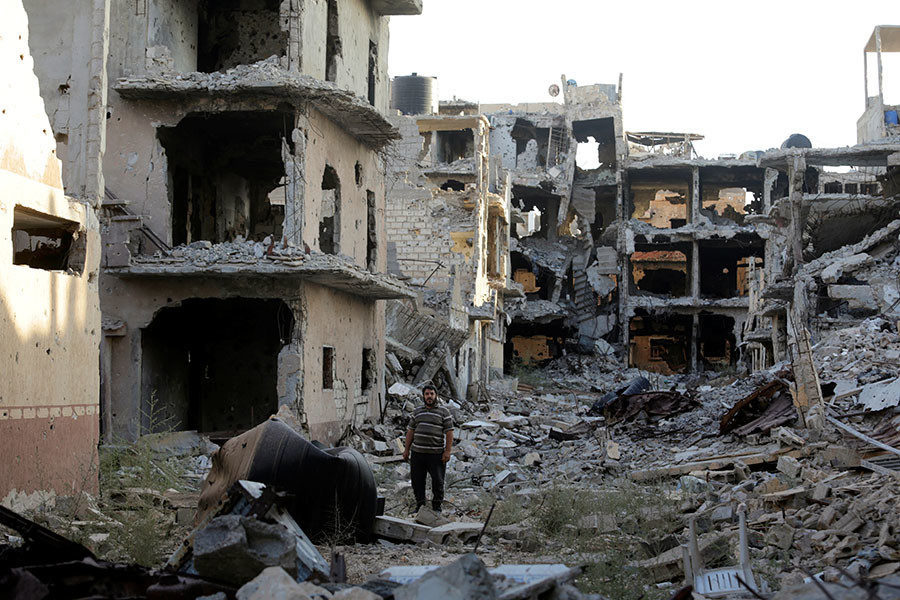
© Esam Omran Al-Fetori / ReutersA man stands next to destroyed and damaged buildings in Sabri, a central Benghazi district, Libya, August 15, 2017.

Reader Comments
to our Newsletter