
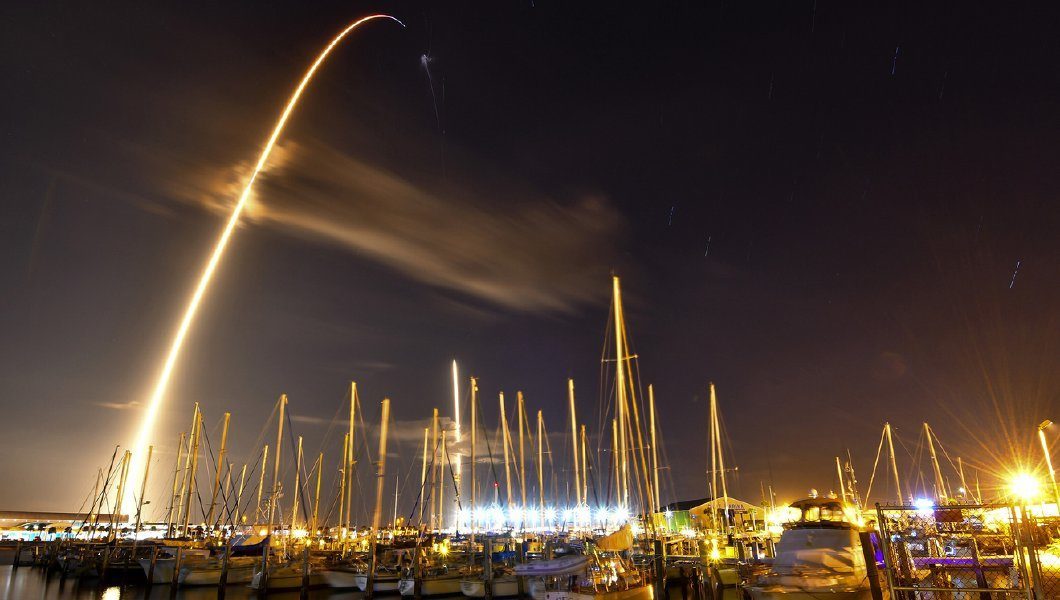
© Malcolm Denemark/Florida Today via APOn Sunday, SpaceX launched a secret satellite codenamed Zuma on its first flight of the new year. Since then, no one knows what has happened to it.
The Pentagon is not saying anything about the fate of the military payload, code-named "Zuma," that was launched this week and may have crashed soon after, and neither is anyone else.
"I would have to refer you to SpaceX, who conducted the launch," said Dana White, chief Pentagon spokesperson when questioned about the unexplained mystery Thursday, four days after the satellite did or did not go into orbit, or more likely ended up falling back to Earth and plunging into the ocean.
A reporter for Bloomberg, who was among the first to report that something had gone awry with Sunday's launch, was aghast that Pentagon briefers were refusing to give even the barest details about the highly-classified mission.
"I'm sorry. This is a billion-dollar satellite. It's been four days. Was it a success or a failure?" pressed Bloomberg's Tony Capaccio. "And what's the fate of the satellite?"
"I'm done. We're not going to be able to give you any more information," replied Lt. Gen. Kenneth McKenzie, director of operations for the Joint Staff.
"I'm asking you, from an accountability standpoint, this thing went bump in the night somewhere, and nobody knows what happened to it?" Capaccio pressed. "You're the government, you paid for it, you're the overseers, and you're asking us to go to the company who might have been partially responsible for the problem?"
"I understand, and given the classified nature of all this ... that's the answer," White said.
Very little information has been made public about the Zuma payload, which is presumably a spy satellite of some kind, but may have other capabilities such as the ability to repair other satellites in space.
A video posted on SpaceX's website, appears to show a picture-perfect launch from Cape Canaveral Sunday night.
But by Monday, various space monitoring sites were reporting the satellite was not in orbit.
SpaceX has said its Falcon 9 rocket "did everything correctly" but says it cannot provide any more details because of the classified nature of the payload.
Northrop Grumman built the satellite and, according to published reports, the decoupler as well. It's not issuing any statements, saying it can't comment on classified missions.
Some experts speculate that the satellite may have failed to separate from the second stage booster, and rode it back to Earth, burning up in the atmosphere.
One thing is obvious: The Pentagon isn't planning to clear up the mystery anytime soon. It's not even clear if the U.S. military was the U.S. government agency that paid for the satellite in the first place.







Comment: Bloomberg reports SpaceX is denying responsibility for the failure of the satellite, claiming that "Falcon 9 performed as expected". If confirmed by investigators, it leaves open possibilities such as a failure in the coupling that was supposed to release the satellite from the rocket. A spokesman for Northrop Grumman, the satellite manufacturer, declined to comment on the coupling due to the classified nature of the mission.
The launch failure could revive debates about SpaceX's rivalry for military contracts with United Launch Alliance which was the sole provider for the Pentagon until Elon Musk challenged what he called an unfair monopoly.
See also: Highly classified US spy satellite launched by SpaceX expected to be 'total loss' after failure to launch into orbit