
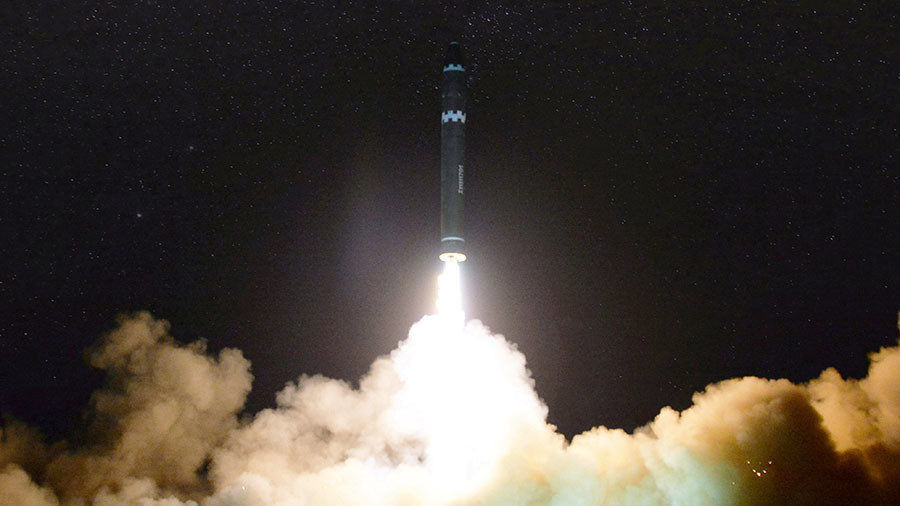
© KCNA / Reuters
Almost certainly the two recent telephone conversations between US President Trump and Russian President Putin have touched on this.
The unusual secrecy in which the negotiations were conducted meant that when the sanctions resolution was finally agreed and was voted for unanimously by the UN Security Council it came as something of a surprise.
In the run up to the vote the US had however been making fully clear what sort of pressure it wanted the UN Security Council and China specifically to impose on North Korea: a total embargo on all supplies of oil to North Korea along with a naval blockade and an effective cessation of all trade between North Korea and the outside world.
The important point to take away from the UN Security Council meeting is that China again rejected these demands.
Here it is important to make a number of points about China's deliveries of crude oil to North Korea.
Firstly, crude oil is about the only product North Korea needs to import in order to keep its economy going which it cannot produce itself. I say this though it is known that North Korea has been stockpiling crude oil in anticipation of a possible future embargo of crude oil deliveries to itself and would probably be able to keep its economy going for some time albeit at a reduced rate if crude oil were indeed cut off.
By contrast North Korea is able to refine crude oil and can sustain its economy if refined oil products such as petroleum are cut off, provided it continues to be supplied with crude oil in sufficient quantity.
I would add briefly and in parenthesis that the Germans in the 1930s perfected a technology for making synthetic oil from coal, which North Korea produces itself and of which it has no shortage. The procedure is however complicated and expensive and comes with environmental cost. There is no information that North Korea has copied it, though presumably over time it could do so.
Secondly, all crude oil which North Korea imports comes from China.
Thirdly, it appears that China does not actually require payment from North Korea for this crude oil, which is provided essentially as a gift.
The text of the latest sanctions resolution voted for unanimously by the UN Security Council is provided at the end of this article.
Its key provision is paragraph 4 which caps crude oil deliveries to North Korea at four million barrels for any twelve month period. Not only does this however fall well short of a total oil embargo. It is the same amount that China supplied to North Korea last year.
In other words China has again rejected the US demand for a total oil embargo, and specifically for a total embargo on all crude oil supplies.
Moreover the text of the resolution shows that China has also rejected the US demand for a naval blockade of North Korea. Instead a complex system of inspections of North Korean ships suspected of trading in prohibited products has been introduced, which however will be subject to ultimate supervision by the UN Security Council itself.
The resolution will however significantly toughen economic conditions in North Korea. The key point is that though North Korea is able to refine its own petroleum, it must now do so from the crude oil it imports, which is capped at last year's levels, since imports of refined oil products such as petroleum have been almost entirely stopped.
The point is explained clearly in a commentary by China's official Xinhua news agency
The resolution sets a ceiling of 500,000 barrels for the import of refined petroleum to the DPRK during a 12-month period beginning from Jan. 1, 2018.In summary, China will supply to North Korea sufficient crude oil to enable North Korea to sustain its civilian economy. However by essentially ending all but a small quantity of North Korea's imports of petroleum and refined oil products China is trying to force North Korea to choose between sustaining its civilian economy or its military, which like all militaries everywhere is a major user of petroleum products.
That reduces the country's import of refined oil by almost 90 percent, and is a reduction from the 4.5 million barrels it imported in 2016, as well as a 2 million-barrel limit stipulated in a September resolution.
The resolution also restricts the DPRK's crude oil imports to no more than 4 million barrels a year and requests that countries supplying oil to Pyongyang provide a quarterly report to the Security Council committee monitoring the sanctions.
The U.S.-drafted resolution refrains from banning all oil imports for the Northeastern Asian nation, something the administration of President Donald Trump has threatened many times amid Pyongyang's non-stop provocative actions.
The calculation appears to be that North Korea will soon run out of sufficient refined oil products such as petroleum to do both, and that rather than risk its civilian economy it will cut back on its military and its ballistic missile and nuclear weapons programme, which is itself a heavy user of refined oil products.
That this is indeed China's calculation is explained in detail by an editorial in the semi official Chinese English language newspaper Global Times.
Chinese society says no to North Korea's development of nuclear technologies but also feels sympathetic toward North Korean people that suffer the hardships. We hope the sanctions only target its nuclear development and missile activities. We do not want to hurt people's livelihoods or impair the stability of the regime.The problem is that this calculation may prove wrong. On this issue there now appears to be a difference between China and Russia, with the Russians warning that no amount of sanctions will ever persuade the North Koreans to give up on their ballistic missile and nuclear weapons programme.
The Russians are almost certainly right. Not only have the North Koreans shown a complete unwillingness to compromise on their ballistic missile and nuclear weapons programme up to now, but with that programme now very close to success, with the Hwasong-15 apparently capable of reaching any part of the continental US and North Korea apparently very close to miniaturising a thermonuclear warhead for it, North Korea has no real incentive to draw back now. Perhaps in a year's time, when the key elements of the programme are completed, it may do so, but having got so far there seems little point in doing so now.
The question is what happens if North Korea presses ahead? Global Times makes Chinas's concerns clear
Chinese society says no to North Korea's development of nuclear technologies but also feels sympathetic toward North Korean people that suffer the hardships. We hope the sanctions only target its nuclear development and missile activities. We do not want to hurt people's livelihoods or impair the stability of the regime. Beijing has endured mounting pressure from Washington.This suggests that the Chinese see the resolution as the last chance to avoid war. If so, and if that is right, then since there is practically no chance of North Korea drawing back war is indeed coming.
Pyongyang's nuclear and missile development is unacceptable. It is also unacceptable to use force against it and change the political situation in North Korea and the Korean Peninsula. It is hoped that Washington and Pyongyang can discover their common interests.
The new resolution is extremely harsh. It may be the last hope for a desperate situation on the peninsula. South Korea recently said it could suspend joint military drills with the US until after the PyeongChang Winter Olympics in February 2018. It is hoped Pyongyang gets the message and responds positively.
A peaceful solution to the nuclear crisis is becoming more costly for both North Korea and the US.
Read the full text of Security Council resolution 2397 (2017) here.


Comment: Is the US provoking North Korea into a no-win situation leading to ultimate war or are recent reports just more sabre-rattling for the US to prove its relevance?
- Mattis to US troops: 'Storm clouds gathering' over Korean Peninsula, 'you gotta be ready'
- More bluff and bluster? Daily Telegraph confirms that US 'preparing to attack' North Korea
- Mattis to US troops: 'Storm clouds gathering' over Korean Peninsula, 'you gotta be ready'
While its unlikely to happen Washington might do well to consider a more diplomatic strategy given this: Washington's flag-waving myths about attacking North Korea need a serious dose of reality