
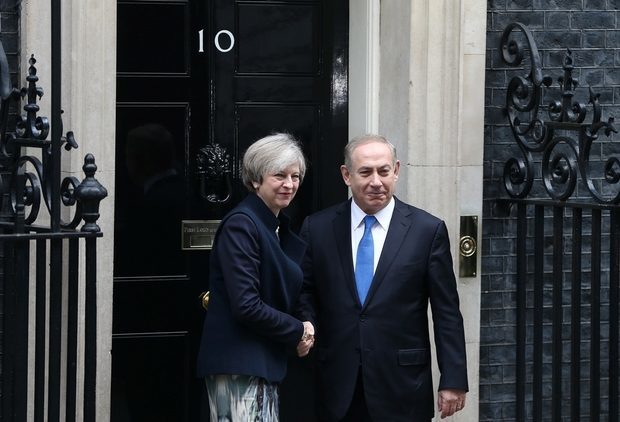
© REUTERS/Neil HallBritain's Prime Minister Theresa May and Israel's Prime Minister Benjamin Netanyahu pose for photographs outside number 10 Downing Street in London, Britain February 6 2017
Theresa May will deliver a calculated insult to the Palestinian people this week. Her promise to commemorate "with pride" the Balfour Declaration's centenary indicates that the British government is becoming more gung-ho in its support for Israeli aggression.
Assurances given to human rights advocates by Foreign Office staff that the anniversary would be marked solemnly, rather than celebrated, have been nullified by Downing Street.
What exactly is May proud about?
Imperial sponsor
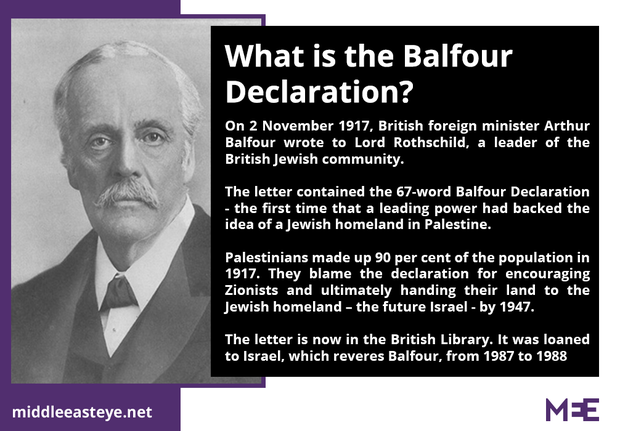
On 2 November 1917, Arthur James Balfour, then foreign secretary, gave the green light for an act of large-scale larceny. Through his declaration to the Zionist Federation, Britain ultimately became the imperial sponsor of a Jewish state that would be formed in Palestine by expelling its indigenous people en masse.
© Middle East Eye
In a period when the principle of self-determination was gaining wider currency - and had been endorsed by Woodrow Wilson, the US president - the Balfour declaration was an anomaly.
Palestinians were denied autonomy largely because of a lobbying offensive conducted by Chaim Weizmann, an influential Zionist based in Manchester. As a general principle, old Ottoman territories may be run "in the natural interests of the present inhabitants," Weizman argued, but an exception must be made in the case of Palestine.
While paying lip-service to the rights of Palestinians, Weizmann insisted that they be accorded a lesser status than incoming Jewish settlers. Today, Israel depicts the declaration as a magnanimous gesture towards persecuted Jews. The truth is far grubbier.
Zionism was a political ideology firmly opposed by Britain's only Jewish cabinet minister in 1917, Edwin Montagu. In a trenchant memorandum, he warned that Jews "will hereafter be treated as foreigners in every country but Palestine."
Montagu's view was diametrically opposed to that of his cousin Herbert Samuel. A staunch Zionist, Samuel promoted the ideology as a vehicle for advancing Britain's interests.
Establishing a Jewish colony in Palestine would, according to Samuel, help prevent France from gaining control of the nearby Suez canal - located on a key trade route connecting Europe and India.
Comment: That's the key concern, and it explains the contradiction between declaring the principle of self-determination while at the same time creating a colony in the Levant: Western (Anglo-American) geopolitical interests, specifically, ensuring that global shipping lanes were controlled at the nexus points - Panama Canal (Pacific Ocean-Atlantic Ocean), Gibraltar (Atlantic-Mediterranean), the Suez Canal (Mediterranean Sea-Red Sea), the Bab-el-Mandeb strait (Red Sea-Indian Ocean), the Hormuz strait (Persian Gulf-Indian Ocean), and the Malacca Strait (Indian Ocean-Pacific Ocean). He who controls those, (substantially) controls the world.
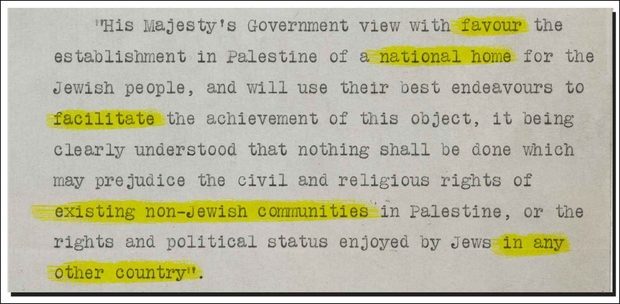
Samuel was central to efforts aimed at making sure the declaration had practical effects - particularly after it had been incorporated in the League of Nations mandate under which Britain ruled Palestine between the two world wars.
In 1920, Samuel became the first British high commissioner for Palestine. Over the next five years, he introduced numerous measures to facilitate and finance the acquisition by the Zionist movement of land on which Palestinians had lived and farmed for generations.
Resistance to colonisation was crushed with great brutality. When a major Palestinian revolt broke out in the 1930s, the British administration in Jerusalem told military commanders they may take whatever steps were deemed necessary. Communities were punished collectively for failing to obey their oppressors.
More than 100 men were rounded up in Halhul, a village near Hebron, during May 1939 on the pretext that it had a bad reputation. Eight of those men died from heat exhaustion after being held in an open-air pen.
The British authorities blamed their deaths on the weather but also admitted that they had been deprived of adequate food and water for several consecutive days.
In the latter stages of the revolt, Bernard Montgomery, a well-known figure in the British Army, instituted a shoot-to-kill policy. According to his order, anyone who assisted a rebel should be treated as a rebel.
Such commands gave British soldiers carte blanche to terrorise Palestinians with impunity.
Comment: That's the same Montgomery who became Deputy Supreme Commander of NATO in Europe until his retirement in 1958, and after whom a large square in Brussels in named. British, Israeli, Western; it's all one structure.
The Zionist militias
Members of the Haganah - the largest Zionist militia at the time - were hired by Britain to assist with the revolt's suppression. The result of that collaboration was that many of the Zionist forces who drove around 750,000 Palestinians from their homes the following decade had received British training.
Britain, thereby, laid the groundwork for the Nakba, the 1948 ethnic cleansing of Palestine.
The relationship between Britain and Zionism has not been seamless. Two armed Zionist groups, the Irgun and the Lehi, came to perceive Britain as a bitter foe in the 1940s.
By waging guerilla warfare against Britain they caused Winston Churchill to waver from his support for Zionism and lament how the ideology had spawned "gangsters".
Britain's reaction to the gangsters' exploits was nonetheless much more restrained than the way it dealt with the 1930s Palestinian revolt.
Alan Cunningham, the last British high commissioner for Palestine, maintained that Britain had to uphold its commitments to Zionism under the League of Nations mandate. Cunningham, by contrast, was indifferent to Palestinian suffering.
At one point, he tried to excuse Britain for destroying Palestinian dwellings in the 1930s by claiming they were of "relatively little pecuniary value". Britain relinquished its mandate for Palestine in May 1948. Israel declared itself a state immediately afterwards.
Comment: That's not the newly-arrived European Jews 'forcing the British out'; the British and/or the Americans could have squashed them at any time, so their leaving means they collaborated in doing so with the Zionist terrorists. They were (and still are) all in cahoots with one another.
Boycotting Israel, a moral imperative
The sponsorship of Zionism has continued. Many Israeli crimes against humanity have been abetted by Britain. The military occupation which began in June 1967 was facilitated by British battle-tanks. Israel's assault on Gaza during the summer of 2014 was enthusiastically backed by Britain, too.
Brexit might be advantageous for Israel - at least in the short term. At a time when Theresa May's relationship with her EU counterparts is somewhat tense, she appears to regard Benjamin Netanyahu as a steadfast ally. The Israeli prime minister will receive red carpet treatment when he attends the Balfour celebrations in London this week.
May's pandering to Netanyahu demonstrates she is out of step with public opinion. While her government seeks to boost trade with Israel, ordinary people in Britain and around the world are boycotting Israeli goods and institutions.
There is a historical resonance behind how boycotting has assumed a central importance in efforts to make right the wrongs inflicted by Arthur Balfour and his colleagues.
Boycotts offended Balfour's aristocratic sensibilities when they were used to challenge the powerful.
Heading Britain's colonial administration in Ireland during the late 19th century, Balfour supported legislation that would make the boycotting of landlords punishable by up to six months' hard labour. The term "boycott" has been traced to Ireland in that period.
It was named after Charles Boycott, a land agent whose employees refused to cooperate with him after he served a series of eviction notices.
It is apt that the Palestinians are tackling Balfour's toxic legacy with a tactic of which he strongly disapproved. Boycotting Israel is a moral imperative.
About the author
David Cronin is a journalist and activist living in Brussels. His book Balfour's Shadow: A Century of British Support for Zionism and Israel is published by Pluto Press. He is also the author of Europe's Alliance With Israel: Aiding the Occupation (Pluto, 2011) and Corporate Europe: How Big Business Sets Policies on Food, Climate and War (Pluto, 2013).


Comment: See also:
Corbyn turns down lobby group invite to Balfour Declaration centenary bash - Jewish press flips out
Rashid Khalidi: Balfour Declaration was 'gun pointed at heads' of Palestinians
A People That Shall Dwell Alone - Israel's Attack On The Gaza Flotilla
The Rise of Russia and the 'End of the World'
More than a pointed insult to Palestinians, this is a concerted effort to prop up the ideological basis of the current world order, which is dying. Israel is as much British as it is American and 'Jewish'. It's a modern Western 'crusade' in the Middle East. The most successful one in the history of European/Western imperial efforts in fact.
Listen to British foreign secretary Boris Johnson explain that "British values found a home in Israel":
Israel's fate is tied to the fate of the US as world hegemon and the UK's as key enabler. So when powerful interests begin boycotting the US dollar in earnest, that's when we'll see effective boycotting of Israel, forcing regime change there and then, maybe, peace.