
© the drive.com
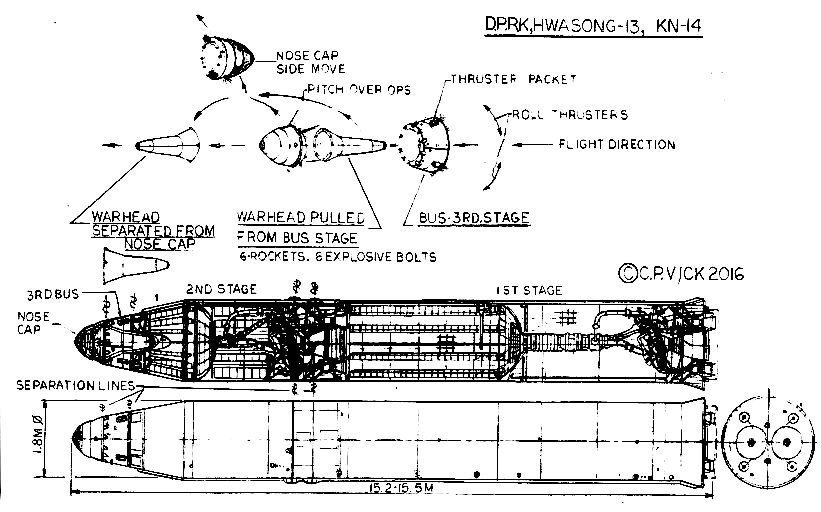
But the Western press apparently did not know one crucial fact: The rocket carried a reduced payload and, therefore, was able to reach a much higher altitude than would have been possible if it had instead carried the weight associated with the type of first-generation atomic bomb North Korea might possess. Experts quoted by the press apparently assumed that the rocket had carried a payload large enough to simulate the weight of such an atomic bomb, in the process incorrectly assigning a near-ICBM status to a rocket that was in reality far less capable.
Only three and a half weeks later, on July 28, there was a second launch of the same type of missile, this time at night, Korean time. The rocket flew approximately the same powered flight trajectory that it had on July 3 (or July 4 in North Korea), this time, however, reaching a higher altitude-a reported 3,725 kilometers. This longer flight path led to yet more unwarranted conclusions that the continental United States was now directly under threat of nuclear attack by North Korea. Actually, however, in this second case, by our calculations, the second stage of the so-called ICBM carried an even smaller payload and tumbled into the atmosphere at night over the Sea of Japan. The spectacular night-reentry of the rocket-what was almost certainly the heavy front-end of the nearly empty upper stage-created an impressive meteoric display that some experts mistook for the breakup of a failed warhead reentry vehicle.
From the point of view of North Korean political leadership, the general reaction to the July 4 and July 28 launches could not have been better. The world suddenly believed that the North Koreans had an ICBM that could reach the West Coast of the United States and beyond. But calculations we have made-based on detailed study of the type and size of the rocket motors used, the flight times of the stages of the rockets, the propellant likely used, and other technical factors-indicate that these rockets actually carried very small payloads that were nowhere near the weight of a nuclear warhead of the type North Korea could have, or could eventually have. These small payloads allowed the rockets to be lofted to far higher altitudes than they would have if loaded with a much-heavier warhead, creating the impression that North Korea was on the cusp of achieving ICBM capability.
In reality, the North Korean rocket fired twice last month-the Hwasong-14-is a "sub-level" ICBM that will not be able to deliver nuclear warheads to the continental United States. Our analysis shows that the current variant of the Hwasong-14 may not even be capable of delivering a first-generation nuclear warhead to Anchorage, Alaska, although such a possibility cannot be categorically ruled out. But even if North Korea is now capable of fabricating a relatively light-weight, "miniaturized" atomic bomb that can survive the extreme reentry environments of long-range rocket delivery, it will, with certainty, not be able to deliver such an atomic bomb to the lower 48 states of the United States with the rocket tested on July 3 and July 28.
For the extensive and informative version of this article, go here.
General conclusions, for now
Our general conclusions from intensive study of a wide variety of data relating to the two rockets that North Korea launched in July:
- The Hwasong-14 does not currently constitute a nuclear threat to the lower 48 states of the United States.
- The flight tests on July 4 and 28 were a carefully choreographed deception by North Korea to create a false impression that the Hwasong-14 is a near-ICBM that poses a nuclear threat to the continental US.
- The Hwasong-14 tested on July 4 and 28 may not even be able to deliver a North Korean atomic bomb to Anchorage, Alaska.
- Although it is clear that North Korea is not capable of manufacturing sophisticated rocket components, their skill and ingenuity in using Soviet rocket motor components has grown very substantially. This is not good news for the long run.






Sorry not sorry, but America is the bad guy.