
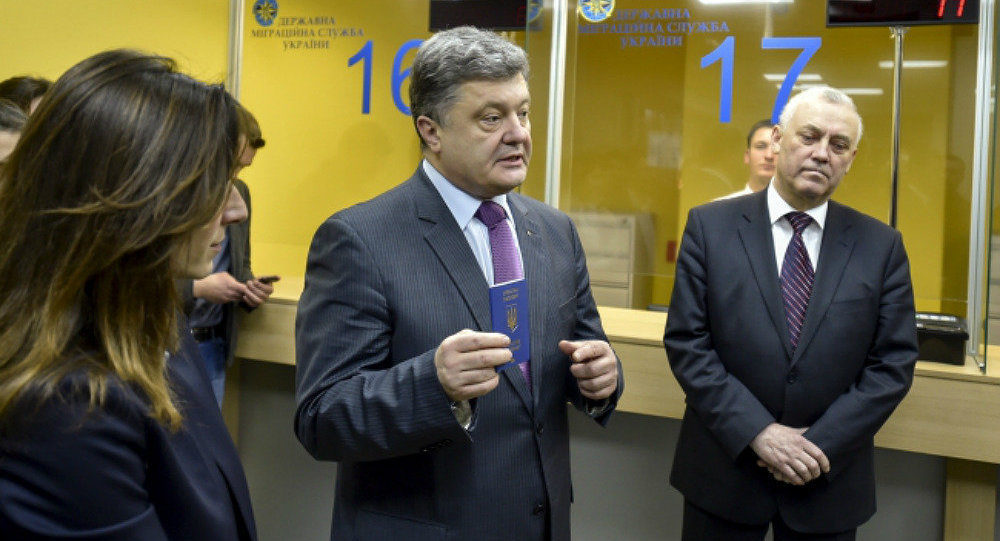
© Press-servise of the President of Ukraine
Earlier this month, the EU parliament and the European Council formalized a long-awaited visa liberalization agreement with Ukraine. Ukrainian President Petro Poroshenko dubbed the decision 'historic', saying that it was Ukraine's final goodbye to its Soviet and Russian 'imperial past'.
The agreement, expected to take effect June 11, will allow Ukrainian citizens with biometric passports to enter Schengen Area countries (except for the UK and Ireland), for up to 90 days in any 180-day period visa-free. During entry, travelers will be required to produce a return ticket, proof of a hotel reservation or an invitation from relatives living in the EU, proof of medical insurance and at least 45 euros for each day they plan to spend on Schengen Area territory.
As June 11 approaches, however, some European observers are becoming increasingly nervous that Ukrainians will use the visa-free arrangement to come and work illegally in EU countries, finding ways around the restrictions of their temporary tourist visas. On Sunday, The Financial Times ran a story explaining that aside from Poland, which takes advantage from an influx of Ukrainians coming in to do jobs Poles don't want to, Western European nations are concerned about a possible mass inflow of Ukrainians starting next month.
Comment: It may be troubling for some, but the European economic 'elite' are salivating at the prospects of cheap labor.
Speaking to Radio Sputnik, Russian political scientist Vladimir Shapovalov explained why Europeans' concerns are justified.
"These fears are well-founded. Notwithstanding the fact that the EU has adopted special regulatory measures aimed at preventing the influx of guest workers, it's obvious that many Ukrainian citizens will attempt to use the visa-free regime to stay in Europe," the analyst said.According to a 2016 United Nations report, 80% of Ukrainians live in poverty, earning less than $5 a day. About 1.9 million Ukrainians, or 9.5% of the working population, are also unemployed.
"Today, there are already hundreds of thousands of Ukrainians looking for work in EU countries, and it's obvious that the introduction of a visa-free regime strongly stimulates the aspirations of Ukrainians looking to get into Europe."
"And these aspirations are understandable," Shapovalov added. "The Ukrainian economy is facing a grave crisis, exacerbated by political problems and those related to the [war in eastern Ukraine]. In this situation, working abroad is not just a decision taken on a whim, but a real opportunity to avoid the tremendous social problems and poverty which are typical for Ukraine."
Shapovalov suggested that the problem of possible illegal labor migration to EU countries is only compounded by the fact that Kiev is actively seeking to discourage Ukrainians from coming to Russia to work.
An estimated 2.1 million working-age Ukrainians are estimated to be living and working in Russia. They send home hundreds of millions of dollars-worth of remittances to their home country each year. If these migrant workers are squeezed out of Russia, they will need to find somewhere else to go to feed families.
"It's no secret that there are millions of Ukrainians working in Russia. If the Ukrainian government creates a regime banning citizens from working in Russia, Ukrainians will have nothing left to do but dash from the east to the west, that is, to seek work in Poland, Germany, France and the UK. This is the result of the policy being pursued by Kiev and, indirectly, the EU," Shapovalov concluded.



Reader Comments
to our Newsletter