
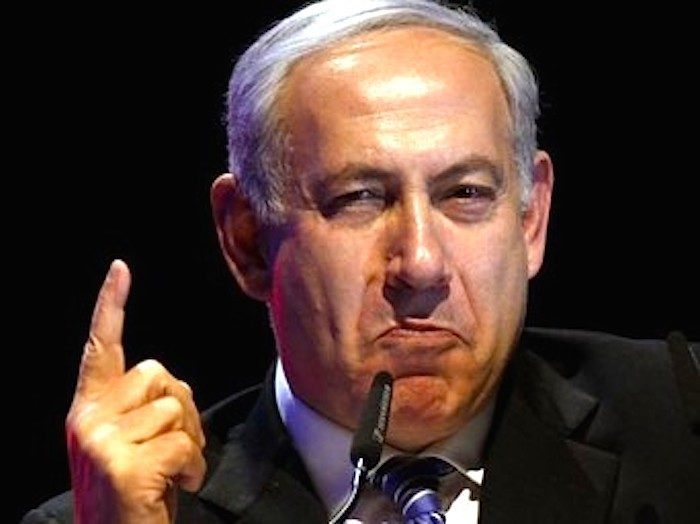
© Veterans Today"...those who work against us will lose — because there will be a diplomatic and economic price for their actions against Israel."
Comment: In the run-up to the landmark vote, Netanyahu took a belligerent tone, calling the resolution a "declaration of war" as he asked New Zealand's foreign minister Murray McCully to withdraw support from the document. "If you continue to promote this resolution, from our point of view it will be a declaration of war. It will rupture the relations and there will be consequences."
New Zealand's Foreign Minister Murray McCully wrote in a statement that the vote should "not come as a surprise to anyone," adding, "We have been very open about our view that the [Security Council] should be doing more to support the Middle East peace process and the position we adopted is totally in line with our long established policy on the Palestinian question."
While the move by Jerusalem is symbolic, and does not officially demote ties with the countries, Israel nonetheless canceled aid programs in Senegal. Despite this, Israel's official stance is that there has been no change in relations with the two countries, with the Foreign Ministry writing in a statement, that there has been "no decision to downgrade diplomatic relations with Senegal and New Zealand."
The hotly-disputed UN Security Council resolution stated that the presence of Israeli settlements on the West Bank has "no legal validity and constitutes a flagrant violation under international law and a major obstacle to the achievement of the two-State solution and a just, lasting and comprehensive peace." Senegal and New Zealand are two co-sponsors of the resolution, and Israel has no diplomatic relationship with additional sponsors, Venezuela and Malaysia.
The four countries resurrected the measure after Egypt, who originally proposed it, backed away after Israel encouraged US President Donald Trump to convince Egyptian President Abdel Fattah al-Sisi to drop the resolution.
Following a phone called between the two heads of state, a Sisi spokesman said, "The presidents agreed on the importance of affording the new US administration the full chance to deal with all dimensions of the Palestinian case with a view of achieving a full and final settlement."
The measure passed with 14 votes in favor and an abstention by Washington. Jerusalem decried the decision as "distorted and shameful," and vowed to penalize those responsible. Netanyahu warned that "those who work against us will lose — because there will be a diplomatic and economic price for their actions against Israel."
Comment: Following the vote, Israel suspended millions of dollars in funding to UN bodies "especially hostile" to Israel and ordered reevaluation of all contracts with the UN.
After making these remarks Netanyahu proceeded to decline the offer of a meeting with British and Chinese officials, disinvited the Ukrainian prime minister, cut aid to to Angola and Senegal, and, according to reports, scolded at least a dozen of his ambassadors.
Comment: He threw a temper tantrum.
Seemingly cooling down, Netanyahu later moved to improve relations with countries that did not cosponsor the resolution but still voted in favor. The Times of Israel reported the Israeli prime minister making a phone call to Ukrainian President Petro Poroshenko last week "to further strengthen the friendship between Israel and Ukraine."
Netanyahu traveled to London earlier this week, meeting with British Prime Minister Theresa May.




Comment: The Trump-Netanyahu connection is troublesome in that the president had a biased, pro-Israel perspective going into office. However, Trump recently backed off of moving the US embassy to Jerusalem, which means he could be open to evaluating US-Israel commitments from a more moderate and global outlook.
See also: Trump says US embassy in Tel Aviv is not going anywhere