
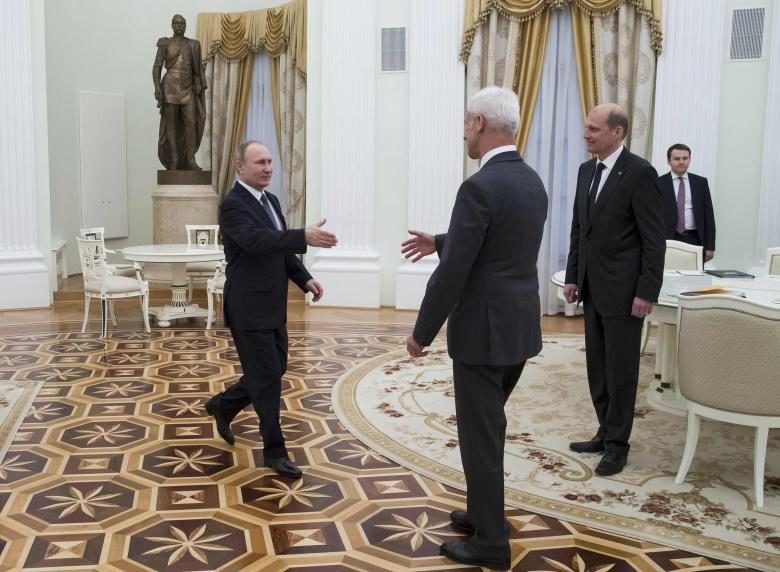
© REUTERS/Ivan Sekretarev/PoolRussian President Vladimir Putin greets Volkswagen AG Chief Executive Matthias Mueller during their meeting at the Kremlin in Moscow, Russia February 8, 2017.
Putin said he understood the challenges the car maker faced in Russia, where the country's once-booming auto market has fallen victim to a sustained economic downturn.
"We are very happy that your business as a whole is doing well, although we understand there are certain difficulties," Putin said after the meeting, a rare face-to-face between the Russian leader and a major European industrialist after the West sanctioned Moscow for its 2014 annexation of Ukraine's Crimea.
"We are always ready to discuss any questions you have to help you develop further in our country."
VW Group, which produces the Volkswagen, Audi, Seat and Skoda brands, is Russia's largest foreign car maker by sales and revenue. But its sales fell by 5 percent in Russia last year, according to the Association of European Businesses (AEB) lobby group, as the wider market fell by 11 percent year-on-year.
Some foreign car makers, such as General Motors, have quit Russia, but Volkswagen has sustained investment, betting sales will one day recover to their 2012 peak of almost 3 million vehicles a year from around 1.4 million vehicles now.
Comment: GM hasn't given up yet: General Motors tries back door sneak to return to Russia
America's biggest automaker GM wants to come back to the Russian low-budget car market, but it may need to rebrand its vehicles and deliver them via Uzbekistan, reports Life.ru.
GM was forced to leave Russia in 2015 due to US-imposed sanctions against the Kremlin.
The carmaker may return using the GM-Uzbekistan subsidiary, and is negotiating with a Russian Derways plant, which assembles Chinese cars, the media reported.
If the talks are successful, GM-Uzbekistan will deliver low-budget Chevrolet cars to Russia under the Ravon brand. The Chevy Cobalt will be rebranded the Ravon R4, the Spark - Ravon R2, the Aveo - Ravon R3. The Nexia and the Lacetti hatchback would be named the Ravon Gentra. The cars are sold as Chevrolets in Uzbekistan and exported under the Ravon brand.
"Since October last year, the Uzbeks are looking for a Russian partner to organize the industrial assembly of Ravon cars. The Derways plant is being considered. I must say, the decision hasn't been made; the talks are in progress," a source told Life. A Ravon spokeswoman did not confirm the negotiations with the Russian plant.
Seventy-five percent of GM-Uzbekistan belongs to the government of the Central Asian country with the rest being owned by the US car producer.
"Ravon can fill the niche of low-budget cars on the Russian market...The low-budget car's market is quite big, and B-class automobiles sales surged despite the overall decline," said VTB Capital automotive market analyst Vladimir Bespalov.
In 2015, General Motors significantly cut its presence in Russia, scrapping sales of low-budget Opel and Chevrolet cars. The company is now officially selling only premium brands like Cadillac.
Last year, GM sold 10 million cars for the first time in its history, as strong sales in China made up for slower sales in the US. GM is the third-biggest automaker in the world behind Volkswagen and Toyota.
The company makes cars at a factory in Kaluga, some 170 kilometers (105.63 miles) southwest of Moscow, and started production at a new engine plant in the city in 2015. It also has two other production sites.
An industry source said Mueller's meeting with Putin had been to discuss "exclusive benefits" for his company.
Volkswagen said in a statement it was committed to the Russian market, where it said it provided 6,800 direct and 50,000 indirect jobs, and planned further development there.
"We are thinking ahead over the future and looking for the ways of implementing our global strategy at the Russian market," the company said.
Putin told reporters tax privileges offered by the Russian government were already helping support Volkswagen's sales.
The AEB sees Russian car sales increasing by 4 percent in 2017 after four consecutive years of decline, but said on Wednesday they had fallen 5 percent in January. VW Group sales increased 2 percent for the month.
Volkswagen has fared worse elsewhere. After admitting in September 2015 that it cheated U.S. diesel emissions tests, it is still battling regulatory investigations, investor and consumer lawsuits, and striving to rebuild its reputation.


Reader Comments
to our Newsletter